







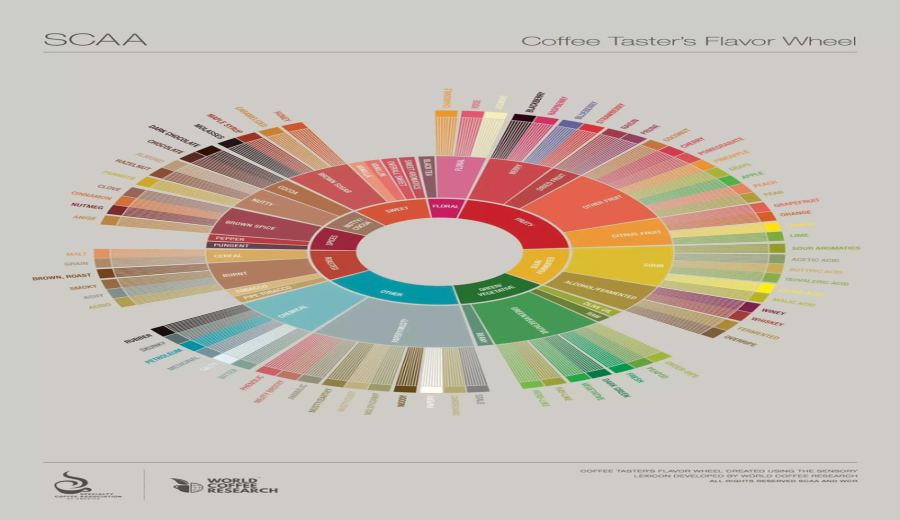
Introduction:This article provides an in-depth analysis of the newly updated Coffee Taster’s Flavor Wheel released in 2016 by the Specialty Coffee Association of America (SCAA) and the World Coffee Research (WCR). By comparing it with the previous version, it reveals the major advancements in flavor description systems over the past 20 years. Through high-resolution bilingual (Chinese–English) visuals, it explains the revision logic behind the ten major flavor categories and illustrates how professional cuppers use this standardized language to accurately convey the aromas, sweetness, and defect characteristics of coffee. For roasters and sensory training practitioners, the article also offers practical application tips for using the flavor wheel.
In January 2016, the Specialty Coffee Association of America (SCAA) and the World Coffee Research (WCR) jointly completed the first major update to the Coffee Taster’s Flavor Wheel in 21 years. This tool, regarded as the “sensory dictionary” by coffee professionals worldwide, has undergone twenty years of exploration and accumulation in the field of coffee flavors, and has finally received a comprehensive upgrade. The new version not only redefines the flavor categories but also introduces precise professional terminology, becoming a key bridge connecting coffee cultivation, roasting, and evaluation.
Flipping through the new high-definition flavor wheel chart, the most noticeable change lies inthe refinement of flavor categories. The more general categories of the original version—such as “sweet aromatics” and “acidic aromatics”—have been split into independent sections like “fruitiness,” “floweriness,” and “sweeteners.” Each subcategory is labeled with specific flavor examples—for instance, under “caramelized,” common cocoa-derived flavors such as toffee and roasted almonds are further specified. This structured design enables cuppers to more accurately identify the complex layers within a coffee.
The creation of the flavor wheel stemmed from the industry’s urgent need forstandardized communication. Early coffee evaluations relied on subjective descriptions, where interpretations of terms like “fruit acidity” or “nuttiness” varied greatly across regions. By systematically organizing sensory reports from cuppers around the world, the SCAA consolidated tens of thousands of flavor terms into a clearly layered circular structure: the outer ring represents macro flavor types (such as fermented, herbal), which then gradually break down into specific flavor descriptors as you move inward. This design allows roasters in Brazil and Ethiopia to discuss the intensity of citrus notes in coffee using the same terminology.
Professional users will notice that the new version places particular emphasis onhighlighting defect flavors. In the peripheral areas of the traditional flavor wheel, descriptions of common quality issues—including “rubberiness” and “over-fermentation”—have been added. These are typically caused by improper storage or processing mistakes. By comparing the flavor wheel, roasters can quickly determine whether green beans have been overly dried (resulting in woody notes) or excessively fermented (exhibiting vinous off-flavors), allowing them to adjust the roasting profile to salvage the flavor.
In practical application, it is recommended to first observe the overall impression of the coffee and locate it within one of the broader outer-ring categories (such as “sweeteners” or “spices”), then gradually work inward to find matching specific descriptors. For example, a Kenya AA with bright acidity may correspond to inner-circle descriptors like “redcurrant” or “blackcurrant”; if it carries a fermented wine-like aroma, it’s worth checking whether it falls near the warning zones for “raisin” or “overripe.” (It is suggested to place a bilingual high-resolution image of the new flavor wheel here, highlighting key sections.)
The evolution of the flavor wheel is a microcosm of the development of coffee sensory science. The first version in 1995 divided flavors into just six basic categories. With the growth of the global specialty coffee movement, the 2016 version contains over 110 precise descriptive terms. Notably, this revision does not discard the old system but enhances its usability through more rigorous classification logic—for example, separating macadamia and hazelnut (previously grouped under “nuts”) to avoid confusion with low-quality “stale nut” flavors.
For coffee enthusiasts, understanding the flavor wheel can significantly enhance tasting experiences. It is recommended to start by practicing with everyday coffee: first record intuitive impressions (such as fruity notes or chocolate aftertaste), then verify specific descriptions against the flavor wheel. With long-term training, one can not only more acutely capture regional coffee characteristics (such as the fermented wine notes of Colombian coffee or the blueberry tones of Ethiopian beans) but also deduce brewing parameter issues from flavor defects—for instance, a cardboard-like taste might indicate insufficient cleaning of the filter.
This professionally certified flavor description system remains the global standard for coffee competitions and laboratories to this day. Whether you’re a beginner building a sensory memory library or a roaster fine-tuning heat curves to achieve ideal flavor balance, the structured reference provided by the new flavor wheel can substantially reduce communication barriers. When we talk about “cleanliness” or “prominent sweetness,” we are in fact referring to precisely defined flavor coordinates within this circular diagram.
The above content is compiled by CoffeeHunters, a coffee news website.


