







Introduction:Drip bags are a convenient yet flavorful specialty coffee option that allows for easy brewing without complex equipment. However, many people make common mistakes when brewing, such as steeping directly or pouring too much water at once, resulting in subpar coffee flavor. This article will detail the correct way to brew drip bag coffee, including the ideal water temperature range, the golden 1:15 coffee-to-water ratio, suitable brewing vessels, as well as demonstrations of four common mistakes, helping you consistently brew a drip bag coffee with clear layers and a clean flavor.
Thanks to their convenience and portability, drip bags have become an ideal choice for many coffee enthusiasts to enjoy specialty coffee in their daily lives. While the brewing method is similar to pour over in principle—both being filtration-based extraction—drip bags do not require additional tools like grinders or filter cones. With just hot water and a cup, you can enjoy a distinctively flavored coffee anytime, anywhere.
However, drip bag coffee is absolutely not instant coffee, nor is it suitable for steeping like a tea bag, nor should you pour a large amount of hot water all at once. Brewing incorrectly not only fails to bring out the delicate nuances of the coffee but may also result in a mouthful of woody fibers or off-flavors. This article will start with the basic definition of drip bag coffee, point out four common brewing mistakes, and explain in detail the correct brewing techniques, including recommended water temperature ranges, coffee-to-water ratios, and practical pouring methods, helping you avoid pitfalls and consistently extract clean, layered coffee.
As specialty coffee culture becomes increasingly popular, more and more consumers hope to enjoy a good cup of coffee easily at home or in the office. However, not everyone has the time or conditions to visit a café and slowly experience the joy of pour over. As a result, drip bags have emerged as a convenient yet quality compromise for busy lifestyles.
So-called drip bag coffee is essentially pre-ground coffee, finely to medium-fine, packed into a specially designed sealed filter bag. The bag features "ear"-like suspension structures on both sides, allowing it to hang securely on the rim of a cup. With just hot water and a suitable cup, no complicated equipment is needed for quick brewing. Compared to traditional pour over, drip bags come with pre-ground coffee, eliminating the need for a grinder and scale, and the filter bags are usually made of biodegradable non-woven fabric. This not only allows the soluble substances in the coffee to fully release but also removes the hassle of using filter paper and filter cones.
However, even though drip bag coffee seems simple, there are still many common brewing mistakes that can easily affect the final flavor. Below are four of the most common mistakes to be careful to avoid.
Mistake 1: Treating it like instant coffee by pouring the grounds directly
First and foremost, it must be emphasized that drip bag coffee is absolutely not the same as instant coffee. Instant coffee is made through special drying techniques that turn extracted coffee liquid into powder, which dissolves in water with almost no extraction process. In contrast, what’s inside a drip bag is real coffee grounds, of which only about 30% of the flavor substances can dissolve in water, while the rest are insoluble woody fibers, or what we commonly call coffee grounds. If you tear open the drip bag and pour the coffee grounds directly into the cup with water, not only will the flavors not be effectively extracted, but you’ll also end up drinking mouthfuls of coffee grounds, greatly affecting the taste.
Mistake 2: Steeping the drip bag like a tea bag
Some people will simply drop the drip bag into a cup and pour hot water over it, letting it steep for several minutes, thinking that’s all it takes to brew. In fact, this approach is completely wrong. Since the coffee grounds in drip bags are ground relatively fine and each bag typically contains about 10 grams, pouring water directly onto the surface of the filter bag and letting it steep will cause the middle layer of grounds to be difficult to evenly wet. Coffee grounds that are not fully saturated not only release flavors incompletely but may also release woody or papery tastes. Additionally, over-steeping may also make the coffee liquid weak and tasteless, or even carry unpleasant off-flavors.
Mistake 3: Pouring too much water at once
Many people, when brewing drip bag coffee, use a large kettle to pour water directly. Due to the wide spout, the water flows in rapidly, not only causing the liquid level to rise too high, but also risking coffee grounds spilling out, severely affecting the taste. The correct approach is to control the amount and speed of pouring to avoid instantly filling the filter bag.
Mistake 4: Using a container that is too small or too short
When brewing drip bag coffee, if the cup or pot chosen is too small or not tall enough, the liquid level can quickly submerge the bottom of the drip bag, causing the bottom coffee grounds to be over-extracted and resulting in unnecessary bitterness. It is recommended to use a relatively tall and moderately sized container to ensure that the liquid level maintains a safe distance from the filter bag during the extraction process.
After understanding the common mistakes, let’s now focus on how to correctly brew drip bag coffee. Mastering just a few key elements will allow you to easily extract coffee with balanced flavor and clear layers.
Choose a taller brewing container
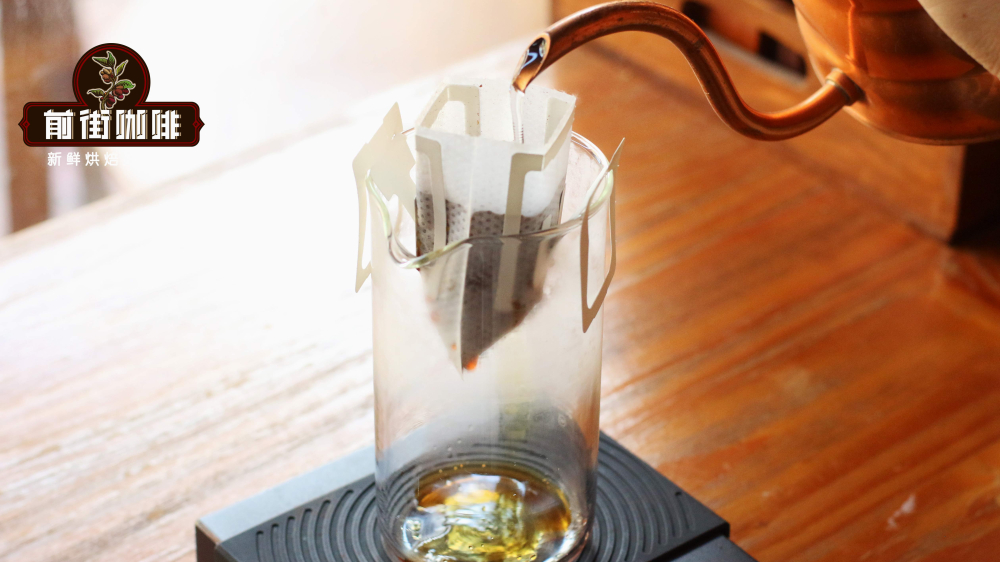
First, it is recommended to choose a cup with a higher rim or a taller, deeper pot, so that during the brewing process, the bottom of the drip bag does not come into direct contact with the liquid, avoiding over-extraction of the bottom coffee grounds and helping maintain overall flavor balance.
Master the ideal water temperature range
Water temperature control is crucial for drip bag coffee. Generally speaking,the recommended water temperature range is between 88℃ and 92℃—too high or too low may affect flavor release. For drip bags of different roast levels, the recommended water temperatures are as follows: for medium-light roasts (with floral, berry, or citrus flavor notes), use 90℃ to 92℃; for medium roasts (commonly with nutty, cocoa flavors), the recommended water temperature is 89℃ to 90℃; for medium-dark roasts (with herbal, spicy, or dark chocolate notes), a water temperature of 88℃ to 89℃ is suitable for extraction.
Pour water in small amounts multiple times for even extraction
It is recommended to use a narrow-spout or professional coffee pouring kettle to help precisely control the water flow and pouring position. If professional equipment is not available, manually pouring water in small amounts multiple times can also be adopted, avoiding filling the inside of the filter bag all at once, ensuring the coffee grounds are evenly wetted and gradually release flavors.
Maintain the golden 1:15 coffee-to-water ratio
Finally, regarding the coffee-to-water ratio,it is recommended to use the standard 1:15 ratio—that is, for every 10 grams of coffee grounds, use 150 grams of hot water, yielding approximately 140–145 grams of coffee liquid. This ratio helps achieve a balanced intensity and layered flavor and serves as the optimal benchmark for most drip bag coffee packages.
The above content is compiled by CoffeeHunters, a coffee news website.


