








Introduction:Delve into the rise of Panamanian specialty coffee — from its historical background, three core growing regions, to the world-renowned BOP competition. This article focuses on the unique flavor profile and washed processing style of Boquete Geisha, and details beginner-friendly pour over parameters for Panamanian washed Geisha to help you master balanced acidity and sweetness in brewing.
Although Panama is not among the earliest countries to cultivate coffee, its exceptional geographical environment and rigorous farming management have enabled it to stand out in the specialty coffee market. In particular, the Geisha coffee produced in the Boquete region, with its distinctive floral and fruity notes, has become highly sought after by coffee enthusiasts. This article will take you through the evolution of Panama’s coffee industry — from its historical origins and major producing areas to the globally acclaimed BOP competition — and offer an in-depth analysis of Boquete Geisha’s processing methods and pour over parameters, helping you better appreciate this iconic specialty coffee.
The History of Panamanian Coffee
Coffee cultivation in Panama began in the mid-to-late 18th century. Historical records indicate that the first coffee beans arrived in Panama in 1742 via a ship from the French Caribbean, but it wasn’t until around 1780 that settlers began small-scale planting near Portobelo. Initially limited by climate and terrain, progress was modest until the 1820s, when coffee gradually expanded nationwide and eventually replaced cocoa as the primary beverage.
Geographically, Panama borders Costa Rica and Colombia, and is influenced by both the Caribbean Sea and Pacific Ocean air currents. Especially in the Boquete Valley at elevations exceeding 6,500 feet, the cool, humid microclimate combined with fertile volcanic soil produces coffee cherries with intense and layered aromas. Additionally, in the late 20th century, the construction of the Panama Canal attracted many elite individuals from the United States and Europe. These later became key drivers of the specialty coffee movement, introducing refined management and post-harvest techniques that significantly improved coffee quality and secured Panama’s place in the global specialty market.
Overview of Panama’s Major Coffee Regions
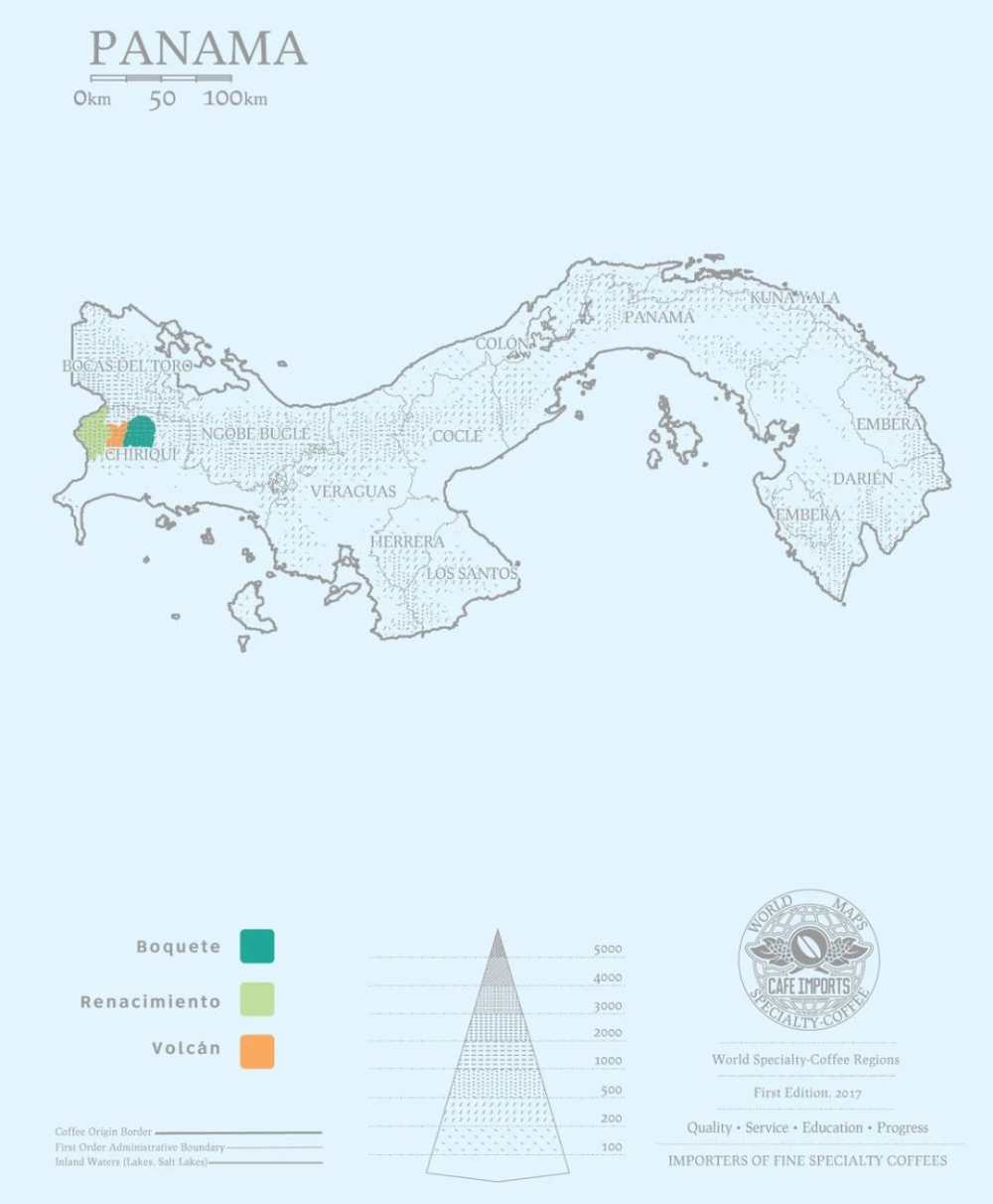
Panama’s coffee-growing area spans approximately 20,000 hectares, about 80% of which are Arabica varieties, primarily concentrated in three renowned regions within the western Chiriquí Province: Boquete, Volcán, and Renedo de Upala. All three areas lie along the Central American Cordillera, adjacent to the Volcán Barú, benefiting from rich volcanic soils and diverse altitude conditions that provide an ideal environment for coffee cultivation.
Among them, the Boquete Valley is not only the birthplace of Panama’s coffee industry but also one of the most famous Geisha-producing regions today. The area is home to roughly 50 to 75 coffee farms and 15 processing facilities, mostly situated at elevations around 1,600 meters. The cool, dry climate, coupled with the daily morning mist, slows the ripening process of the coffee cherries, allowing them to accumulate richer acidity and aroma. Most local farmers are smallholders, with average farmland under 30 hectares. The harvest season typically runs from September to December, often relying on the skilled Gnobe Bugle indigenous people for picking — renowned for their expertise and contributing additional assurance to coffee quality.
The Turning Point in Specialty Coffee: The Birth of the BOP Competition
Before 1989, Panamanian coffee prices were regulated under the International Coffee Agreement. However, after the agreement collapsed in 1989, green bean prices plummeted, forcing Panama to seek a new market position. In 1996, the Panama Specialty Coffee Association (SCAP), formed by seven local estate owners, held the first specialty coffee green bean competition — the now world-famous Best of Panama (BOP). This competition not only encouraged collaboration among domestic small producers but also allowed global buyers to bid on top lots through open auctions.
BOP is one of the oldest coffee green bean competitions in existence and is widely recognized in the industry as a benchmark for specialty beans. Entries are divided into Geisha and non-Geisha categories, further subdivided by processing methods such as natural and washed. An international jury conducts blind tastings and scoring, with the highest-scoring lots showcased at the auction. In recent years, champion Geisha lots have achieved record-breaking prices — in 2022, the natural Geisha from Finca Guava scored 95.96 points to win, while the washed Geisha from Finca Aurora took first place in the washed category with 96.15 points, demonstrating Panama’s solid standing in the high-quality coffee arena.
The Allure of Geisha Flavor and Washed Processing
Panamanian Geisha is renowned for its delicate floral notes, citrus tones, and tea-like aftertaste. Washed processing, in particular, highlights its clean, bright acidity and refreshing mouthfeel. The steps of washed processing include: first removing the outer skin and pulp of the coffee cherry, then fermenting the mucilage-covered seeds in water for about 24 hours, followed by rinsing with clean water to remove residual fruit mucilage, and finally drying the parchment-covered green beans either naturally or using machines until the moisture content reaches around 12%, after which the parchment is removed to complete the process.
This traditional method not only ensures stable quality but also allows Geisha to exhibit greater clarity and complexity. Roasted Panamanian washed Geisha often features white floral notes, bright acidity of citrus and lemon, accompanied by a subtle green tea finish. The overall profile is balanced and dynamic. To fully showcase its characteristics, medium-light roasting is recommended, along with appropriate extraction techniques to highlight its balanced acidity and sweetness.
Pour Over Parameters and Techniques for Panamanian Washed Geisha
To highlight the nuanced flavors of Boquete washed Geisha, it is recommended to use a V60 dripper. Its unique spiral channel design and large hole structure help control water flow rate and extend extraction time, thereby enhancing flavor clarity and layering. Below are the practical reference parameters for brewing:
- Dripper: V60
- Water temperature: 91–92°C
- Coffee dose: 15 grams
- Coffee-to-water ratio: 1:15
- Grind size: Fine sugar-like (approximately 80% through a #20 sieve)
Recommended brewing steps use a three-pour method: First, pour 30 grams of water for a 30-second bloom to activate the coffee’s aroma; next, pour 120 grams of water with a slightly higher flow rate to expand the coffee bed and promote even extraction; finally, when the liquid level drops to half, pour 90 grams of water in small circles to avoid excessive agitation. Total water volume is 240 grams, with total brew time controlled around 2 minutes and 10 seconds.
This parameter setup helps improve extraction yield while avoiding over-extraction and bitterness, fully showcasing the bright acidity of citrus, lemon, and bergamot, with a creamy mouthfeel and honey-like sweetness in the aftertaste. The overall cup is refreshing and layered.
By understanding the regional characteristics, processing techniques, and pour over details of Panamanian coffee, you’ll be able to more accurately appreciate the unique charm of Boquete Geisha — whether for everyday enjoyment or deeper exploration of the specialty coffee world, there’s much to gain.
The above content is compiled by CoffeeHunters, a coffee news website.


