







Introduction:Want to understand the real differences between Ethiopian Yirgacheffe G1 and G2 coffee beans? This article delves deep into the evolution of Ethiopia’s coffee grading system. From physical characteristics and cupping flavors to defect rates, we’ll explore how G1 and G2 differ in green bean and roasted bean appearance, as well as extraction flavor, helping you make more precise choices when selecting your beans.
As the birthplace of coffee, Ethiopia’s coffee grading system has had a profound impact on the global specialty coffee market. Among them, the washed and natural beans from the Yirgacheffe region—commonly graded as G1 and G2—are particularly focal points for many coffee enthusiasts. What exactly sets these two grades apart in terms of grading criteria, appearance, and flavor? This article will fully break down Ethiopia’s current coffee grading logic and provide a multi-dimensional comparison between G1 and G2.
Ethiopia’s coffee grading system was once overseen by the CLU (Cupping and Liquoring Unit) under the Ministry of Agriculture. Before the establishment of the ECX (Ethiopia Commodity Exchange), this institution had already set preliminary grade standards. Prior to the ECX, washed beans were only divided into G1 and G2, while natural beans topped out at G3. Grading at that time mainly depended on the number of defective beans, with G1 being the highest grade and having the fewest defects, while G3 was the upper limit for natural beans.
With the establishment of the ECX, the grading system underwent major adjustments. The new system no longer looked solely at the number of defects but evaluated based on a combination of physical characteristics and cupping flavor. Both washed and natural beans were categorized into three main groups: Specialty (premium), Commercial (commercial), and Local / Domestic (domestic consumption). Only Specialty and Commercial grades are suitable for export, while Local is primarily for the domestic market.
According to ECX’s scoring rules, both washed and natural beans are graded based on the following criteria:
【Washed Processing Scoring Weights】
Physical characteristics account for 40%, including: defect count (20%), bean size (10%), color (5%), and aroma (5%)
Cup quality accounts for 60%, including: cleanliness (15%), acidity (15%), mouthfeel (15%), and flavor characteristics (15%)
【Natural Processing Scoring Weights】
Physical characteristics account for 40%, including: defect count (30%) and aroma (10%)
Cup quality accounts for 60%, with the same items as washed: cleanliness, acidity, mouthfeel, and flavor, each worth 15%

All coffees are first classified by processing method, then scored according to the above criteria into nine grades from G1 to G9. Among these, G1 to G3 undergo a second round of cupping based on SCAA standards. Those scoring above 85 are classified as Q1 (premium grade), 80 to 85 as Q2, and those below 80 are downgraded to general G3, collectively referred to as Commercial Grade. It’s worth noting that only Q1 and Q2 meet international premium coffee export standards.
For example, washed G1 beans must have a defect count of only 0 to 3 per 300 grams, while G2 allows 4 to 12 defects. Although in actual trade, different buyers and sellers may have slight variations in defect definitions, G1 consistently has a significantly lower overall defect rate, which is also why it usually scores and is priced higher. If the defect count meets G1 standards but the cupping score is not above 91, it may still be downgraded to G2.
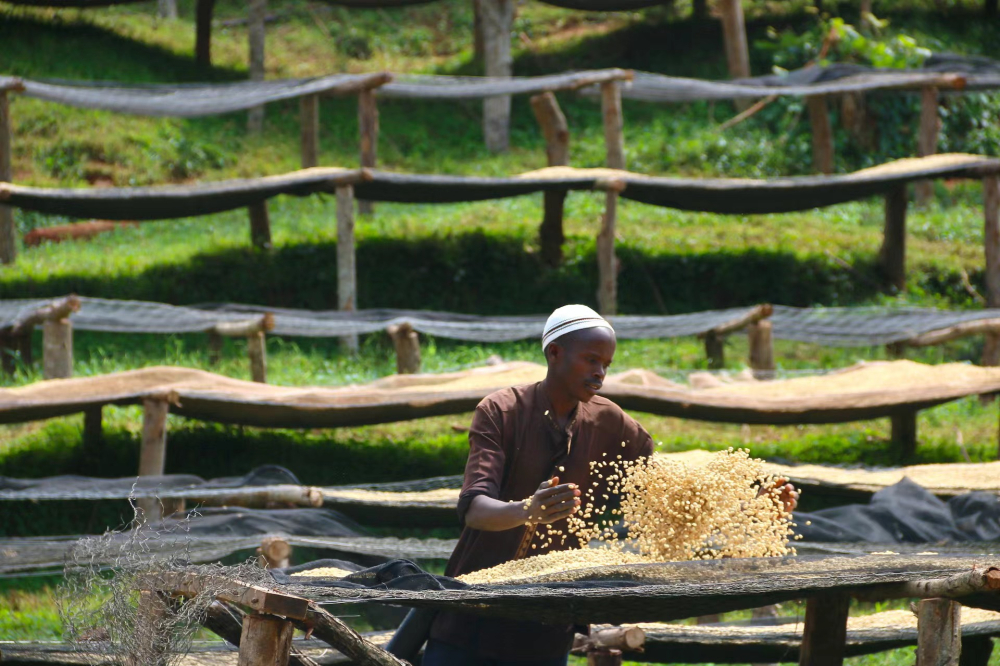
Next, we compare the visible differences between Yirgacheffe G1 and G2 from an observable physical standpoint. First, looking at green beans, G1 and G2 are often difficult to distinguish at a glance in terms of size and shape, but G2 is more prone to defects such as insect damage, broken beans, or underripe beans, especially when not strictly sorted.For reference, see images showing the placement of green beans, where the likelihood of defects is typically higher in G2.
As for roasted beans, because many specialty coffee roasters (such as industry players) perform manual sorting both before and after roasting, the visual differences between G1 and G2 after roasting are often minimal. Without specific labeling, consumers can hardly tell their original grade just by looking at the roasted beans.
Finally, we compare the flavor performance of the two through cupping. Taking washed Yirgacheffe G1 and G2 as examples, both exhibit distinct citrus, berry, honey, and tea-like flavors, with bright acidity and floral notes. However, G1 performs more cleanly overall, with clearer and more identifiable flavor layers and richer, more delicate aromas. In contrast, although G2 also has excellent fruit acidity and aromatic foundation, its overall flavor concentration and purity are slightly inferior, and the mouthfeel is somewhat more muted.
In summary, the grading differences between Ethiopian Yirgacheffe G1 and G2 are mainly reflected in defect rates, cupping scores, and final flavor performance. G1 has fewer defects, higher cupping scores, and more cohesive and refined flavors; G2, while still performing well, has room for improvement in detail and purity. For coffee lovers seeking a high-quality pour over or extraction experience, understanding these details will help make a more suitable choice.
The above content is compiled by CoffeeHunters, a coffee news website.


