







Introduction:Kenya AA coffee beans are renowned for their intense fruity acidity and rich body, with beans from the Kiambu region often exhibiting unique notes reminiscent of cherry tomatoes and dark plums. This article will delve into the characteristics of Kenya’s major coffee-growing regions, the differences between the SL28 and SL34 varieties, the AA grading system, and the steps and flavor impact of the K72 washed processing method—helping you better appreciate what makes this classic specialty bean so distinctive.
Kenyan coffee holds a prominent place in the global specialty market, with its greatest appeal lying in its bright, well-structured acidity and bold, substantial body. Among the various grades, AA beans are not only the largest in size but are also often considered the hallmark of high-quality Kenyan coffee. In this article, we’ll take the AA TOP batch from Asali Honey Processing Factory in the Kiambu region as an example to comprehensively analyze Kenya coffee’s regional traits, varietal genetics, grading system, and the most iconic K72 washed process—taking you on a deep dive from flavor to craftsmanship to better understand this unforgettable coffee.
Located in East Africa, Kenya is bisected by the equator and traversed north to south by the East African Rift Valley. The country is predominantly highland terrain, with an average altitude of about 1,500 meters—ideal for coffee cultivation. Its cool, stable climate and fertile volcanic soils give Kenyan coffee its signature bright acidity and complex layers. Loved for its intense fruitiness, strong acidity, and robust body, Kenyan coffee stands out compared to its neighbor Ethiopia with its more pronounced and well-defined acidity, making it an ideal choice for coffee enthusiasts who enjoy fruity profiles but want to explore different flavor dimensions.
Overview of Major Growing Regions
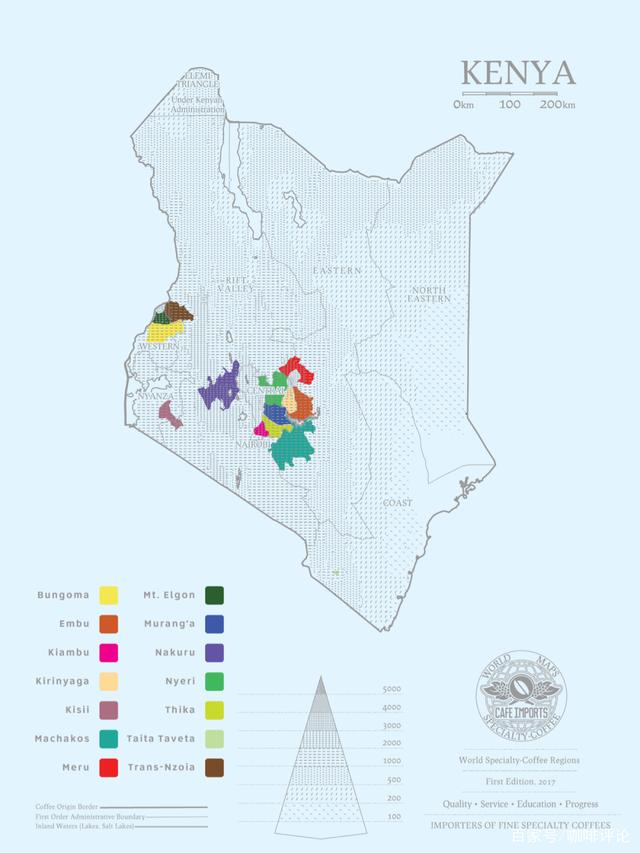
Kenya’s coffee is primarily grown in the central and western highlands, including six core areas: Thika, Kirinyaga, Mt. Kenya West, Nyeri, Kiambu, and Muranga. Coffee from these regions is mainly harvested during the main season from October to December and the fly season from June to August.
Thika is located near Kenya’s capital, Nairobi. Though known as an industrial town, its surrounding areas boast rich coffee-growing regions. Coffee cultivation here dates back to the late 19th century, with the SL28 and SL34 varieties accounting for up to 90% of local plantings. The altitude in the Thika region ranges between 1,550 and 1,750 meters, and the resulting beans feature bright acidity, a rich berry-like juiciness, and a honey-like finish. Compared to Ethiopian beans, the acidity here is more intense and fuller-bodied, making it suitable for drinkers who want to experience vivid fruitiness while preferring a stronger body.
Another notable region is Kirinyaga, adjacent to Nyeri and situated on the slopes of Mount Kenya. It’s known for its layered complexity and substantial body. Coffee here is mostly processed by smallholder farmers through cooperatives, delivering flavors with bright acidity and delicate sweetness, making it a standout in the specialty coffee market. Nyeri, meanwhile, benefits from the volcanic soils of Mount Kenya, with its red earth being exceptionally well-suited for coffee cultivation. The coffee often carries notes of berries, citrus, and floral tones, and is one of the key contributors to Kenya’s international coffee reputation.
Varietal Characteristics: SL28, SL34, and Ruiru 11
The main varieties cultivated in Kenya include SL28, SL34, and Ruiru 11. Among them, SL28 and SL34 are genetic mutants and form the backbone of Kenya’s high-quality coffee, offering excellent sweetness along with citrus and dark plum flavors—but they are also relatively susceptible to leaf rust. Ruiru 11, a hybrid developed during the 1985 coffee leaf rust epidemic, boasts high yields but lacks the nuanced flavor profile of traditional varieties, and is thus less commonly highlighted in the specialty market.
Kenya’s Coffee Grading System
Kenyan coffee beans are graded primarily by bean size, divided into eight grades. AA is the highest grade, with bean size between 17–18 screens, and is considered representative of specialty coffee. AA+ refers to batches within the AA grade that perform exceptionally well in cupping. The AB grade, with beans sized 15–16 screens, is the most common in the market. Grades C, TT, and T consist of progressively smaller or lighter beans, while PB denotes peaberry beans and E refers to the rare elephant bean. These grades generally don’t affect flavor but are related to market positioning.
K72 Washed Process: The Flavor-Critical Craftsmanship
The most iconic processing method in Kenya is the K72 washed process. The essence of this technique lies in extended fermentation and multiple washings. The specific process includes three stages of 24-hour fermentation each, totaling 72 hours—hence the name. First, the coffee cherries undergo flotation to remove defects, then the outer skin and pulp are removed, and the beans are placed in water tanks for the first 24-hour fermentation. After washing, they go through a second 24-hour fermentation, are washed again, and then enter a third 24-hour fermentation. Finally, the fermented beans are washed clean and dried.
The hallmark of this method is that the prolonged and repeated fermentation and washing effectively enhance the coffee’s clarity and the crispness of its acidity, while minimizing interference from impurities and undesirable flavors. The familiar “cherry tomato” and “dark plum” notes beloved by many coffee enthusiasts are precisely the result of this refined processing technique. Compared to standard washed processing, the K72 method not only delivers brighter acidity but also richer layers and a longer aftertaste—making it a key factor behind Kenya coffee’s global distinction.
Additionally, the “double washed” or “fully washed” method (Fully Washed), commonly used by Kenyan processing factories, was developed out of practical needs due to limited drying space. This approach involves re-soaking the fermented beans in clean water to cool them down, preventing spoilage while awaiting drying. Surprisingly, this also enhances the fruity acidity, becoming one of the hallmark features of Kenya coffee’s flavor profile.
In summary, Kenya AA coffee beans—especially those from the Kiambu region—combine an ideal growing environment, premium varieties, and the exquisite K72 washed process to achieve their distinctive cherry tomato and dark plum notes, along with a bold yet refined acidity. Understanding these underlying elements not only helps you select and brew Kenya coffee more accurately but also allows you to savor the intricate craftsmanship and regional terroir in every cup.
The above content is compiled by CoffeeHunters, a coffee news website.


