








Introduction:When tasting pour over coffee, temperature is not just about comfort — it’s a key factor that affects flavor perception. The intensity of acidity, sweetness, and bitterness varies greatly at different temperatures, and mastering these changes allows you to more accurately perceive a coffee bean’s potential. This article explores in depth how the three temperature stages — high (50–75°C), medium (35–50°C), and low (below 35°C) — influence a coffee’s overall expression, supplemented with real tasting examples to help you capture every detail and layer of each cup from hot to cool.
When evaluating specialty coffee, temperature is one of the most intuitive clues to understanding its flavors. The acidity, sweetness, and bitterness in coffee exhibit distinctly different intensities with temperature variations: higher temperatures can soften bitterness but may suppress sweetness; medium temperatures bring out the brightest acid-sweet profiles and the richest layers; while lower temperatures tend to accentuate negative flavors, with bitterness intensifying and sweetness weakening. This article takes a sensory science approach, analyzing in detail the tasting considerations for the three main temperature ranges — high (50–75°C), medium (35–50°C), and low (below 35°C) — and includes practical tasting examples to help you interpret the flavor transitions of pour over coffee step-by-step from hot to cold.

Tasting specialty coffee shares similarities with wine tasting; both can be analyzed systematically. Though evaluation angles are diverse, the flavor differences caused by temperature are among the easiest and most intuitive methods for beginners to grasp.
Many baristas, when describing a coffee’s flavor profile, often mention “at high temperatures it shows..., transitioning to... at medium temperatures, and revealing... at low temperatures.” The reason behind this lies in how human taste buds’ sensitivity to the five basic tastes — sourness, sweetness, bitterness, saltiness, and umami — changes with temperature. Among these, coffee mainly expresses acidity, sweetness, and bitterness, and each is affected by temperature to varying degrees.
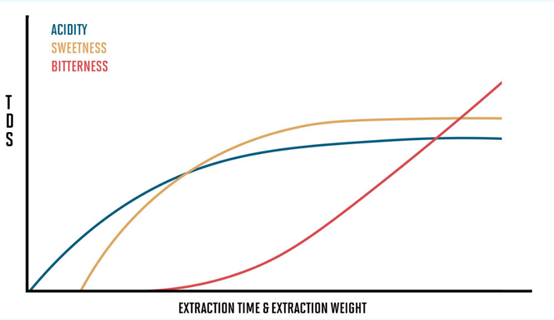
Bitterness is one of the most sensitive tastes to humans. At high temperatures, the heat of the liquid stimulates the mouth, temporarily masking some of the bitter sensations. However, as the temperature drops, bitterness gradually emerges. Therefore, dark roast coffee may taste relatively mild in bitterness when freshly brewed, but if left to cool, the bitterness can become prominent or even unpleasant.
Sweetness is most easily perceived when close to human body temperature (around 37°C). When the temperature is too high (above 50°C) or too low (below 35°C), the perception of sweetness becomes dull. Therefore, to fully appreciate a coffee’s aftertaste and sweet, smooth texture, it is recommended to drink it within a moderate temperature range.
Acidity, though not as dramatically affected by temperature, becomes more pronounced at lower temperatures due to the weakening of sweetness — especially in light roasted coffees, where acidity may turn sharp or monotonous after cooling.
For this reason, many professional cupping procedures evaluate the same coffee at high, medium, and low temperatures to fully understand its flavor characteristics and potential flaws.
High Temperature Stage (50–75°C)
Freshly brewed coffee typically ranges between 65–75°C, which is too hot for most people to drink comfortably. Not only is it difficult to take big sips, but the high temperature may also dull taste sensitivity, making it hard to discern subtle flavors. Research shows that at this temperature, coffees of different roast levels may taste quite similar because the heat blurs the perception of fine details.
However, it’s important to note that the aroma of coffee is most intense at high temperatures. The heat accelerates the release of volatile aromatic compounds, bringing the olfactory experience to its peak. Therefore, it’s recommended to prioritize smelling the coffee right after brewing to appreciate its aroma profile. Once the temperature drops to around 60–65°C, you can take small sips, allowing the liquid to cool rapidly through contact with air, which helps capture more distinct flavor details.

Medium Temperature Stage (35–50°C)
When the coffee cools below 55°C, the aroma begins to fade, but this is actually the best time to experience its layered flavors. At medium temperatures, the coffee is no longer too hot and fully showcases the balance of acidity and sweetness along with its delicate nuances. Your taste buds are most sensitive to acidity and sweetness at this range, allowing you to perceive richer textures and layers.
It is recommended to take larger sips during this stage, paying attention to the coffee’s mouthfeel, acidity, sweetness, body, and aftertaste. You may also hold the coffee in your mouth for 1–2 seconds to let your tongue fully sense its weight and texture, then wait for the aftertaste to unfold after swallowing.
Low Temperature Stage (Below 35°C)
When coffee cools to room temperature or lower, some negative flavors such as grassiness or woody notes may emerge. Additionally, aroma dissipates significantly at low temperatures, and taste buds become more sensitive to bitterness while less responsive to sweetness, often resulting in a flat impression that is overly bitter or sour.
Tasting at low temperatures can help you assess a coffee bean’s overall performance, including stability and potential flaws. However, due to the noticeable decline in aroma and flavor intensity, it’s best used as the final stage in the overall tasting process, for comparison and verification.
To more intuitively demonstrate how temperature affects flavor, the following uses a light roast coffee (e.g., a Geisha from Wandering Estate by a certain coffee brand) and a dark roast-style coffee (e.g., a Queen Estate coffee from a certain brand) as examples, documenting their overall flavor transitions from hot to cool.
High Temperature Performance
At high temperatures, Wandering Estate Geisha emits distinct jasmine, lemongrass, and honey-like sweetness, with light orange acidity on the sip, low bitterness, and an overall smooth mouthfeel. Queen Estate, on the other hand, presents aromas of roasted peanuts and baked bread, with a well-balanced flavor upon entry.

Medium Temperature Performance
The Geisha’s aroma shifts to delicate floral notes and yellow lemon, with sweetness significantly enhanced. Brown sugar, sweet orange, and yellow peach flavors stand out, and the finish carries a hint of matcha-like quality. Queen Estate is based on roasted nut aromas, offering chocolate and maple syrup flavors on the palate, with a full body, moderate bitterness, and a long-lasting aftertaste.
Low Temperature Performance
At low temperatures, both coffees show a significant reduction in aroma and a flattening of flavor layers. The Geisha mainly retains its yellow lemon and brown sugar acidity with a slight tea-like character. Queen Estate exhibits a distinct almond note, with increased bitterness and a slightly smoky aftertaste.
The above content is compiled by CoffeeHunters, a coffee news website.


