







Introduction:Mandheling coffee is often the starting point for many coffee beginners exploring single-origin beans, but the variety of names on the market—such as Golden Mandheling, Tiger Mandheling, and Green Emerald—can be confusing. This article delves into the origins of Mandheling, the terroir of Sumatra’s Lintong region, and explores the differences between grades like Lintong Mandheling and Golden Mandheling in terms of processing methods, flavor profiles, and pricing, helping you choose the Mandheling coffee that suits you best.
When it comes to Indonesian coffee, most people immediately think of “Mandheling.” This name is both familiar and unfamiliar to many beginners exploring single-origin coffee. Commonly seen Mandheling labels on the market include Golden Mandheling, Premium Golden Mandheling, GAYO, Tiger, Horse Face, Green Emerald, and more, making it hard to tell them apart. In fact, “Mandheling” is neither a region, a port, nor a coffee variety name, but rather a mispronunciation of the name of Indonesia’s Mandailing ethnic group (Mandheling), which later became a general term for Arabica coffee produced in Sumatra.
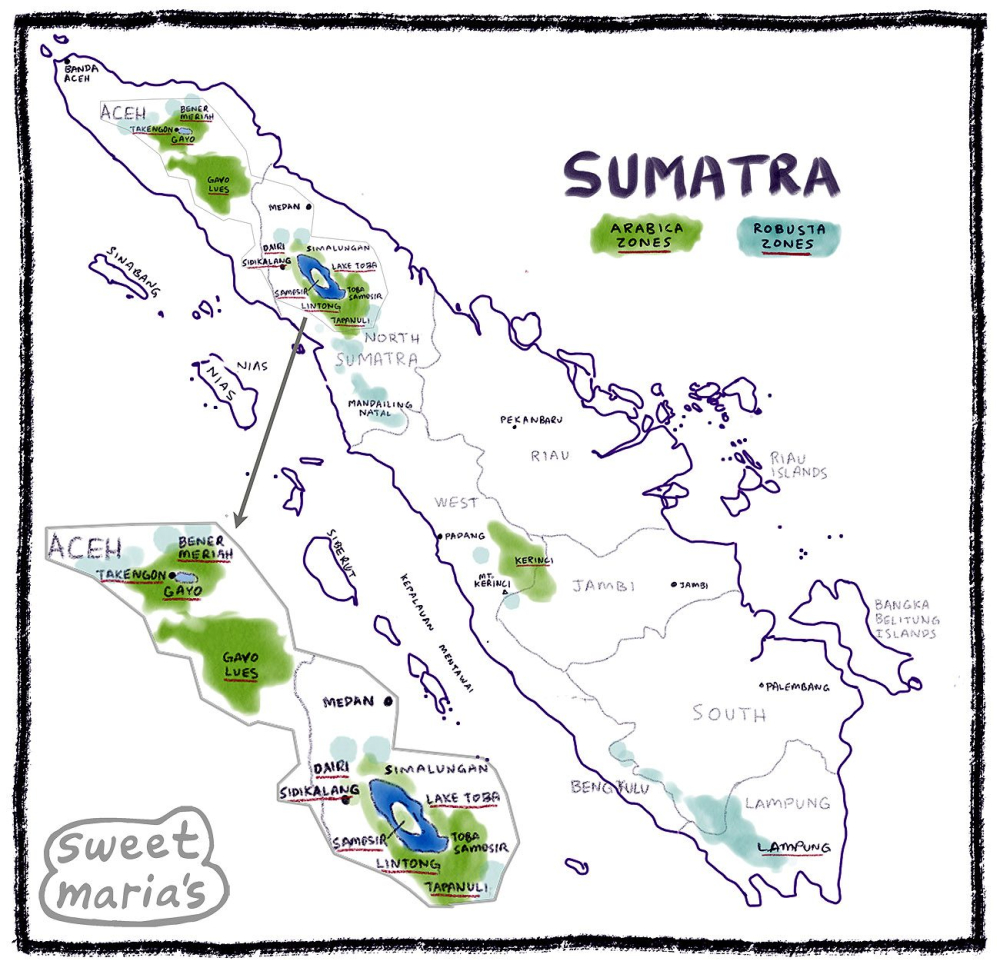
As the world’s largest archipelagic nation, Indonesia introduced Arabica coffee cultivation as early as the 18th century during the Dutch colonial period. Its main producing regions include Sumatra, Java, and Sulawesi, with Sumatra standing out as the most representative Mandheling origin due to its climate and terrain—especially the North Sumatra regions of Aceh and Lintong.
Lintong is located at the northern tip of Sumatra, near the famous Lake Toba. Lake Toba is a massive volcanic crater lake, covering an area of 1,130 square kilometers with a surface elevation of about 900 meters, making it the largest volcanic lake in the world. The region’s high altitude and volcanic soil provide an ideal environment for coffee cultivation, contributing to the unique flavor characteristics of Mandheling coffee.
Typical Lintong Mandheling coffee, processed using the wet-hulled method and medium-to-dark roasted, exhibits a rich and bold flavor with pronounced bitterness but a sweet aftertaste, often accompanied by complex aromas of spices, herbs, and even earthiness. The acidity is relatively low but layered, with sweetness mostly released in the aftertaste rather than through bright fruit acids, making it particularly suitable for drinkers who prefer dark roast flavors and full-bodied textures. Its flavor profile is often described as featuring notes of chocolate, cloves, and woody tones, forming a sharp contrast with the more common fruity-style coffees.
However, how does the commonly seen “Golden Mandheling” differ from regular Lintong Mandheling? In fact, Golden Mandheling does not represent a special grade from a particular origin, but is a trademark registered by Indonesia’s local Pwani Coffee Company (abbreviated as PWN). After purchasing Mandheling green beans, this company applies stricter selection criteria, including three rounds of manual sorting and one round of machine sorting, ensuring that each bean meets high standards in quality and appearance, with a defect rate of only about 2%.
As a result, Golden Mandheling typically offers a cleaner, sweeter flavor profile compared to regular Lintong Mandheling, with more concentrated aromas and finer expressions of body and spice notes. Many coffee enthusiasts find that Golden Mandheling has a more pronounced sweetness, a longer aftertaste, and an overall more balanced performance. These nuanced differences are also reflected in its price, making Golden Mandheling generally more expensive than regular Lintong Mandheling or G1-grade products.
Returning to the topic of pricing, the price differences in Mandheling coffee mainly depend on factors such as origin, processing method, grade, and the level of selection refinement. For entry-level or everyday drinking beans, Lintong Mandheling is a common and cost-effective choice. This coffee, also processed with the wet-hulled method and medium-to-dark roasted, features strong spicy and woody aromas, low acidity but clear layers, and a sweet-aftertaste-following-bitterness quality that gives it a highly distinctive profile, making it very suitable for consumers who enjoy bold flavors.
In summary, from the geographic conditions of the Lintong region, the processing characteristics of the wet-hulled method, to the various Mandheling names launched by different brands and merchants, every aspect influences the final flavor and price. If you’re just beginning to explore the world of Mandheling, it’s recommended to start with basic Lintong Mandheling to experience its rich and solid foundational flavors; if you’re pursuing higher quality and a more refined taste, you might want to try the rigorously selected Golden Mandheling to enjoy a purer, sweeter, and more layered coffee experience.
The above content is compiled by CoffeeHunters, a coffee news website.


