







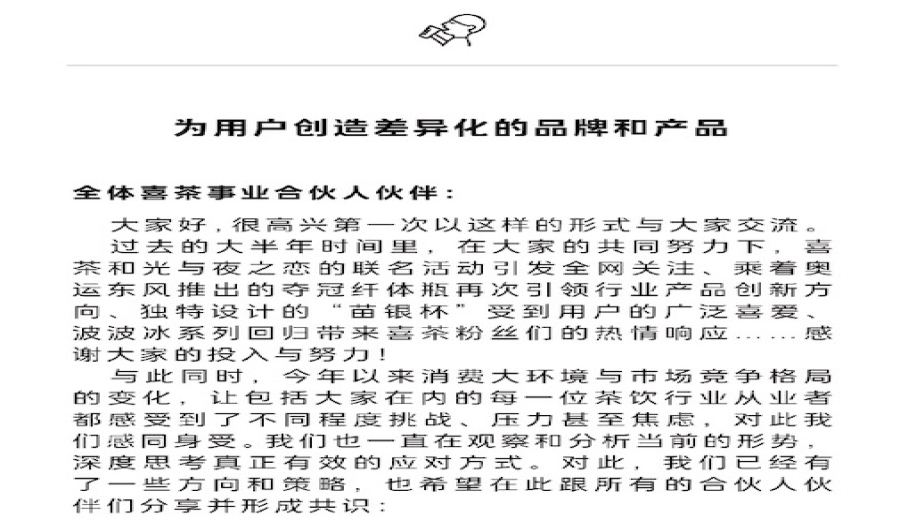
Introduction:Faced with severe homogenization in the tea beverage market and intensifying price competition, HEYTEA recently issued an internal letter to its business partners, clearly stating its strategy to break through the impasse by focusing on "differentiated products and brand experiences," and abandoning the trend of blindly following popular categories and engaging in low-price competition. What key strategies does this internal letter reveal? How has the market responded? This article takes you deep into the analysis of HEYTEA’s transformation approach and future challenges.
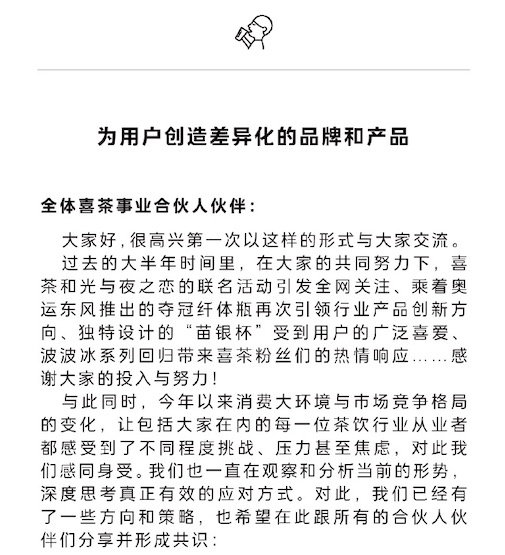
On September 18, 2024, HEYTEA sent an internal letter titled "Creating Differentiated Brands and Products for Users" to all business partners, directly pointing out the current difficulties facing the tea beverage industry: intensified homogenized competition and a clear trend of low-price competition. The core message of the letter is clear — HEYTEA has chosen to take the path of "creating differentiated products and brand experiences for users to the extreme" as its future development direction, explicitly stating that it will no longer blindly follow popular market categories or engage in mere price wars.
In the letter, HEYTEA pointed out that in recent years, the consumption environment has changed, and the tea beverage market competition has entered a white-hot stage. Due to the mismatch between the growth rate of consumer demand and the expansion pace of overall tea beverage supply, many brands have ended up adopting similar product and brand strategies within limited demand, ultimately falling into the quagmire of homogenized competition. In the face of such a market landscape, HEYTEA’s proposed solution is to stick to differentiation and take the road less traveled.
Although HEYTEA has made clear its general direction of "not following trends, not engaging in low-price competition," the internal letter does not further disclose specific details on how to achieve differentiation. It only states that the brand will "focus on what it is good at and what users also need," demonstrating a cautious and pragmatic attitude. Industry insiders analyze that this may be HEYTEA choosing to stabilize its position during the market downturn before gradually driving innovation.
According to the content of the internal letter, HEYTEA will increase investment in two major areas — brand and product — covering brand visual design, packaging innovation, brand event planning, store space design, and the development of peripheral products. Especially in terms of products, HEYTEA emphasizes that it "will not follow the industry’s popular categories." Future new products will no longer repeat the existing product structure but will explore in the direction of healthy tea beverages, seeking more possibilities for innovative categories and product combinations.
In terms of expansion strategy, HEYTEA has also sent out clear adjustment signals. In the coming months, it will control the speed of store densification, no longer blindly pursuing the number of new stores, but instead focusing more on the quality of new openings and the operational standards of existing stores. Public data shows that as of July 2024, the total number of HEYTEA stores globally has exceeded 4,000; compared to the end of 2023, when there were 3,200 stores — with more than 2,300 being business partner stores — approximately 1,000 new stores were added in 2024, indicating a noticeable slowdown in overall expansion.
After the release of this internal letter, it sparked widespread discussion online, with mixed opinions among netizens. Some consumers support HEYTEA’s choice of a differentiation strategy, believing that in the current market environment, only by maintaining its unique characteristics can the brand survive fierce competition. However, many netizens have raised doubts about HEYTEA’s innovation capability, noting that so far this year, the brand has rarely launched refreshingly new products. Seasonal offerings often consist of simple fruit pairings with tea bases, lacking novelty, and some fruit ingredients have been replaced with fruit jelly to align with the low-price strategy, affecting the overall quality and freshness of the drinks.
Some netizens bluntly state that HEYTEA’s biggest problem is not homogenization, but rather a clear decline in product quality. In the past, when prices were higher, HEYTEA’s cheese fruit teas won praise for their rich flavors and unique taste profiles. Now, even with price reductions, it’s hard to recapture that former wow factor. Some consumers even suggest that if HEYTEA hopes to regain market recognition, it might consider adjusting its pricing strategy, returning to a higher price range, and ensuring the use of real tea, real ingredients, and fresh fruit, rather than relying mainly on powdered mixes.
Notably, some of HEYTEA’s products have recently seen another round of price adjustments, with non-promotional single items quietly rising back to around 20 RMB, drawing market attention. Regarding HEYTEA’s emphasis on an "anti-price war, anti-competition" stance, there are also differing voices online. Observers point out that under the current overall economic environment and consumer trends, the low-price strategy remains mainstream in many industries, especially as employment and economic pressures increase consumer sensitivity to pricing. If HEYTEA insists on not lowering prices yet fails to provide sufficient value justification for its products, its future market acceptance will face a serious test.
In summary, this internal letter from HEYTEA not only reveals the brand’s strategic thinking in the face of market challenges but also reflects the reality that the entire tea beverage industry has entered an adjustment phase. In the future, whether HEYTEA can successfully reverse its situation with a differentiation strategy still depends on the specific execution details and market feedback. For the industry, this also serves as an important case for reflecting on how to find breakthroughs amid homogenization and price competition.
The above content is compiled by CoffeeHunters, a coffee news website.


