







Introduction:Bubble tea shop employees are required to prepare hundreds of drinks daily while standing for long hours. A single mistake may lead to penalties ranging from copying product names as punishment, receiving red or yellow warning cards, to hefty fines. These management practices reflect the operational challenges faced by the tea beverage industry under the pressures of customer satisfaction and food safety. This article delves into common disciplinary measures in bubble tea shops, analyzes their impact on employees, and sheds light on the current state of industry management.
In the fast-paced environment of bubble tea shops—where employees repeatedly shake drinks and stand for extended periods—even minor oversights can result in unexpected punishments. From being publicly shamed, copying drink names a hundred times, to being fined for not responding promptly to group chat messages, these management methods have sparked widespread discussion and highlighted the immense pressure faced by frontline staff in the tea beverage sector.
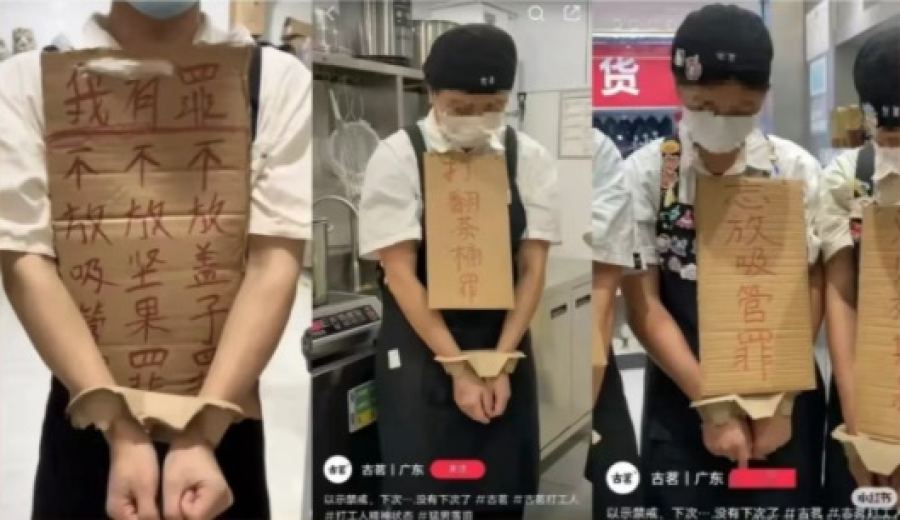
Take GuMing as an example. Some of its official accounts have released a series of "meme" videos showing employees being forced to wear "guilt placards" for work mistakes, such as "forgot the straw," "missed the expiration label," or "spilled the tea bucket." While these videos attempt to create a lighthearted tone, netizens have criticized them as disrespectful to employees and argue that they add to psychological and work-related burdens.
The case of HYPER CHA is also drawing attention. A former employee revealed that after mislabeling a product, the store manager made her copy the drink name “Bo Ya Jue Xian” (a HYPER CHA drink) one hundred times, leaving her hand numb. Searching terms like “HYPER CHA penalty copying” on social media platforms easily turns up many similar stories—employees sharing experiences of being made to copy the so-called “four elements” a hundred times due to system-displayed values falling below thresholds, or even being forced to do penalty copying during holidays like the Winter Solstice.
The content of penalty copying varies widely—it’s not limited to product names. Employees may also be punished for being late without clocking in, making operational mistakes, or skipping steps. Some staff say that even when their handwriting becomes messy from all the writing, management remains unsatisfied, making them feel as if they’ve gone back to their school days. Moreover, some online communities even offer “penalty copying services,” with clear pricing such as 5 yuan for 50 copies or 8.88 yuan for 100 copies, showing how common and troubling these punishments have become.
In addition to penalty copying, fines are another common disciplinary tool. As bubble tea shops operate in high-risk areas for food safety and customer complaints, brand headquarters often enforce strict management systems. It’s reported that some brands use a red and yellow card system. If a store or employee commits a violation, they receive a yellow card; accumulating three yellow cards turns into one red card, and each red card equals a fine of 5000 yuan and affects the store’s performance rating.
Reasons for fines aren’t limited to errors during drink preparation or packaging—they can also include not replying to work group messages promptly or failing to store mobile phones as required. These details are often not fully explained during recruitment, causing employees to easily face penalties for small mistakes in their daily work.
In 2023, Luckin Coffee was also exposed for requiring employees to copy negative customer reviews 100 times as one of its internal disciplinary measures. While such actions aim to improve service quality, they have also raised concerns about the psychological burden on employees.
Overall, the disciplinary mechanisms in bubble tea shops reflect the industry's stringent demands for quality and service amid rapid expansion, but they also place tremendous pressure on frontline workers. Understanding these current practices helps consumers gain a more comprehensive view of the operational realities behind the tea beverage industry, and also reminds job seekers to carefully consider workplace environments and management cultures when choosing careers.
The above content is compiled by CoffeeHunters, a coffee news website.


