







Introduction:Are popular energy drinks on the market really that "healthy"? A third-party evaluation of 12 energy drinks reveals the truth: a 500mL bottle of Dongpeng Special Drink contains as much as 66.5 grams of sugar, equivalent to 15 sugar cubes (based on 4.54 grams per cube), even surpassing many carbonated beverages. High sugar intake is not only closely linked to obesity and metabolic issues, but may also accelerate the aging process. This article delves into the sugar content data of these energy drinks, the underlying formulation logic, and their potential health impacts, helping readers make smarter choices when selecting beverages for a pick-me-up.
Do you think energy drinks that boost alertness will just give you a quick lift? In reality, a common 500 milliliter bottle of Dongpeng Special Drink contains as much as 66.5 grams of sugar — that’s roughly equivalent to eating about 15 standard sugar cubes at 4.54 grams each. Such an astonishing level of sugar not only far exceeds that of most beverages on the market, but is even more excessive than carbonated drinks, which are already considered high in sugar.
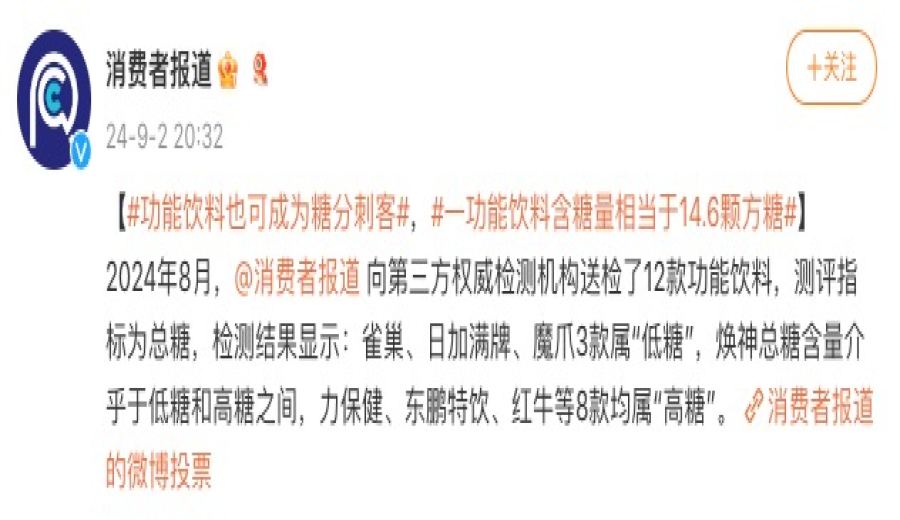
According to a third-party test report on 12 mainstream energy drinks on the market, Dongpeng Special Drink ranks the highest in terms of sugar content. The report categorizes these drinks into three levels: "low sugar," "mid-range," and "high sugar." Brands such as Nestlé, Nichirei, and Monster are classified as low sugar, while as many as eight products, including Dongpeng Special Drink, Lipovitan, and Red Bull, are clearly placed in the high sugar category.
On this list, Dongpeng Special Drink takes the top spot with 66.5 grams of sugar per 500mL bottle, which equates to approximately 14.6 sugar cubes. Such a level of sugar intake is nearly at the upper limit of daily recommended intake, or even several times over. In fact, China's Dietary Guidelines for Residents suggest that adults should consume no more than 50 grams of added sugar per day, and ideally keep it below 25 grams, to reduce the risks of obesity, diabetes, and cardiovascular disease.
In response to external criticism regarding its high-sugar formula, Dongpeng stated that its product formulation has passed safety assessments and approvals by relevant national authorities, and recommends that consumers drink only one bottle per day. However, whether such advice can truly offset the potential harm of high sugar intake remains open to question.
It is worth noting that the impact of a high-sugar diet on the body is multifaceted. Excessive sugar intake can cause rapid spikes in blood sugar, stimulating large amounts of insulin secretion. While insulin regulates blood sugar, it also promotes the conversion of excess sugar into fat, which can accumulate over time, leading to weight gain and even increasing the likelihood of developing metabolic syndrome.
Although energy drinks are generally marketed with selling points like "boosting alertness" and "quick energy replenishment," sugar often plays a key role in these products. Sugar can rapidly elevate blood sugar levels, providing the body with an immediate energy response, making it one of the ingredients that cannot be entirely eliminated from many energy drink formulations. However, these short-term benefits often come with long-term health risks.
According to standards set by the Hong Kong Department of Health, a beverage with a sugar content exceeding 7.5 grams per 100 milliliters is considered a "high sugar" drink. Dongpeng Special Drink contains as much as 13.3 grams of sugar per 100mL, far exceeding this warning threshold. This means that even a small bottle can easily lead to excessive sugar intake without one realizing it.
Market research also shows that Dongpeng Special Drink’s consumer base is gradually expanding from traditional groups such as truck drivers and delivery personnel to urban white-collar workers. An increasing number of office workers pulling late-night shifts view it as a "lifesaver," hoping to power through long working hours with its help. Yet, in the pursuit of productivity, the health risks associated with high sugar intake are often overlooked.
Additionally, financial reports from Dongpeng show that white granulated sugar, as one of its main raw materials, is not only costly but also directly affects the overall gross margin. For example, in 2020, the procurement cost of white granulated sugar amounted to 22.7034 million yuan, accounting for 23.7% of all raw material costs, second only to flavoring ingredients. This shows that the proportion of sugar in the product formulation is not just a health issue, but also part of commercial reality.
Faced with a wide array of energy drinks on the market, when making a choice, consumers should not only focus on whether the drink can "boost energy," but should also carefully read nutritional labels to understand the sugar and additive content, so as to stay alert while also protecting their health.
The above content is compiled by CoffeeHunters, a coffee news website.


