







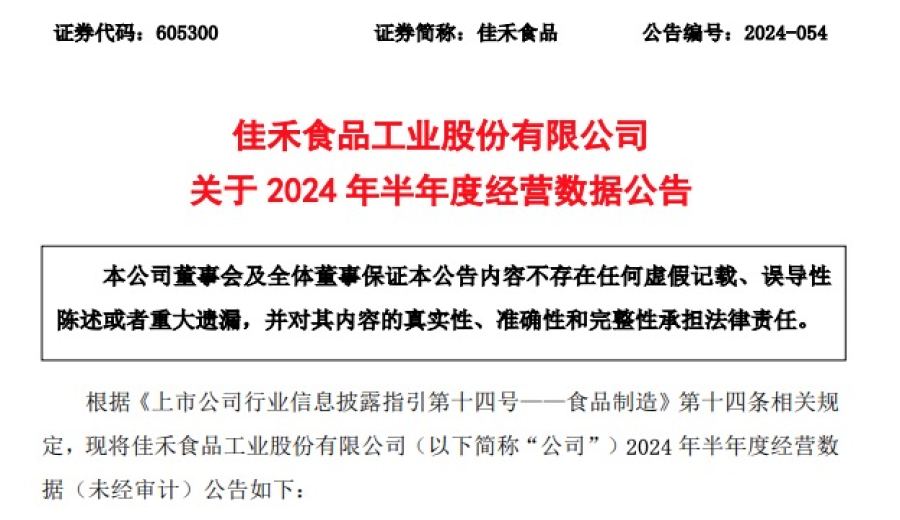
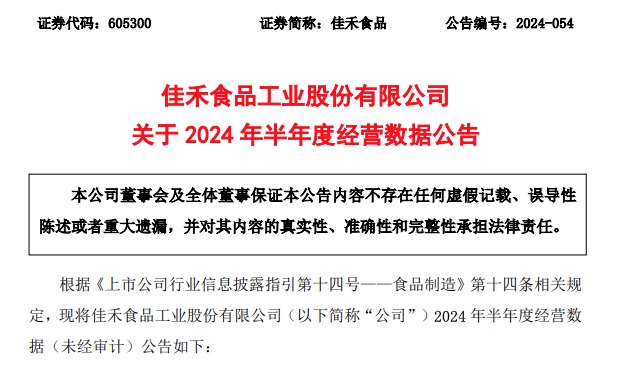
Introduction:Jiahe Food’s revenue and net profit both declined in the first half of 2024, with total revenue falling to 1.073 billion yuan and net profit shrinking by nearly 50%. Once known as the “non-dairy creamer king” for dominating the tea and coffee markets with powdered creamer, the company is now facing immense pressure as new tea brands increasingly move toward “non-non-dairy creamer” formulations. This article delves into the rise and fall of non-dairy creamer, how the trans fat controversy has impacted the industry, and explores possible future transformation directions for Jiahe.
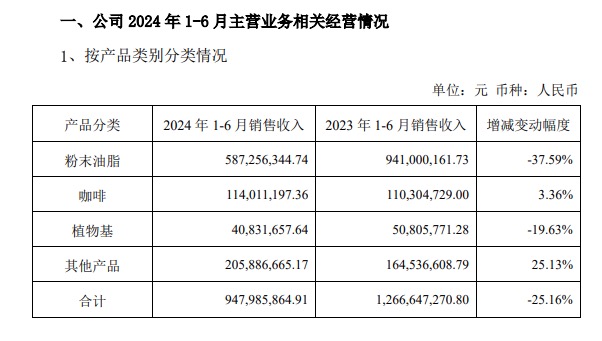
In the first half of 2024, Jiahe Food’s financial performance fell short of expectations: total revenue was 1.073 billion yuan, a year-on-year decline of 19.12%, and net profit amounted to just 69.4439 million yuan, plummeting 48.77% compared to the same period last year — almost halved. This company, which once dominated the market with its non-dairy creamer, is now suffering a heavy blow as new tea brands phase out the ingredient. Non-dairy creamer, once the soul of “coffee mate” and the base of milk tea, is gradually fading from the mainstream spotlight.
Looking back at Jiahe Food’s development, the company was established in 2001 with main products including non-dairy creamer, coffee powder, and instant drinks. As early as 2018, its non-dairy creamer products held a 14.33% domestic market share and 26.85% of the export market, leading its peers. At the time of its IPO in 2021, its stock price once peaked at 32.95 yuan, with a market cap surpassing 13 billion yuan, earning it the title “non-dairy creamer king” in the market.
Non-dairy creamer, commonly known as “coffee mate,” was first created in the 1950s as a white powder made from hydrogenated vegetable oil. It effectively improves the texture of beverages, enhancing smoothness and richness, while also being quick to dissolve and easy to store, making it widely used in instant coffee and milk tea. Especially in the early days when instant coffee had a noticeably bitter taste, adding non-dairy creamer became almost a standard move for consumers, making the coffee taste smoother and more mellow.
By the 1990s, with the entry of Nestlé instant coffee into China, “coffee mate” also made its way into households across the country. For the first generation of coffee consumers at that time, instant coffee paired with non-dairy creamer was almost a fixed combination, aimed at making the originally bitter coffee easier to drink.
However, what truly caused a surge in demand for non-dairy creamer was the rise of the milk tea industry. In the 1990s, when domestic dairy resources were limited, many first-generation milk tea brands, lacking fresh milk, turned to using non-dairy creamer, milk tea powder, chemical additives, and artificial colorings to simulate a milky aroma and rich taste. Even as the tea drink market evolved to include real tea leaves and fruit elements, non-dairy creamer remained a key base ingredient in milk tea for a long time.
In its 2021 prospectus, Jiahe Food revealed that its clientele included many well-known tea and food brands such as CoCo, Uncle No Name, Gu Ming, Yihe Tang, Mixue Ice Cream & Tea, Xiang Piao Piao, Uni-President, Wahaha, and Unilever, demonstrating its high market penetration. However, although non-dairy creamer is a legal food additive, the hydrogenated vegetable oil in its ingredients — if not properly processed — can produce trans fats, which pose potential risks to cardiovascular health when consumed in excess over the long term.
As early as 2018, the World Health Organization (WHO) launched the REPLACE initiative, aiming to completely eliminate industrially produced trans fats from the food supply chain by 2023. With growing consumer health awareness, the public has become more sensitive to the association between trans fats and non-dairy creamer, with some even developing a trend of “fearing non-dairy creamer.”
Starting in 2023, domestic new tea brands have successively announced product upgrades, gradually phasing out traditional non-dairy creamer-based formulations. For example,霸王茶姬 (Bawang Tea Ji) launched its “Ice Berg Non-Hydrogenated Base Milk” in late July 2023, emphasizing it contains no milk powder, non-dairy creamer, or hydrogenated vegetable oil; in August, Tea Bai Dao introduced its “True Fresh Milk Tea Series,” highlighting no non-dairy creamer, low trans fats, and a light taste; in September, HEYTEA also launched its self-developed “True Milk” base, claiming zero non-dairy creamer, no additives, and 3.8 grams of protein per 100 milliliters. Nearly all leading tea brands are moving toward a “non-non-dairy creamer” direction, responding to consumer expectations for health and natural ingredients.
With the reversal of market trends, Jiahe Food’s stock price has also taken a major hit. After the semi-annual report was released, its stock price fell to 10.57 yuan, a drop of nearly 70% from its historical high of 32.95 yuan. In this new era of “0 non-dairy creamer,” whether Jiahe Food can successfully transform and develop new product lines aligned with health trends will be key to maintaining its market position in the future.
The above content is compiled by CoffeeHunters, a coffee news website.


