







Introduction:As an important origin of specialty coffee in China, Yunnan has garnered significant attention for its planting history, regional distribution, and variety characteristics. This article will provide a detailed introduction to Yunnan’s four major coffee-growing regions — Pu’er, Dehong, Baoshan, and Lincang — and offer an in-depth comparison of the flavor profiles between the two most commonly cultivated varieties, Catimor and Typica. Through practical planting cases and cupping data, it aims to help you gain a more comprehensive understanding of Yunnan coffee’s potential and unique traits, along with practical references for roasting and pour over parameters.
In recent years, Yunnan in China has gradually emerged as a notable presence in the specialty coffee market. Its unique geographical environment and climatic conditions have enabled locally grown coffee beans to demonstrate potential that rivals that of the international market. This article will take you on a deep dive into the historical development of Yunnan’s coffee cultivation, the distinctive features of its main producing regions, and provide a focused analysis of the similarities and differences in flavor profiles between the two major cultivars, Catimor and Typica. It offers readers who are interested in learning about or tasting Yunnan coffee a complete information resource.
The history of coffee cultivation in Yunnan dates back to 1904, when French missionaries introduced the first coffee seedlings from Vietnam and planted them in Binchuan County, officially marking the beginning of indigenous coffee cultivation in China. However, large-scale commercial planting truly began in 1955, with an initial cultivation area of approximately 4,000 hectares. Over the following decades, the industry steadily expanded, and by the end of 1997, the province had 7,800 hectares of coffee farms. Today, Yunnan accounts for over 70% of the total coffee cultivation area in China and contributes 83% of its production, making it unquestionably the heart of China’s coffee industry.
Yunnan’s coffee-growing regions are primarily located between 15°N and the Tropic of Cancer in the southern and southwestern parts of the province, covering administrative areas such as Pu’er, Dehong, Baoshan, and Lincang. The terrain here is mostly mountainous and hilly, with elevations generally ranging from 1,000 to 2,000 meters. Coupled with abundant sunshine, moderate rainfall, and significant diurnal temperature variations, these conditions contribute to Yunnan coffee typically exhibiting a rich yet non-bitter profile, pleasant aromas, and subtle fruity acidity. These exceptional natural advantages are key factors shaping the flavor profiles of coffee in each region.
Pu’er City is currently the largest coffee-growing base in Yunnan, with a total coffee cultivation area of 789,000 mu, an annual output of 586,600 tons, and a total output value of 2.469 billion yuan. As many as 54 towns and townships under Pu’er’s jurisdiction are engaged in coffee cultivation, earning it the reputation of “China’s Coffee Capital.” It is not only a major hub for coffee trade on the Chinese mainland but also a popular destination for hosting domestic and international coffee study tour groups.
Dehong Prefecture is another key birthplace of coffee in Yunnan. As early as 1914, there are records of the introduction of small-seeded coffee, giving it a planting history of over a century. The region is home not only to China’s largest coffee seed gene bank — the Agricultural Ministry’s Ruili Coffee Germplasm Resource Garden — but also one of the nine national-level tropical crop germplasm resource gardens. Dehong mainly produces small-seeded coffee varieties and once set a national record of 363.5 kilograms per mu in yield, far exceeding the market average and demonstrating excellent planting potential.
Baoshan’s coffee also boasts a long history and has been certified as a geographical indication product. Its mild climate (average annual temperature of 21.5°C, extreme high of 40.4°C, and no frost throughout the year) is considered ideal for cultivating small-seeded coffee. The local coffee is known for its rich and mellow flavor, soft aroma, and distinct fruity notes. Especially in the Lujia ba area, the traditional Typica variety is well-known. Although it has lower yields and is more challenging to cultivate, its flavor quality far surpasses that of the generally higher-yielding Catimor, making it a favorite among many specialty coffee enthusiasts.
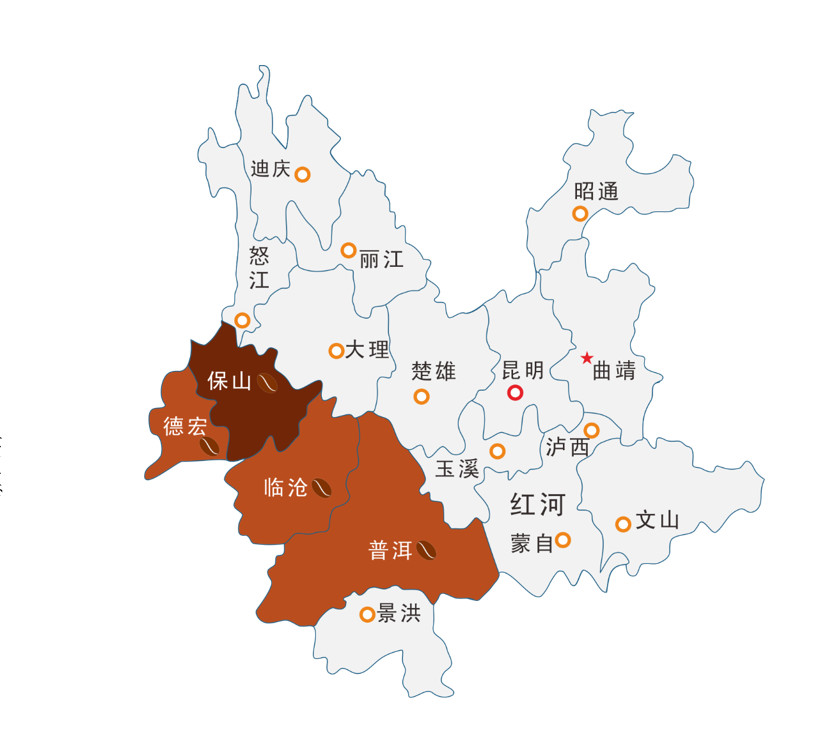
Lincang City, located in the southwest of Yunnan and south of the Tropic of Cancer, features a distinct dry and wet season climate with abundant sunshine. The coffee-growing regions here are mainly distributed across counties such as Gengma, Zhenkang, Yunxian, Cangyuan, and Yongde, and several high-quality coffee nursery bases have been established. Due to its unique geographical location and ecological environment, Lincang has attracted the attention of numerous coffee brands and growers. One coffee brand (note: this article does not involve brand marketing content) has even chosen to establish a dedicated Typica plantation in Lincang, aiming to showcase the most authentic Arabica coffee flavors.
Typica, as one of the oldest Arabica varieties, is renowned for its pure lineage and elegant flavor profile. However, compared to Catimor, it has relatively lower yields and higher cultivation requirements, which is why most farmers still prefer to grow the higher-yielding and more disease-resistant Catimor variety. Nevertheless, for growers pursuing ultimate flavor, Typica is undoubtedly the best choice to showcase Yunnan coffee’s potential. The Typica planted by one coffee brand in Lincang, after several years of cultivation, yielded its first harvest in 2020–2021 and was launched under the “Brand Name 2013” series. Subsequent batches of beans from this plantation have continued to receive positive reviews.
In terms of processing methods, these coffee beans are mostly processed using washed or natural (sun-dried) methods to preserve the purest regional flavors. For example, the 2022 batch of the “Brand Name 2013” series, processed using the natural method, enhanced sweetness and fruity aromas. During cupping, it exhibited multi-layered flavors such as dried apricot, caramel, black plum, and black tea, receiving widespread acclaim in the market. Regarding roasting and pour over recommendations, since these coffees are mostly medium roasted, it is recommended to use a V60 filter cone, with medium-fine grind (approximately 75% passing through a #20 sieve), water temperature controlled at 90–92°C, and a coffee-to-water ratio of 1:15, which can fully highlight its bright fruity acidity and rich aftertaste.
Specifically, roast recommendations can be slightly adjusted based on different equipment, but typically after charging the beans at around 200°C, by controlling the drying phase, Maillard reaction, and first crack stage in terms of heat and air flow, the beans can be dropped after three minutes of development to achieve the best flavor balance. For pour over, a staged extraction method is suggested: start with a 30-second bloom using 30 grams of water, then gradually pour up to 227 grams in total, with the total extraction time controlled to around two minutes. This helps to bring out the distinctive floral and fruity aromas and gentle acidity unique to Yunnan coffee.
The above content is compiled by CoffeeHunters, a coffee news website.


