








Introduction:Delve into the geographic advantages, historical background, and micro-region characteristics of Ethiopia’s Sidama zone, with a special focus on how Bensa town crafts captivating coffee flavors through high altitudes and diverse processing methods. This article explores the origin of the terms "Sidamo" and "Sidama", highlights the distinctive features of Bensa coffee that stand out in COE competitions, and analyzes key steps in sun-drying processing along with practical pour-over parameters.
Sidama (Sidamo/Sidama) is one of Ethiopia’s three officially recognized coffee zones, located at the heart of the East African Rift Valley highlands, blessed with exceptional climate and geographical conditions. The region generally features high altitudes, moderate temperatures, and annual rainfall ranging from 1550 to 2220 millimeters, coupled with fertile soil—contributing to Sidama coffee’s renowned bright acidity, rich and silky body, as well as vibrant floral, spicy, and fruity flavor layers.
This article begins with the evolution of the zone’s name, explaining the differences and historical background between the terms "Sidamo" and "Sidama". It analyzes how micro-regions such as Bensa stood out in the COE competitions from 2020 to 2021, and provides an in-depth look at the processing methods commonly used for high-altitude Bensa coffee and their impact on flavor. The article also details the cupping profile of a high-altitude sun-dried coffee and offers a three-stage pour-over recommendation to help you fully appreciate the unique charm of Sidama coffee.

When it comes to Sidama coffee, many people immediately think of its refreshing and bright tone, rich floral notes, and juice-like round body. Such coffees often exhibit complex layers, balanced acidity and sweetness, and a long aftertaste, making them highly favored by coffee enthusiasts and professional buyers worldwide. As one of Ethiopia’s three official zones, Sidama offers a diverse range of coffee styles, from fruit-forward profiles to vibrant floral expressions, each with its own distinct character.
However, many people encounter two different Chinese translations when searching for this zone: "Sidamo" and "Sidama". In fact, the pronunciation of "Sidamo" originates from the indigenous Sidama people. The Sidama possess their own unique culture and traditions, including a UNESCO-listed intangible cultural heritage—the Fiche Chambalala New Year celebration—which attracts over five million people to gather annually in the capital city of Hawassa.
Nevertheless, during the late 18th to early 19th century, the region was invaded by foreign powers, who mispronounced or deliberately altered the local name "Sidama" to "Sidamo", giving the term a somewhat derogatory connotation in certain contexts. It wasn’t until the 1990s, when the Ethiopian government implemented a federal system based on ethnic distribution and language, that Sidama regained its original name. However, since the term "Sidamo" had already gained widespread use in coffee trade, and the Ethiopian government had also applied for the Sidamo® trademark in earlier years, the international market still commonly refers to this zone’s coffee as "Sidamo".
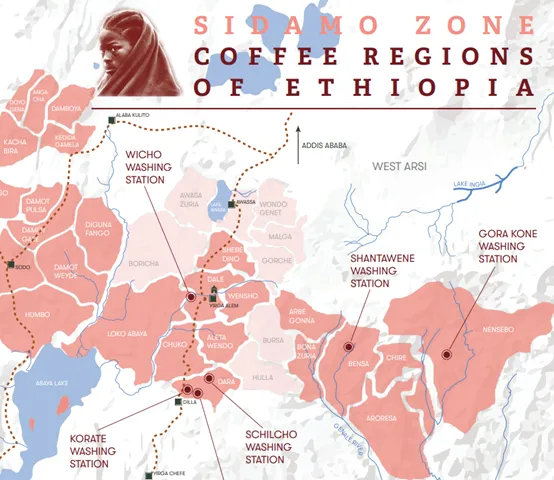
In the 2020 and 2021 COE (Cup of Excellence) international competitions, several micro-regions within the Sidama zone performed exceptionally well, particularly the four towns located on the Sidama plateau: Arbegona, Bensa, Bura, and Bona Zuria. Among them, all five champion farms listed in 2021 were from Bensa town, demonstrating the outstanding quality and potential of coffee from this area.
Bensa town has an altitude ranging from 1800 to 2300 meters. The high-altitude environment not only slows down the ripening process of coffee cherries but also promotes the development of more complex flavor compounds in the beans. Common flavor profiles include intense tropical fruit notes, and sometimes even the fresh aroma reminiscent of strawberries.

Bensa coffee employs diverse processing methods, including washed, natural (sun-dried), and red honey. Washed Bensa coffee typically showcases bright acidity and clear citrus and floral tones. During the washing process, farmers carefully select ripe red cherries, which are then depulped, fermented, washed, and evenly spread on drying beds. During the initial drying phase, the cherries must be turned every 2 to 3 hours to prevent mold or uneven drying, with the entire process usually lasting 12 to 15 days until the moisture content drops to 11.5%.
Although "Bensa" sounds similar to Guangdong’s Ban Sha herbal tea in Chinese, the coffee here is by no means a herbal drink, but rather a high-altitude specialty with delicate taste and lingering aftertaste. To help coffee enthusiasts get closer to the Bensa flavor profile, the following introduces a real case: a sun-dried coffee from a high-altitude region, with its processing and cupping details worth exploring.
This sun-dried coffee selects only fully ripe cherries during harvest, which are hand-picked by farmers and sent to the Hatessa processing station for initial sorting. Before the actual sun-drying, the cherries are further categorized by skin color to eliminate overripe or underripe ones, ensuring all coffee fruits reach the ideal maturity. The first three days of sun-drying are critical—as the cherries have high moisture content, they need frequent turning (recommended every hour or at least every two hours) to avoid mold or undesirable fermentation. The cherries are spread in a thin layer to facilitate ventilation, and the entire sun-drying process usually takes 14 to 18 days until the moisture content stabilizes at the target value, after which it can be stored.
When cupping this sun-dried coffee, the first impression is its sweet floral and fruity aromas. The dry fragrance features notes of magnolia, pineapple, yellow peach, and small Taiwanese mango, accompanied by soft fermentation scents, offering a rich and pleasing flavor complexity.
Upon sipping, the dominant flavors are tropical fruits, with the acidity and sweetness of ripe pineapple, passion fruit, and perfume lemon standing out prominently. There are also gentle black tea tones and delicate floral notes, resulting in a mild mouthfeel and a long-lasting aftertaste. As the temperature drops, nutty fruit flavors such as yellow peach and dried apricot gradually emerge, while the acidity remains clear and layered, delivering surprising flavor transitions.
For this Ethiopian sun-dried Alo coffee, the following pour-over parameters are recommended to fully showcase its flavor characteristics:
Filter:V60
Water temperature:92-93°C
Coffee dosage:15 grams
Coffee-to-water ratio:1:15
Grind size:Granulated sugar size (approximately 78% passing through a #20 sieve)
Pouring method:Three-stage
The specific process is as follows: First, pour water equal to twice the coffee dosage (about 30 grams) for a 30-second bloom to allow the coffee grounds to fully expand. Then, pour water in small streams in circular motions from the inside out until reaching 125 grams for the first pour. Once the water level drops to the middle of the filter, pour again with the same fine stream until reaching 225 grams to complete the extraction, with a total brewing time of about 2 minutes. These parameters help balance acidity and sweetness, highlight fruity notes, and extend the complexity of the aftertaste.
The above content is compiled by CoffeeHunters, a coffee news website.


