







Introduction:Want to brew a medium-dark roast coffee with rich body but no bitterness? This article dives deep into the characteristics of medium-dark roasted beans, starting with how roast level affects flavor, and comparing the differences between light-roast Ethiopian Yirgacheffe and dark-roast Sumatra Mandheling. It also provides four practical techniques—low temperature, soft water flow, slow pouring, and coarse grind—to help you precisely control water temperature, grind size, and pouring method, ensuring every cup of medium-dark pour over coffee delivers a solid body and captivating layers of flavor.
From roasting and grinding to brewing, every step influences the final flavor of your coffee. The roast level not only determines the color of the coffee but also directly impacts the balance of acidity, body, and bitterness. Generally speaking, the darker the roast, the more pronounced the body, the lower the acidity, and the higher the bitterness. Understanding these basic differences is the crucial first step toward brewing your ideal cup.
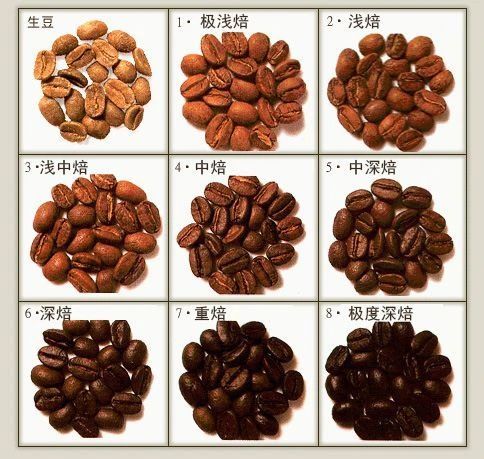
The most intuitive way to judge roast level is by observing the color of the beans. Although color may vary slightly depending on the bean variety, it can generally be categorized into light roast, medium roast, and dark roast. Light roast beans appear light brown or brownish, with less oil, bright acidity, and showcase the unique flavors of their origin—making them commonly used in cupping. Medium roast beans are medium brown in color, with occasional surface oil, striking a good balance between acidity and body, and offering a rich variety of flavors. As for dark roast beans, they are usually dark brown or even close to black, with glossy surfaces and intense chocolatey and toasty notes, while their original regional characteristics are less pronounced.
In the grinding and brewing stages, choosing the right grind size is crucial. It’s recommended to use a grinder with adjustable settings to precisely control particle size. Taking the common Hario Skerton as an example, the ideal grind size for pour over coffee falls between 3 and 4 on the grind setting, with a sieve extraction rate of around 80%. This range balances extraction efficiency and smooth mouthfeel. For a familiar comparison, it’s roughly similar to the coarseness of fine sugar.
Recommended grind sizes also vary depending on the coffee origin and roast level. For instance, lightly roasted Ethiopian Yirgacheffe G1 is best brewed with a finer grind and water at 90–91°C, helping to highlight bright acidity and citrusy flavors. On the other hand, dark roasted Sumatra Mandheling is better suited to a medium-to-coarse grind, with the water temperature slightly lowered to around 88°C, which helps reduce over-extraction risk and yields a rounder, fuller body.
It’s worth noting that different brewing devices and methods also have specific grind requirements. For example, espresso requires an extremely fine grind, filter cones or siphon brewers work well with a medium grind, while French press calls for a coarse grind. In addition, brew time is closely related to grind size: the longer the immersion time, the coarser the grind should be to avoid over-extraction; conversely, shorter brew times can tolerate a slightly finer grind. However, these are just general guidelines—actual adjustments should be made based on personal taste preferences.
If the grind is uneven, fines will release flavor compounds faster than larger particles, causing an imbalance in extraction rhythm. This often leads to some parts being over-extracted and others under-extracted, ultimately affecting the overall cup quality. Therefore, maintaining grind uniformity is a key foundation for stable extraction.
For medium-dark roast coffee, if you want to achieve a rich yet non-bitter cup, here are four practical techniques to consider:
First, low water temperature.It’s recommended to keep the water temperature between 86–88°C. Slightly lowering the temperature helps slow down the extraction process, reducing the release of bitterness and impurities, resulting in a more focused and mellow coffee flavor.
Second, soft water flow.When pouring, try to maintain a gentle water stream and avoid forcefully hitting the coffee bed. Control the water level in the filter cone, and after the bloom, pour slowly with a lower water column height. Let the coffee grounds release their flavors steadily as if soaking in water. This approach helps create a soft yet solid mouthfeel.
Third, slow pouring circles.Use a slow, circular pouring motion from the inside out and then from the outside in, avoiding rapid stirring. Fast water flow and agitation can accelerate extraction for medium-dark roasts, intensifying bitterness. By reducing stirring, coffee compounds are released more gently, helping to enhance overall flavor balance.
Fourth, coarse grind.Choosing a coarser grind reduces the contact area between coffee grounds and hot water, preventing early release of bitter and astringent compounds under high temperatures. Paired with low water temperature and slower extraction, it gradually unveils layers of flavor and texture, allowing medium-dark roast coffee to exhibit a rich yet refined character.
In summary, light roast beans, due to lower cell expansion and slower water absorption, typically require a finer grind and slightly higher temperature for proper extraction. Dark roast beans, on the contrary, are better suited to a coarser grind and slightly lower temperature to avoid over-extraction. By adjusting these parameters, even medium-dark roast coffee can deliver surprisingly soft and full-bodied flavors.
The above content is compiled by CoffeeHunters, a coffee news website.


