







Introduction:Want to understand how Brazilian coffee became the classic base for espresso, and how it also showcases the captivating flavors of single origins? This article delves into Brazil’s main producing regions, representative varieties, and innovative processing methods—from Cerrado to South Minas, from Red Bourbon to Yellow Bourbon—paired with practical flavor descriptions and brewing suggestions to help you find the Brazilian beans that best suit your taste and brewing style.
Brazil is the world’s largest coffee producer, known for its stable, low-acid, and balanced flavor profile, and has long served as the backbone of espresso blends. Moreover, with advancements in processing techniques and careful variety selection, Brazil has also steadily made its mark in the single-origin coffee scene, particularly showcasing unique charm in SOE (Single Origin Espresso) applications. This article will guide you through the essence of Brazilian coffee—from three carefully selected producing regions, renowned Bourbon varieties, to the pulped natural processing method that changed the fate of Brazilian coffee—offering practical insights for both beginners and baristas seeking reliable bean sources.
It is commonly believed that the higher the altitude, the greater the bean density and flavor complexity. However, Brazil is the opposite. Due to its mostly low-altitude, flat terrain and lack of significant microclimate variations, it produces coffee beans with mild flavors and consistent profiles. These beans typically have low acidity but offer rich sweetness, a full body, and excellent extraction stability, making them highly suitable as a base for espresso. Many well-known blend recipes—such as those emphasizing crema and chocolate notes, nutty profiles, or even balanced commercial blends—rely on the contribution of Brazilian beans.
If you wish to experience the original profile of Brazilian single-origin coffee, start with beans from the Cerrado region processed using the pulped natural method. When medium roasted, these coffees often reveal layers of cream, peanut, toasted bread, and caramel, accompanied by a soft hazelnut tone. They are smooth on the palate, with extremely low acidity, and a slightly bitter yet non-irritating finish. They are not only great for pour over but also work well with moka pot, siphon, French press, and even espresso SOE extractions, demonstrating high adaptability.

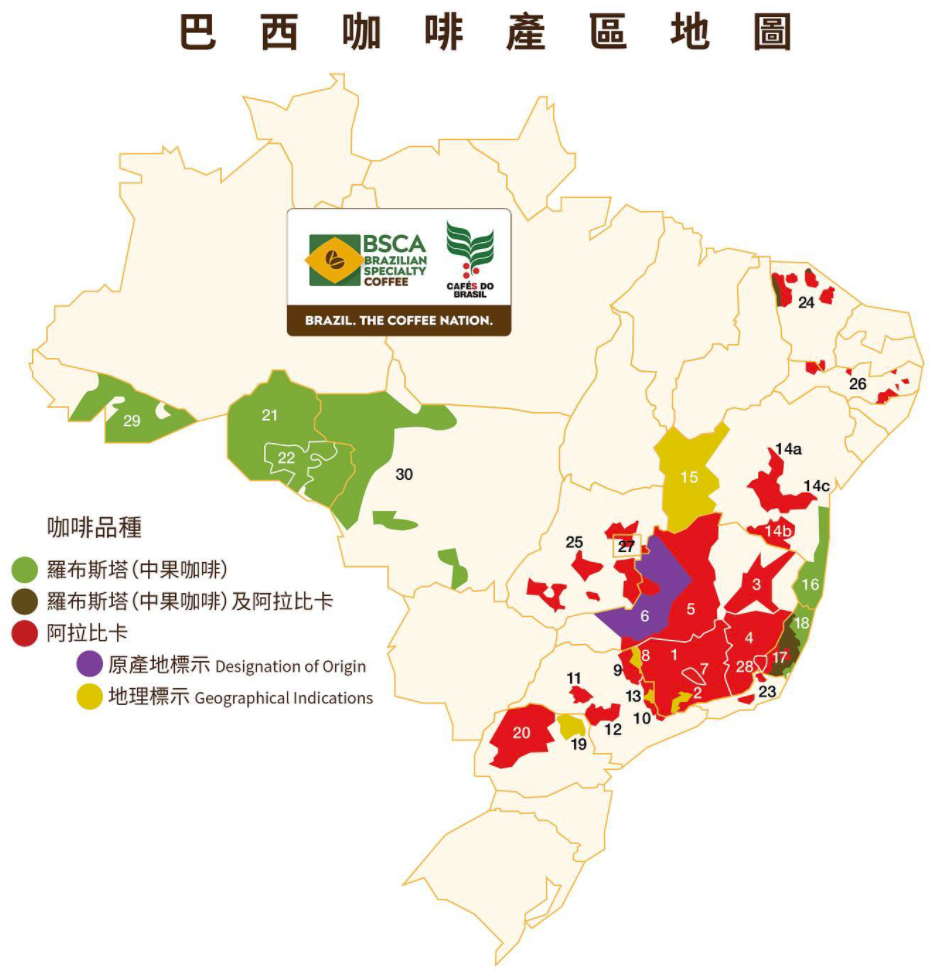
Brazil’s coffee cultivation history spans over three hundred years and has been a significant economic crop since the 1970s. Currently, coffee is produced in 17 states across the country, but nearly 90% of the output is concentrated in the southeastern region, particularly in Minas Gerais. This state and several surrounding key areas form the core of Brazil’s specialty coffee. Statistics show that Minas Gerais alone has a coffee plantation area of 1.22 million hectares, larger than the entire planting scale of Colombia.
Among the many producing regions, Cerrado, South Minas, and Mogiana are regarded as the three representatives of Brazilian specialty coffee. Cerrado is located in the western highlands of Minas Gerais, sharing its name with the local savannah known as Cerrado. This region, with altitudes exceeding 1,000 meters, flat terrain, and a concentrated harvest period, has attracted large farms for many years, with each farm spanning over 10 hectares, offering excellent conditions for large-scale management. South Minas is situated in the southern part of Minas Gerais, mostly at elevations above 1,100 meters, where foothills and gentle slopes intermingle. With distinct dry and wet seasons and significant day-night temperature variations, it provides an ideal growing environment for Bourbon and Yellow Bourbon, becoming a cradle for cultivating elegant-flavored coffees.
Another specialty coffee hub is the nearby Mogiana region. Here, coffee trees are often planted among grasslands and native vegetation, with mineral-rich red volcanic soil that helps coffee cherries absorb ample nutrients, resulting in rich aromatic expressions. The area hosts both farms that continue traditional farming methods and those adopting modern management systems, giving Mogiana coffee a balance of consistency and individuality. It often features a unique sugarcane-like sweetness along with clear fruitiness and chocolate notes, earning high favor among coffee enthusiasts.
Among the many varieties, Bourbon can be considered one of the representatives of Brazilian coffee. Bourbon is a mutation of Typica and can be divided into Red Bourbon and Yellow Bourbon based on the color of the ripe fruit. Red Bourbon turns deep red when mature and is usually grown in high-altitude regions, exhibiting a balanced acid-to-sweet ratio, rich aroma, and soft mouthfeel, making it a top choice for many stable blends. Yellow Bourbon, named for the bright yellow color of its ripe fruit—a trait resulting from genetic selection—tends to accumulate more sugar in high-altitude environments, often delivering intense sweetness and a juice-like flavor. Yellow Bourbon even swept the top three spots in Brazil’s Cup of Excellence competition twice, drawing significant market attention.
Brazil employs a variety of coffee processing methods, among which the development of the pulped natural method has made outstanding contributions to quality improvement. In the past, Brazil mostly used traditional sun-drying, exposing the entire coffee fruit directly to the sun, which easily led to the absorption of off-flavors and fermentation odors, negatively affecting overall performance. By the 1990s, local research institutions developed the pulped natural technique: first removing the skin and pulp while retaining a thin layer of mucilage, then drying in the sun for 1 to 3 days, and finally mechanically controlling moisture content to 12% followed by aging. This method not only speeds up the process but also significantly reduces undesirable flavors, allowing Brazilian coffee to showcase cleaner, fuller characteristics. Additionally, some regions still preserve traditional sun-drying methods, such as using African raised beds for precise temperature control and manual turning to ensure even drying, further enhancing the coffee’s purity and detail expression.
The above content is compiled by CoffeeHunters, a coffee news website.


