








Introduction:Mandheling and Blue Mountain are often hailed as representatives of bold, full-bodied coffee, but in reality, they differ significantly in terms of origin, variety, processing method, and flavor profile. This article will provide an in-depth comparison between Indonesia’s Golden Mandheling and Jamaica’s Blue Mountain coffee, exploring everything from regional environments and green bean characteristics to processing techniques and pour over flavors—helping you grasp the unique charm and brewing essentials of these two classic coffees.
In the world of specialty coffee, Mandheling and Blue Mountain are frequently cited as embodiments of rich flavor, yet they actually differ greatly in origin, variety, and processing methods. Blue Mountain coffee hails from Jamaica’s Blue Mountain region, renowned for its washed processing, primarily using the Typica variety, and is known for its delicate and balanced flavor. In contrast, Golden Mandheling comes from Sumatra, Indonesia, and is processed using the wet-hulled (Giling Basah) method, resulting in a bold, layered richness. This article will detail the differences between these two coffees in terms of geographical environment, bean traits, processing methods, and pour over flavors to help you better understand their uniqueness.

When it comes to coffee with a full body and intense flavor, many people immediately think of Mandheling and Blue Mountain. However, it’s important to note that not all coffee beans labeled as “Blue Mountain” on the market actually come from Jamaica’s legally defined Blue Mountain region—that area has only about 6,000 hectares of cultivable land, making its production extremely limited and unable to meet the high market demand. The true premium Blue Mountain coffee, such as that selected by industry professionals (Front Street Coffee), comes from the Clifton Estate. This estate is not only the oldest coffee plantation in Jamaica but also the only farm in the region certified by the Rainforest Alliance (RFA).
[Differences in Origin and Geographic Environment]
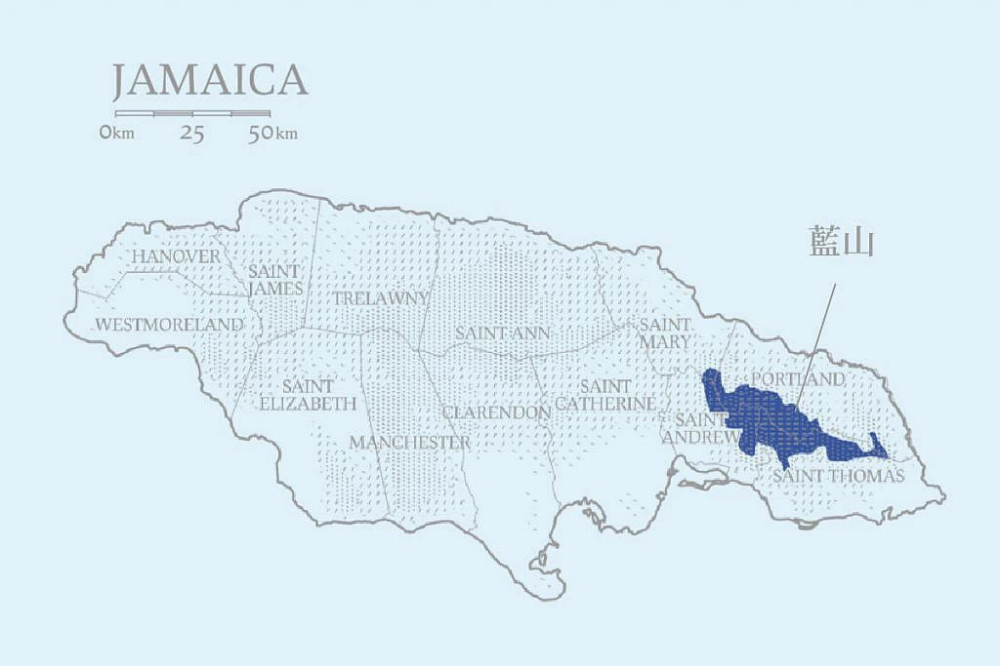
Jamaica’s Blue Mountain coffee is produced in the Blue Mountain region of Jamaica, an island in the Caribbean. The highest elevation in the Blue Mountain region reaches up to 2,400 meters, making it the tallest peak in the entire Caribbean. This area lies within the golden zone of the coffee belt, featuring fresh volcanic soil, clean air, pure water quality, evenly distributed rainfall throughout the year, and significant day-night temperature variation. The fertile soil is rich in elements like nitrogen and phosphorus, and the frequent cloud cover reduces direct sunlight, providing nearly perfect growing conditions for coffee trees and resulting in Blue Mountain coffee’s delicate and multi-layered flavor.
Indonesia is another highly representative coffee-producing country, located near the equator and composed of numerous islands. It is the world’s third-largest coffee producer. Although Robusta makes up a larger proportion, Arabica varieties are mainly grown on islands such as Java, Sulawesi, and Sumatra. Among them, the Mandheling coffee from Sumatra is a standout representation of Indonesia’s specialty coffee. Golden Mandheling belongs to the GARDE 1 grade, indicating an exceptionally low defect rate and a premium quality classification. Its name originates from Indonesia’s well-known Pwani Coffee Company (abbreviated as PWN), which focuses on sourcing high-quality Mandheling beans. These beans undergo rigorous manual sorting to ensure each one meets high standards.
[Key Differences in Processing Methods]
Blue Mountain coffee uses the traditional washed processing method. After harvesting, the coffee cherries are first subjected to flotation to remove unripe fruit, then the pulp and flesh are removed via washing. The mucilage is subsequently eliminated through fermentation, after which the beans are rinsed and dried. Washed processing requires a continuous supply of clean, flowing water, with fermentation lasting approximately 12 to 18 hours. The beans are then friction-washed in water tanks until the surface is smooth and clean. This method preserves the coffee’s bright acidity and delicate aroma, contributing to the balanced and gentle flavor profile of Blue Mountain coffee.
In contrast, Golden Mandheling employs Indonesia’s unique wet-hulled method (known locally as Giling Basah). This technique involves removing the parchment layer while the coffee beans are not yet fully dry (with a moisture content of about 20% to 24%). As a result, compared to the washed method where processing occurs after full drying, this approach yields a bolder flavor with distinctive earthy and herbal notes. Wet-hulled processed coffee is typically full-bodied, with a distinctive character, and often features complex layers of nuts, spices, and chocolate.
[Differences in Green Bean Appearance and Grade]
Blue Mountain coffee primarily uses the Typica variety. The standards for NO.1 grade Blue Mountain green beans include: bean size of 17 mesh or larger, defect rate below 3%, moisture content around 13%, and an attractive bluish-green appearance with plump, uniform beans. These strict standards ensure the high quality and consistency of Blue Mountain coffee.
Golden Mandheling also mainly uses the Typica variety, but the green beans are required to be 19 mesh or larger, with a darker green color and flatter bean shape. Since wet-hulled processing involves hulling at a semi-dry stage—when the beans still have high moisture content—the parchment tends to stick to the bean surface, leading to small dents during removal. These are commonly known as “goat hoof beans” or “horse hoof beans.” These phenomena are not defects but rather natural outcomes of the wet-hulled process, and have even become one of its distinctive features.
[Cupping Flavor Comparison]
In cupping evaluations, Blue Mountain coffee demonstrates an excellent balance of acidity, body, and aroma. Its acidity is delicate and bright, its body silky smooth, and its aroma carries floral, spicy, and subtle lemon notes. On the palate, it offers cocoa and chocolate undertones, with an overall clean, mild, and complex flavor. Bitterness is barely perceptible, and the finish leaves a lingering fruity tone.
In terms of dry fragrance, Blue Mountain often emits aromas of roasted peanuts, hazelnuts, melon, and chocolate; its wet aroma presents layers of oolong tea, caramel, honey, and almond skin. By comparison, Golden Mandheling offers a richer and more varied flavor profile. Common cupping characteristics include notes of nuts, chocolate, spices, and herbs, with a pronounced caramel sweetness in the finish. Overall, it exhibits a bold, full-bodied character with an earthy personality.
[Pour Over Brewing Recommendations and Flavor Profile]
For a pour over comparison between the two, it is recommended to use a KONO filter, with 15g of coffee, water temperature at 88°C, a coffee-to-water ratio of 1:15, and grind size around step 11 on the EK43s. The brewing steps are as follows: start with a 30g bloom for 30 seconds, then pour to 125g and pause, maintaining a slow circular pour, and finally pour up to 225g to complete the extraction.
After pour over brewing, Blue Mountain coffee presents an exceptionally clean, complex, and mild flavor, with prominent chocolate sweetness, excellent balance of acid, sweet, and bitter, and a fruity-toned finish. The overall profile is rich, smooth, and well-rounded. Golden Mandheling, on the other hand, showcases clear layers of nuts, chocolate, and spices, along with a strong caramel aftertaste. Its flavor is bold and distinctive, making it an excellent choice for those who enjoy a full-bodied coffee experience.
The above content is compiled by CoffeeHunters, a coffee news website.


