







Introduction:Discover the rare Java variety coffee beans from the Warique Estate in the Caranavi region of Bolivia, and delve into the complete journey from cultivation, processing to roasting. This article provides an in-depth look at the historical background of this coffee variety, its unique flavor profile, and precise pour over brewing parameters, inviting you to savor its complex layers of hazelnut, citrus, and wine-like aromas.
Located in the inland of South America, Bolivia is not a mainstream coffee-producing country, yet it boasts many specialty coffees with distinctive flavors thanks to its exceptional geographical and climatic conditions. Among the numerous small-scale farms, the Warique Estate stands out for its refined Java variety. These beans, cultivated by the Rodriguez family through their company Agricafe, not only reflect the family’s dedication to quality but also showcase the resilience and potential of Bolivia’s coffee industry.
The Warique Estate is situated in the Caranavi region at an altitude of over 1,600 meters, covering just 6 hectares. The cool climate here slows down the ripening process of coffee cherries, aiding in the accumulation of flavor compounds. After harvest, the coffee cherries are sent to the local “Lunar Processing Plant” for further processing, ensuring consistent processing methods and stable quality.
Speaking of the star variety at the Warique Estate—Java—its story is far richer than the name suggests. This variety originated in the forests of Ethiopia, where it was initially gathered by local inhabitants. It later made its way to Indonesia via Yemen, where it earned the name “Java.” Interestingly, it was often mistaken for a Typica variant, but genetic research has confirmed that it actually stems from Ethiopia’s Abysinia variety. In 1991, thanks to the efforts of international breeding expert Benoit Bertrand, the variety was introduced to Costa Rica via the CIRAD organization, and gradually spread to Panama, Nicaragua, and eventually Bolivia.
Java coffee beans have distinct physical characteristics: they are slender in shape, with yellowish-bronze-colored tips, grow tall, but yield relatively low. Beyond offering flavors as delicate as those of Geisha, it also demonstrates stronger resistance to common diseases such as leaf rust and coffee berry disease, making it particularly suitable for smallholder farmers with limited resources.
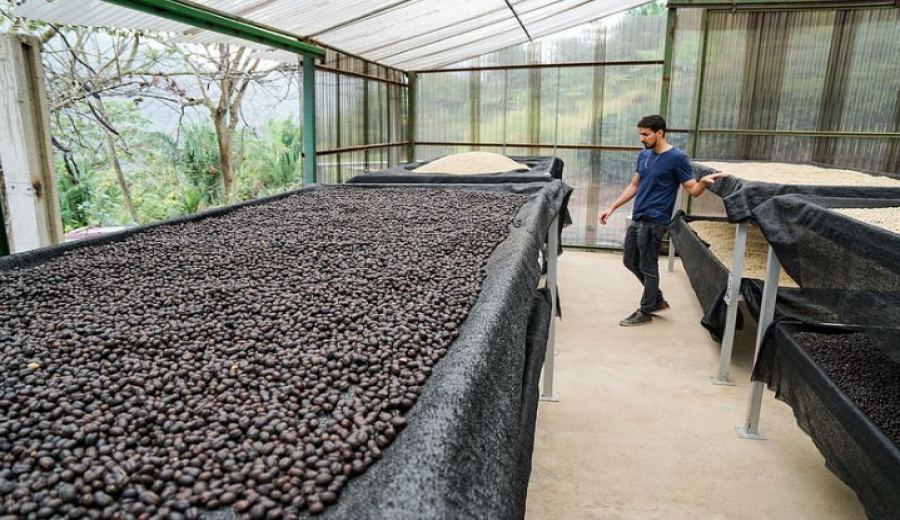
The Java beans from the Warique Estate are processed using the natural (sun-dried) method. This technique is meticulous: harvested coffee cherries are first placed in large water tanks to remove unripe or overripe floaters, keeping only the ripe ones that sink. Then, the whole coffee cherries—including pulp, mucilage, and seeds—are evenly spread on elevated drying beds. They are turned regularly each day to ensure even heat exposure. The entire sun-drying process takes approximately 2 to 4 weeks until the moisture content drops to around 12%. Finally, a hulling machine is used to remove the hard outer layer, resulting in the familiar green coffee beans.
In terms of roasting, these Java beans were processed using a Yangjia 800N semi-direct-fire roaster with a 300g capacity. During roasting, the initial drum temperature was set at 170°C. Thirty seconds after dropping the beans, the heat was turned on at level 140, with the air vent kept at setting 3. The turning point occurred at approximately 1 minute and 39 seconds. From there, the heat and air vent settings were gradually adjusted to control the pace of dehydration and Maillard reactions. As the beans turned yellow and the grassy aroma faded, they entered the first crack. For this roast, the air vent was fully opened at the start of first crack (around 8 minutes and 37 seconds), and the beans were dropped at 190.5°C, with a development time of about 1 minute and 30 seconds.
In cupping, this natural Java bean exhibits prominent notes of hazelnut, cream, and citrus, along with a gentle fermented wine-like aroma, delivering a rich and balanced flavor profile. When hot, the cup presents a creamy sweetness paired with bright acidity of citrus and tropical fruits. As it cools slightly, the cup reveals a sweet orange and vanilla cream-like aftertaste. Upon further cooling, subtle maple-like sweetness and floral notes emerge, reminiscent of jasmine and rose tea, with a long-lasting sugarcane-like sweetness.
If you’d like to brew this Warique Estate Java bean at home, we recommend using the pour over method to fully highlight its flavor details. We suggest using a V60 filter, with a coffee-to-water ratio of 1:15, a water temperature of around 89°C, and a grind size equivalent to 58% passing through a Chinese standard No. 20 sieve (roughly BG 5R). The total brew time should be controlled to around 1 minute and 56 seconds. These parameters will bring out a refreshing acidity and sweetness of citrus, lime, and hawthorn, with a fruit-chocolate and vanilla cream aftertaste. Even as the cup cools, a sweet orange acidity remains, and when chilled, the maple sweetness and delicate floral notes become more pronounced, with a lingering sugarcane sweetness that leaves a lasting impression.
In summary, the Java coffee beans from the Warique Estate not only embody the dedication and wisdom of Bolivia’s smallholder farmers, but also showcase the unique charm of the natural processing method. Whether you’re a coffee enthusiast with a passion for flavor exploration or a pour over aficionado seeking unique varieties, this coffee is definitely worth a try. From cultivation and harvesting to processing and roasting, every step reflects a stringent commitment to quality, making this small-batch coffee from the highlands an essential selection on your flavor discovery journey.
The above content is compiled by CoffeeHunters, a coffee news website.


