







Introduction:Delve into Brazil’s four renowned coffee-growing regions—Minas Gerais, Cerrado, Mogiana, and the Port of Santos—to discover how each unique terroir shapes the flavor profile of its coffees. This article details the differences in altitude, variety, and processing methods, and provides practical brewing references to help you find your preferred Brazilian coffee flavor.
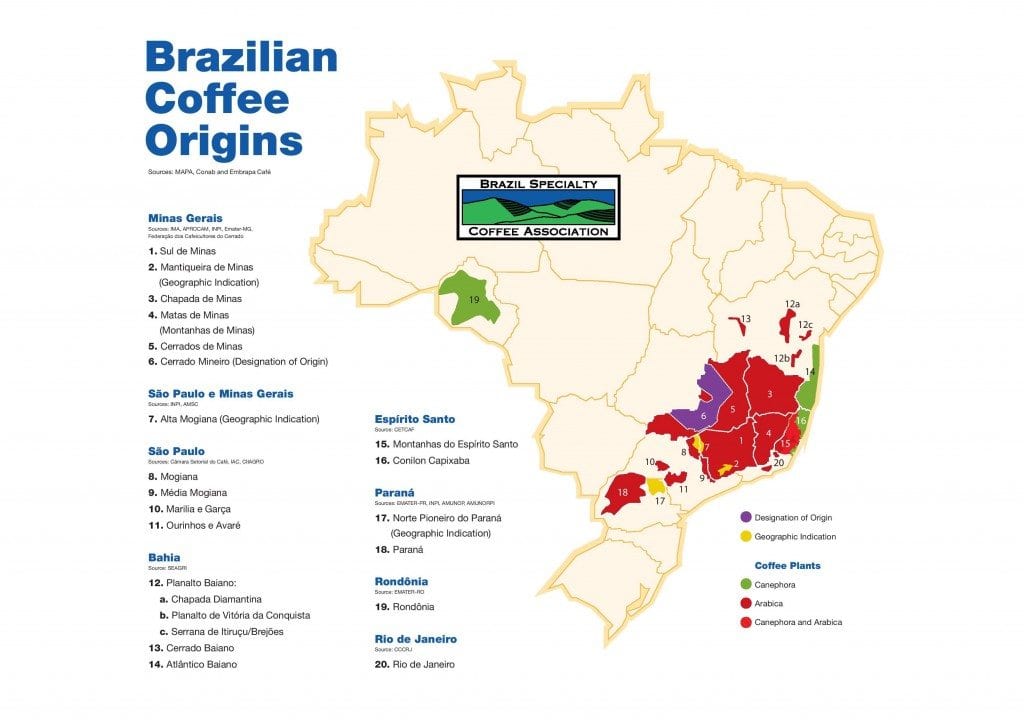
As the world’s leading producer of coffee beans, Brazil not only supplies vast quantities of commercial beans but also cultivates numerous specialty coffees with distinctive characteristics. From tropical rainforests to highland plateaus, this South American giant’s coffee map spans diverse terrains, with Minas Gerais, Cerrado, Mogiana, and Santos in São Paulo being essential destinations for specialty coffee enthusiasts.
Minas Gerais accounts for over half of the country’s Arabica production and is divided into four distinctive sub-regions:Matas de MinasCharacterized by a warm, humid climate that yields caramel and chocolate notes;Minas HighlandsWith its flat terrain and mechanized production, it highlights rich chocolate flavors; the origin-certifiedCerrado, with its distinct seasons and ideal altitude, is considered the benchmark for Brazilian specialty coffee and is often likened to Bordeaux in the coffee world; while the higher-altitudeSouth Minasis known for its intense fruitiness and full body, contributing about 30% of the country’s total production.
São Paulo, home to Latin America’s largest port—the Port of Santos (a hub for Brazilian coffee exports)—also has one of the earliest coffee-growing histories in the region. The state’s two major producing areas each have their own unique traits:MogianaWith its mineral-rich red volcanic soil and mild climate, produces coffee with low acidity, full body, and fruity and chocolatey aftertastes. The renownedQueen’s Estatehas consistently performed well since Brazil’s first Cup of Excellence (COE), winning awards twelve times in seven years;Centro-OesteMeanwhile, the area is dominated by hilly terrain and small-to-medium-sized farms, resulting in relatively balanced and mellow flavors.
Although Espírito Santo is primarily known for Robusta, its southern minority Arabica-growing areas, benefiting from highland climates and mild environments, showcase unique fruit acidity and fruity notes, ranking second in national production. Bahia, on the other hand, is a rising star. Although its coffee industry only began in the 1970s, it has gained recognition in recent COE competitions thanks to advanced agricultural technologies, even winning the semi-washed category championship in 2015. Its high altitude and distinct wet-dry seasons are key factors in its specialty development.
Paraná, once a traditional coffee powerhouse in Brazil, saw its Arabica crops devastated by a severe frost in 1975, leading to a sharp decline in production and pushing futures prices to historic highs. Today, it focuses on diverse crops, and its altitude limitations make it difficult to compete in the high-end specialty market. As for northeasternRondônia, it mainly cultivates Robusta varieties.
Taking the commonly seen Brazilian Red Bourbon and Queen’s Estate Yellow Bourbon as examples, the two have notable differences in processing methods and flavors. Red Bourbon is often processed using traditionalpulped natural(at around 1000 meters), presenting a classic nutty base tone with a smooth mouthfeel, making it ideal for beginners to experience the foundational profile of Brazilian coffee; whereas Yellow Bourbon, with its richer mucilage layer (higher sweetness potential), paired withsmall-batch premium natural(at 1400–1950 meters, processed on African raised beds), can exhibit brighter sweetness and more delicate flavors, often carrying subtle lemon notes in cupping.
For actual brewing, if you want to highlight the aroma and sweetness of Brazilian coffee, it is recommended to usemedium-dark roasting, along with water at 88°C, a slightly coarser grind (e.g., 70% passing through a 20-mesh sieve) and a KONO filter. Recommended parameters: 15g of coffee, a 1:15 coffee-to-water ratio, brewed in three pours—first, 30ml for a 30-second bloom; second, 100ml poured in a circular motion (around 1:05); third, 95ml poured until the drip finishes (total time about 2 minutes). This method extracts a richer layered profile and balanced taste.
The above content is compiled by CoffeeHunters, a coffee news website.


