







Introduction:Delve into the secrets of Colombia’s specialty coffee — from regional geography and harvest seasons to key coffee varieties and processing methods — and gain a comprehensive understanding of the flavor profiles unique to each area. This guide compiles the distinctive characteristics of major producing regions such as Huila, Cauca, and Nariño, and analyzes how altitude and climate influence coffee performance. It is an essential reference for coffee enthusiasts and buyers alike.
Colombia is the world’s third-largest coffee exporter and a major supplier of Arabica and washed beans. The country’s coffee is renowned for its balance, finesse, and suitability for everyday drinking, earning it the title “green gold.” Coffee cultivation is primarily concentrated in the Andes Mountains, where volcanic soils and high-altitude environments foster diverse and layered flavor characteristics.
Colombia’s geographical environment is unique, with a terrain “scratched by a cat,” featuring three mountain ranges running north to south. The main coffee-growing regions are located in these mineral-rich Andean zones. As early as 1808, coffee was introduced to Colombia from the French Antilles via Venezuela. Local farmers mainly practice small-scale, family-based cultivation without relying on mechanization. Their emphasis on detail and sustainable land use results in consistently high-quality and distinctive coffee.
In terms of harvest seasons, due to its equatorial location and elongated north-south span, Colombia is divided into three major regions: northern, central, and southern, each with distinct harvest periods. The southern and northern seasons are opposite, while the central region has a primary and secondary harvest due to its geographical position. The main harvest typically runs from October to January of the following year, with the secondary harvest occurring from April to July. In reality, from coffee fruit picking and processing to the final arrival in consumers’ hands, an additional 2 to 3 months are usually needed for post-harvest processing and transportation.
Colombia grows a wide variety of coffee, including commonly seen ones like Caturra, Bourbon, Typica, and Pacamara, as well as several disease-resistant varieties. Among the most representative are Castillo, Tabi, and Colombia, all developed by CENICAFE to combat diseases such as leaf rust. In addition, there are also small plantings of rare varieties like Gesha and Laurina, which add more variety and depth to the coffee flavors.
Most Colombian coffee is processed using the washed method. Smallholder farmers use small-scale processing equipment (such as Ecomill or Eco-Pulper) to remove the skin, pulp, and some mucilage, followed by short fermentation, washing, and drying. Depending on weather conditions, drying is done via sun drying, raised beds, or low-temperature dryers. This meticulous processing helps preserve the coffee’s clarity and bright acidity, which are key factors behind the clean and layered flavor profile of Colombian coffee.
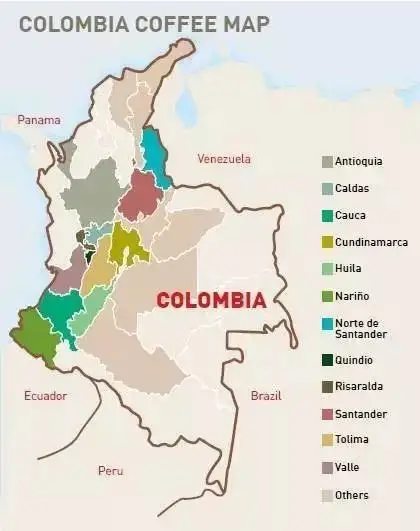
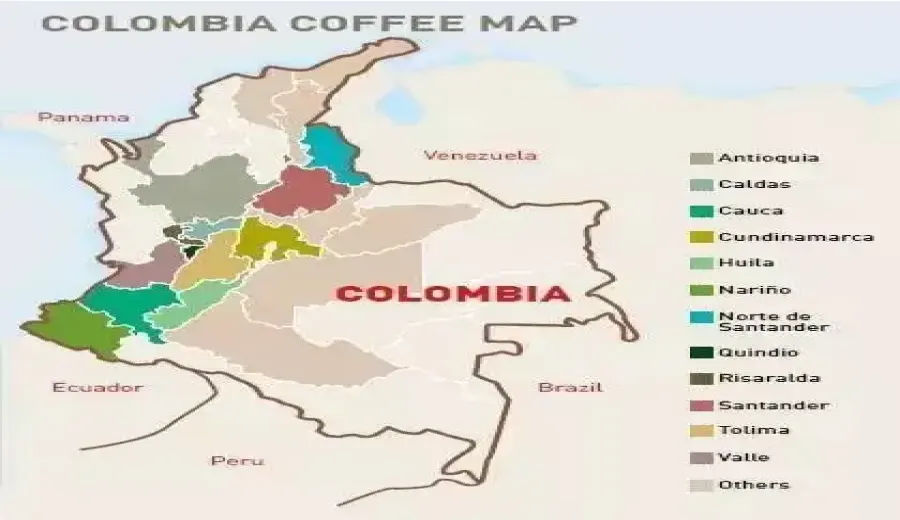
Colombia’s main specialty coffee-producing regions are concentrated in the south, including Huila, Cauca, Nariño, and Tolima. These areas generally sit at altitudes above 1,500 meters, with some exceeding 2,000 meters. The high altitude, combined with significant day-night temperature variations, slows the ripening of coffee cherries, facilitating the accumulation of flavor compounds. The resulting coffee often exhibits pronounced acidity, berry notes, and caramel sweetness.
For example, Huila Province is known for its mountainous highland terrain, with planting altitudes exceeding 1,500 meters. It is one of Colombia’s most important specialty coffee regions. The area has shifted toward emphasizing micro-regions and micro-lots, highlighting regional characteristics and single-farm flavors. Washed Huila beans often deliver a balanced profile of nuts, dark chocolate, and soft fruity acidity.
Cauca Province is a certified origin region for Colombian coffee, with an average altitude of 1,758 meters, and some areas even surpassing 2,100 meters. Its mountainous terrain, abundant rainfall, and volcanic soils, along with significant day-night temperature differences, help coffee cherries ripen slowly, yielding coffee with high acidity and unique sweetness. This region has produced varieties like Castillo processed with double anaerobic washed methods, showcasing complex layers of mugwort, berries, and fermentation aromas.
Nariño is located in southwestern Colombia, bordering Ecuador. The Andes Mountains dominate the region, and coffee-growing areas are mostly situated within the 1,600 to 2,300-meter cloud belt. The volcanic soils are fertile, and the coffee beans produced here are small but dense, with concentrated flavors. Though most are purchased by international large trading companies, a small selection of premium beans shows exceptional potential.
Colombian coffee is graded by bean size, with Supremo (17+ screen size) being the highest grade, followed by Excelso (14 to 16 screen size). Additionally, the Colombian Coffee Growers Federation (FNC) and its affiliated National Coffee Research Center (CENICAFE) play pivotal roles in variety improvement, agronomy promotion, and international marketing. They have successfully built the globally recognized “Juan Valdez” brand image and continue to support smallholders in enhancing cultivation and processing techniques, ensuring Colombia’s international competitiveness and consistent coffee quality.
The above content is compiled by CoffeeHunters, a coffee news website.


