








Introduction:To understand the essence of specialty coffee, one cannot overlook the classic varieties within the Arabica family. This article delves into the origins and evolution of Typica, Bourbon, and Geisha, showing you how these renowned varieties, in regions such as Brazil, Colombia, Jamaica Blue Mountain, and Hawaii Kona, develop unique flavor profiles due to differences in altitude, climate, and cultivation methods. It also teaches you how to make smarter choices when selecting coffee beans based on origin and variety.
Arabica coffee is the most popular coffee variety globally, accounting for over 70% of the market. Its cultivation is mostly concentrated in regions above 1,200 meters in altitude. This variety originated in the Arabian region and later spread to Europe. Through adaptation and evolution in different areas, it gradually diverged into two original branches: Typica and Bourbon. Building on these, further natural mutations and artificial hybridization have given rise to numerous sub-varieties, including Geisha. This article will start with the journey of Geisha’s spread and guide you through the characteristics, pros and cons of these three classic lineages, while also exploring how renowned regions like Brazil, Colombia, Jamaica Blue Mountain, and Hawaii Kona influence the flavor direction and market positioning of coffee through geographic environment and cultivation conditions.
When discussing the origins of Arabica, the homeland of coffee—Ethiopia—must not be overlooked. This place not only boasts the world’s richest wild coffee gene pool but is also the birthplace of the Arabica variety. Generally speaking, Arabica coffee thrives at altitudes above 1,200 meters. Compared to Robusta, it offers a more delicate flavor and enjoys widespread market favor, accounting for about 70% of global coffee production. Originally, this variety was introduced from the Arabian region to Europe and gradually formed two representative branches—Typica and Bourbon—depending on the region of introduction. Later, through natural genetic mutations and human hybridization, many astonishing varieties, such as Geisha, emerged.
The story of the Geisha variety is quite legendary. Initially discovered in Ethiopia’s Geisha Forest, it was not a major cultivated variety locally. It was later taken to Kenya for research and subsequently spread to East African countries such as Uganda and Tanzania, before moving on to Costa Rica, and finally finding its stage in Panama. Especially under Panama’s high-altitude microclimatic conditions, Geisha exhibits exceptional floral, fruity, and citrus notes, quickly rising to the ranks of the world’s top-tier coffees and becoming a dream bean for specialty coffee enthusiasts. As its fame spread, many notable regions, including Jamaica Blue Mountain, also began planting Geisha, underscoring the undeniable appeal of its flavor.
When it comes to classics, Typica is undoubtedly the most iconic elder within the Arabica family. Take Jamaica as an example—this region mainly cultivates Typica. These coffee trees typically grow to heights of 4 to 5 meters, with lateral branches spreading horizontally. The new shoots initially display an attractive bronze color, and the trees can live for several decades. Typica is known for its elegant sweetness and delicate flavors, serving as a flavor benchmark for many baristas. However, its yield is relatively low, and it has almost no resistance to diseases such as leaf rust, leading many regions to gradually reduce its cultivation. Even so, Typica remains an indispensable reference variety in many professional evaluations and competitions.
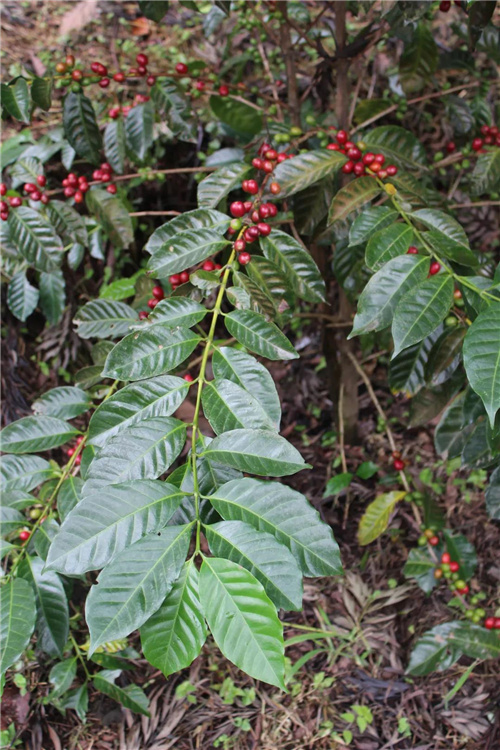
To compensate for the yield and disease susceptibility limitations of Typica, Bourbon emerged as a significant alternative. Legend has it that the Bourbon variety originated from a natural mutation that occurred after Ethiopian coffee trees were introduced to the French island of Bourbon (now Réunion). Its tree structure is similar to that of Typica, also growing to around 4 to 5 meters in height, but with slightly upward-slanting lateral branches and greener leaves. Bourbon not only inherits the elegant flavor foundation of Typica but also achieves a breakthrough in yield, making it a staple cultivation variety in many regions. However, like Typica, Bourbon also faces disease threats, especially leaf rust, but its relatively stable productivity allows it to maintain a presence in both commercial and specialty markets.
When talking about well-known regions for Bourbon, Brazil—the world’s largest coffee producer—cannot be ignored. In Brazil, Bourbon and its derivative varieties such as Yellow Bourbon, Red Bourbon, and the extremely rare Pink Bourbon are all cultivated. Among them, Yellow Bourbon is mainly limited to Brazil’s São Paulo state, while Pink Bourbon is a rare result of genetic interaction between Red Bourbon and Yellow Bourbon, rarely seen in the market. It’s worth mentioning that Brazil mostly employs flatland cultivation, with harvesting relying heavily on mechanized operations. While this improves efficiency, it also leads to uneven ripeness of coffee cherries. Coupled with generally lower cultivation altitudes, Brazilian coffee tends to have a smoother overall flavor, lacking the complex layers often found in high-altitude regions.
In contrast, Colombia’s Arabica plantations are mostly located on the high-altitude slopes of the Andes Mountains. Although the rugged terrain makes mechanical operations difficult and relies entirely on manual harvesting, it is precisely for this reason that coffee cherries can accumulate richer sugars and flavor compounds during their extended maturation period, resulting in high-quality coffee with balanced and layered profiles. Colombia’s geographic and climatic conditions often lend its coffee distinct notes of caramel, nuts, and mild fruit acidity, making it a popular choice for many pour over enthusiasts.
It’s worth noting that altitude is not the sole determinant of flavor. Take Hawaii Kona coffee as an example—it is grown at an altitude of only about 1,100 meters, seemingly below the general standard for high altitude, yet thanks to Hawaii’s unique island microclimate—gentle, stable, with moderate day-night temperature variations—it successfully produces specialty coffee with a rich mouthfeel, abundant sweetness, and a long-lasting aftertaste. This proves that even at slightly lower altitudes, as long as the climate conditions are favorable, an astonishing flavor profile can still be achieved. Therefore, when choosing coffee beans, in addition to considering origin and altitude, don’t overlook the crucial impact of microclimates and cultivation environments on the final flavor.
The above content is compiled by CoffeeHunters, a coffee news website.


