








Introduction:As the birthplace of coffee, Africa is home to numerous distinctive specialty coffee regions. From the floral and citrus notes of Ethiopia, to the berry acidity of Kenya, to the unique characteristics of Burundi and Rwanda, these beans stand out in the global specialty coffee market with their bright acidity and rich aromas. This article will delve into the flavor profiles, mainstream varieties, processing methods, and grading systems of Africa’s major coffee regions, along with practical tasting references to help you find the one that suits your palate best.
The story of global coffee begins in Africa. Particularly Ethiopia, widely regarded as the birthplace of coffee, remains a key player in the specialty coffee landscape. From Ethiopian beans with pronounced floral and citrus notes, to Kenyan coffees renowned for their intense berry acidity, to the distinct expressions from Burundi, Rwanda, and Uganda, African coffees win over many coffee lovers with their vibrant acidity, bold fruitiness, and diverse flavor structures.
This article will focus on Africa’s main coffee regions, systematically introducing the flavor characteristics, common varieties, post-harvest processing methods, and grading systems of each area, alongside practical tasting suggestions. This will give you a more comprehensive understanding of the charm of African coffee and enable you to choose beans that better match your taste preferences.

There is a wide variety of coffee types, and beans from many regions are named after their geographical origin. These names not only indicate the place of production but also directly reflect their unique flavor profiles, including acidity expression, aroma types, body, and mouthfeel nuances. Broadly speaking, beans from the Americas typically exhibit balanced fruit acidity with tones of nuts and cocoa; Asian beans often carry herbal, spicy, and caramel notes with a heavier body; andAfrican beans are most distinctly characterized by their intense tropical fruit flavors and bright, lively acidity..
It’s worth noting that many people have a bias against acidity in coffee, thinking that acidity equals bad taste. However, acidity is actually an essential element that contributes to the layered complexity of coffee flavor. The acidity in a good cup of coffee should be soft, layered, and balanced with sweetness, rather than simply sharp or astringent. Acidity is different from astringency—acidity often brings a refreshing sensation, while astringency is an unpleasant roughness, usually indicating issues in processing or roasting.
The source of acidity in coffee does not come from the green beans themselves, but rather from a series of chemical reactions during roasting. For example, chlorogenic acid breaks down into quinic acid, and oligosaccharides break down into volatile acids such as formic and acetic acids. These reactions create the diverse acidity profiles in coffee when sipped, ranging from bright citrus notes to soft berry acidity.

The overall impression of African coffee can be summarized as “rich fruity aromas and bright acidity.” Represented by Ethiopia and Kenya, the coffees from these regions often feature distinct traits such as tropical fruits, citrus, and berries. Their acidity is lively yet not overpowering, paired with moderate sweetness and aroma, leaving a deep impression easily. However, due to drought and water scarcity in many areas, many African regions still use the natural (sun-dried) method, resulting in beans that are less uniform in shape and slightly higher in defect rates.
Ethiopia: The Coffee Gene Bank
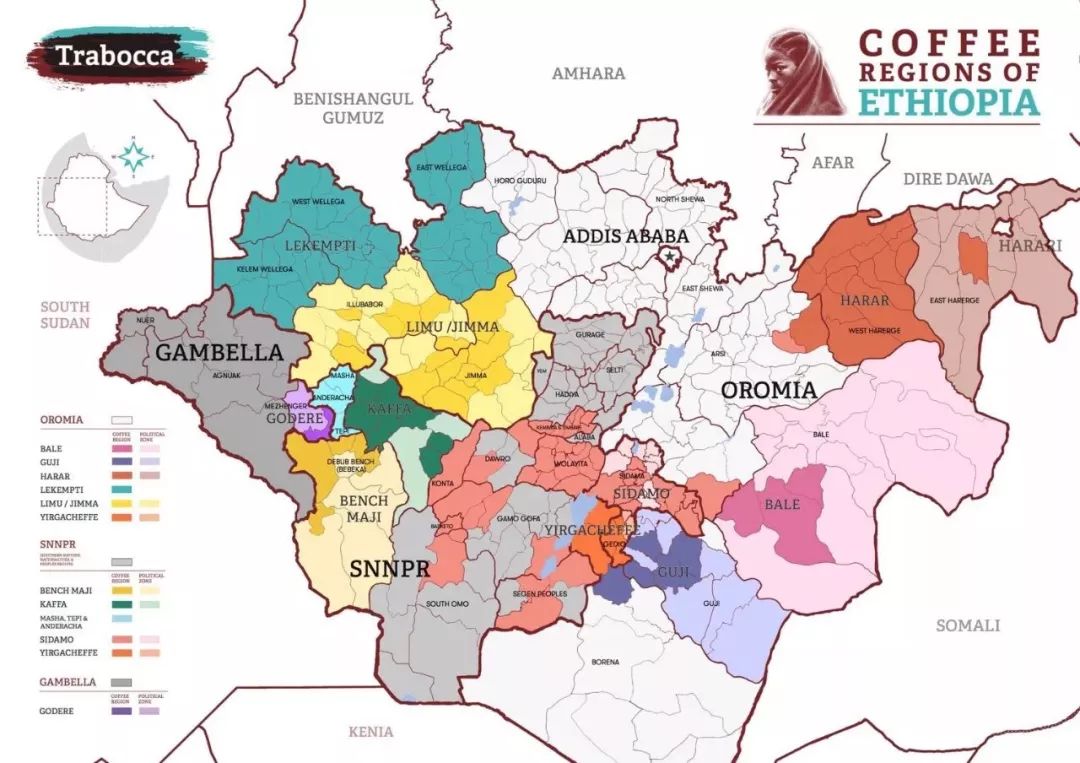
Ethiopia is not only the birthplace of coffee, but also remains one of the world’s major exporters of Arabica beans, particularly known for its two premier specialty regions: Yirgacheffe and Sidamo. The country is home to over 1,900 recorded native coffee varieties. These unselected, wild varieties vary in shape and size, but are also the key to the diverse flavor profiles of Ethiopian beans. Many of these coffees are famed for their “natural red cherry” processing method, delivering captivating fruity and floral aromas.
Ethiopia’s coffee-growing regions can be divided into nine major zones, among whichYirgacheffe sits at an altitude of about 1,800–2,000 meters. Although it is administratively part of Sidamo, its uniquely distinctive flavor profile warrants its separate recognition.Yirgacheffe coffees often exhibit pronounced berry aromas, citrus notes, and a tea-like body. They present bright acidity and gentle sweetness on the palate, making them a top choice for many pour over enthusiasts as an entry-level specialty coffee.
Sidamo, located near the East African Rift Valley, benefits from fertile and well-aerated soils. The coffees produced here also feature floral and citrus notes, and when roasted to a medium level, they often express bergamot, wild ginger lily, and blackcurrant tones, paired with grapefruit-like sweetness. The overall flavor profile is rich and layered.
In Ethiopia, coffee bean grading is primarily based on defect rates. Washed beans are graded up to G1 and G2, while natural beans are topped by G1. G1 grade beans typically offer a purer flavor expression, with clear acidity and prominent aromas.

Kenya: A Perfect Balance of Acidity and Body
Kenyan coffee is renowned for its high-quality Arabica beans, which feature bright acidity, rich mouthfeel, and unique berry and wine-like notes, making it highly favored in the European market. Kenyan coffee mainly comes from large farms and cooperatives, among whichAA grade is the highest, with beans larger than 18 mesh (approximately 7.22 mm), commanding considerable market value.。
The unique flavor of Kenyan coffee partly stems from the SL28 and SL34 varieties cultivated by the Scott Laboratories. These Bourbon-type varieties, adapted to high altitudes and high-phosphorus soils, exhibit intense plum-like acidity and rich layers. Additionally, Kenya’s distinctive “72-hour fermented washed process (K72)” involves three cycles of 24-hour fermentation and washing, further enhancing flavor clarity and the persistence of acidity.
Kenyan coffee grades are divided by bean size into AA, AB, PB (peaberry), etc., and are also scored based on flavor performance. Among these, PB (peaberry) beans are especially popular due to their concentrated flavors.
Burundi, Rwanda, and Uganda: Distinctive Expressions from Diverse Terroirs
Known as the “Heart of Africa,” Burundi’s coffee production is dominated by smallholder farmers, with Bourbon being the primary variety, mostly processed using the washed method. Regions such as Kayanza and Ngozi often showcase a blend of citrus, berry, and floral characteristics, with noticeable acidity and wild charm. The overall flavor is rich and layered, earning high praise in Europe.
Rwanda, known as the “Land of a Thousand Hills,” features mountainous terrain and fertile volcanic soils, along with stable rainfall and high altitudes. These conditions produce coffees with prominent fruit sweetness, lively acidity, and multi-layered complexity. Local varieties such as Red Bourbon often combine berry acidity, citrus notes, and nutty aromas, offering a balanced and distinctive cup.
Although Uganda primarily produces Robusta, it also grows some quality Arabica varieties such as SL14 and SL28. These varieties are drought-resistant and have short harvest cycles, suiting the local environment. Ugandan coffees often exhibit citrus, berry, and spice notes, with balanced sweetness and acidity and a mild aftertaste.
Various African regions also hold quality competitions similar to the Cup of Excellence, such as Uganda’s TOH (Taste of Harvest), providing a platform to discover top regional coffees and helping more outstanding smallholder productions gain recognition.
Tasting and Selection Tips
When tasting African coffee, it’s recommended to gradually assess the dry fragrance, wet aroma, acidity on the palate, sweetness, body, and aftertaste. For example, Ethiopia’s Yirgacheffe often has pronounced berry dry fragrance, with a tea-like soft acidity upon tasting; whereas Kenya AA may present a refreshing plum-like acidity with a sweet finish.
When selecting, check if the packaging has a one-way valve to ensure freshness, and try to consume the coffee within 2–7 days post-roast. Light roasts better highlight acidity and fruitiness, suitable for those who prefer a fresh profile; dark roasts emphasize bitter-sweetness and roasted notes, catering to those who enjoy a richer taste.
In summary, African coffee offers a broad spectrum of flavor exploration through its diverse terroirs, unique varieties, and rich processing techniques. Whether you’re just starting out or already experienced, gaining a deeper understanding of the characteristics of these regions can help you find the perfect cup of African specialty coffee that suits your palate.
The above content is compiled by CoffeeHunters, a coffee news website.


