







Introduction:Want to understand how the natural-process coffee beans from Ethiopia’s renowned Guji and West Arsi regions differ? This article provides an in-depth comparison of the terroir, processing methods, green bean characteristics, and professional cupping results of Hua Kui 4.0 and West Arsi beans, along with practical pour over brewing recommendations to help you find the specialty coffee that best suits your taste.
As the birthplace of coffee, Ethiopia boasts numerous distinctive growing regions. Among them, Guji and West Arsi, both located within the Sidamo region, have gradually gained global attention in recent years. Both areas lie within the high-altitude specialty coffee belt and predominantly employ traditional natural processing methods. However, when it comes to flavor profiles, green bean traits, and ideal brewing methods, each has its own strengths. This article will take you through a comprehensive analysis of these two highly acclaimed natural-process beans—from regional background and processing techniques, to green bean appearance, roasting suggestions, cupping performance, and practical pour over parameters.
[Regional Terroir and Processing Characteristics]
Sidamo is located in southern Ethiopia, surrounding the East African Rift Valley, at an altitude of approximately 1400 to 2000 meters, and serves as a major coffee export hub. The region’s diverse microclimates and complex soil types contribute to the richness of its coffee flavors. Both Guji and West Arsi belong to the Sidamo region but each exhibits a distinct personality. Guji was once part of Sidamo but became an independent region in 2010. It is known for its fertile black soil (Vertisol) and significant day-night temperature variations, which are ideal for producing coffee with intense fruity aromas and layered complexity. West Arsi, situated between Yirgacheffe and Harar, ranges from 1900 to 2200 meters in altitude and is characterized by smallholder farming. Its coffee cherries often feature rich jammy and ripe berry flavors.
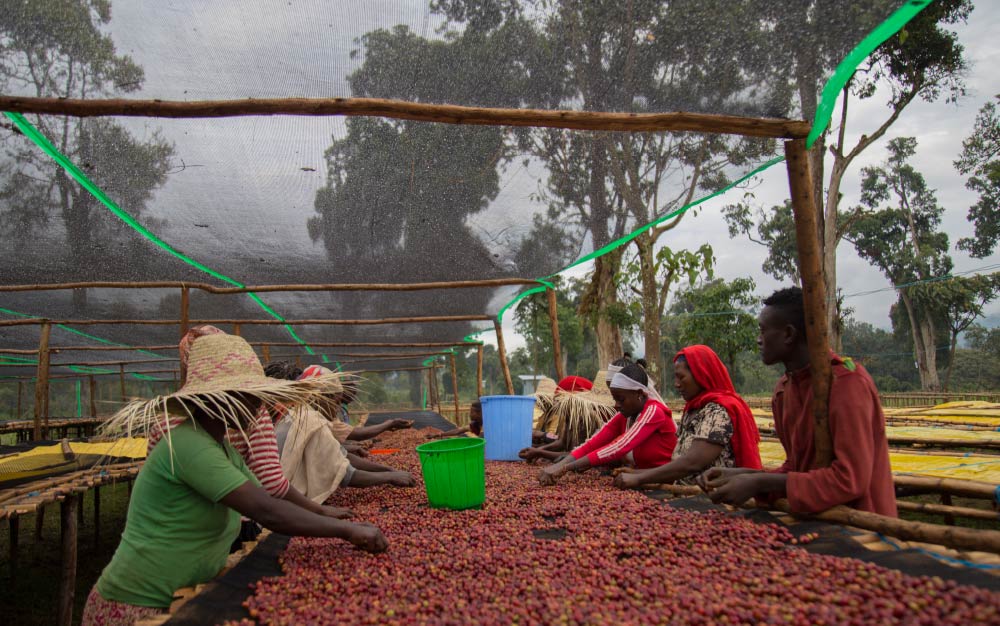
Coffee from both regions is commonly processed using the natural (dry) method, which preserves the sugars and aromas from the coffee cherry pulp. This allows the beans to develop intense berry, tropical fruit, and honey notes during drying, while maintaining a smooth body. Especially in Ethiopia, the natural process often highlights unique regional terroir characteristics.
[Hua Kui 4.0 vs West Arsi: Green Bean and Processing Background]
Hua Kui 4.0 is a natural-process bean from Hambella in the Guji region, with its core production area Dimtu situated at an exceptionally high altitude and processed by the renowned Buku Abel washing station. Hambella is not only one of the highest-altitude sub-regions within Guji but also, due to its geographical isolation, preserves many native coffee varieties. This contributes to the unique berry, creamy, and strawberry notes of the Hua Kui series. Hua Kui 4.0 has seen further refinements in cultivation management and processing techniques, resulting in a more balanced acidity-to-sweetness ratio and a longer-lasting aftertaste during cupping.
In contrast, West Arsi coffee is grown by numerous smallholders using traditional methods. Though each farm is only about 2 to 3 hectares in size, family involvement in harvesting and sorting ensures relatively stable quality control. Natural beans from this region often exhibit rich aromas of ripe plum, nectarine, and mango, accompanied by a honey-like sweetness—making it a must-try for coffee lovers who enjoy juicy, fruit-forward profiles.
[Green Bean Appearance and Roasting Recommendations]
Observing green bean appearance, Hua Kui 4.0 shows slightly uneven sizing due to the inclusion of smaller beans, whereas West Arsi beans appear more uniform, reflecting more consistent cultivation and harvesting standards. For roasting, to highlight the fruity and acidic characteristics of both natural beans, a light roast is recommended, with an appropriately extended drying phase to ensure even heat penetration to the bean core.
Recommended roasting parameters for Hua Kui 4.0 (using Yangjia 800N as an example): charge temperature 175°C, air damper 3, flame 120; turning point around 151.7°C, first crack begins at 9’50”, first crack development 1’40”, drop temperature 196°C. For West Arsi, it is suggested to start with a slightly lower charge temperature (160°C), air damper 3, flame 120, first crack starting around 9’08”, development time 1’20”, drop temperature 193.5°C, to retain more delicate fruit aromas.
[Cupping Flavor Profile]
Cupping results show that Hua Kui 4.0 presents fresh citrus, berry, blueberry, and passion fruit aromas in the dry scent, with blackcurrant and rose layers in the wet aroma. Upon tasting, notes of almond, strawberry, and blackcurrant interplay with bright acidity, accompanied by noticeable fermentation character and a long-lasting sweetness. West Arsi’s dry scent is simpler, dominated by berry notes, but reveals rich jammy, plum, cranberry, nectarine, and mango tropical fruit tones upon brewing, with a honey-like smooth sweetness in the aftertaste.
[Practical Pour Over Parameters and Brewing Recommendations]
It is recommended to use a V60 #01 filter, with water temperature controlled at 90–91°C, coffee dose 15g, brew ratio 1:15, and grind size similar to superfine sugar (approximately 80% passing through a #20 sieve, i.e., BG6M). The pour over steps are as follows: first pour 30g of water for a 30-second bloom, then add 95g of water (total ~125g) within about 1 minute; when the water level drops to 2/3 of the coffee bed, pour the remaining 100g of water (total ~225g) over approximately 1 minute 40 seconds to 1 minute 45 seconds, with total brew time controlled between 2 minutes 00 seconds and 2 minutes 10 seconds, then let it drip to completion.
Brewing Hua Kui 4.0 with these parameters, high-temperature notes include pronounced almond and berry aromas, which transition into blackcurrant juiciness and honey sweetness as the cup cools, showcasing a distinctly sweet and layered profile. West Arsi, on the other hand, offers intense berry juice flavors at higher temperatures, shifting to a sweet interplay of plum, nectarine, and mango as it cools, with a smooth honey finish—ideal for those who prefer bold fruit flavors and a round mouthfeel.
The above content is compiled by CoffeeHunters, a coffee news website.


