







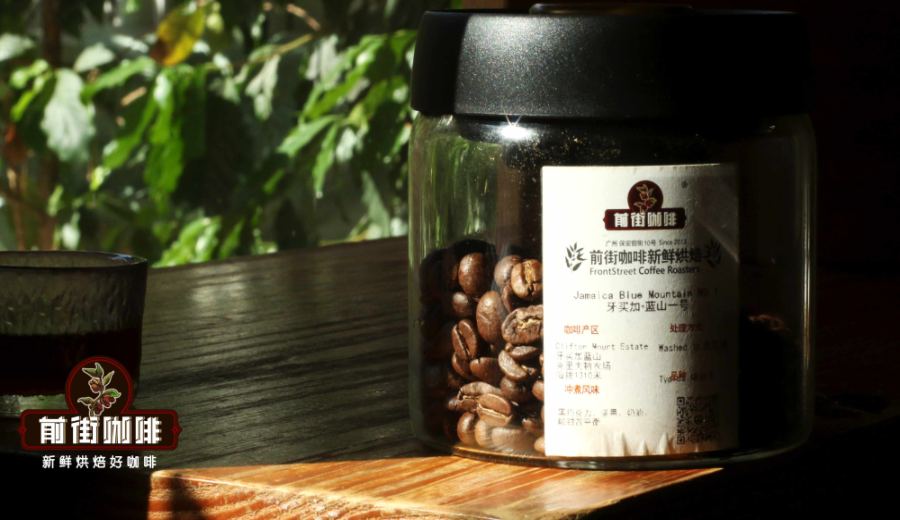
Introduction:Jamaican Blue Mountain No. 1 coffee beans are renowned for their rarity and exceptional balance, but products labeled as "Blue Mountain" on the market often confuse consumers. This article delves into the certification of authentic Blue Mountain coffee regions, its historical background, and focuses on the No. 1 grade produced at the 1310-meter-high Clifton Estate. It provides a comprehensive explanation of bean variety characteristics, roasting profiles, and pour over parameters to help you understand what true Blue Mountain flavor is, along with practical brewing recommendations.
Blue Mountain coffee has long been hailed as the pinnacle of the coffee world. Its fame is not only due to its high price, but also because of its extremely limited production. Genuine beans from the Blue Mountains of Jamaica can only be grown at elevations above 910 meters, and the variety is strictly limited to the ancient and pure-flavored Typica. Annual production is extremely scarce, amounting to only about 300 to 600 tons, which is the main reason for its high price. This article will introduce you to the official certification and regional distribution of Blue Mountain coffee, and take the more readily available Clifton Estate Blue Mountain No. 1 as an example to detail its roasting strategy and pour over method, helping you fully experience the unique charm of Blue Mountain coffee.
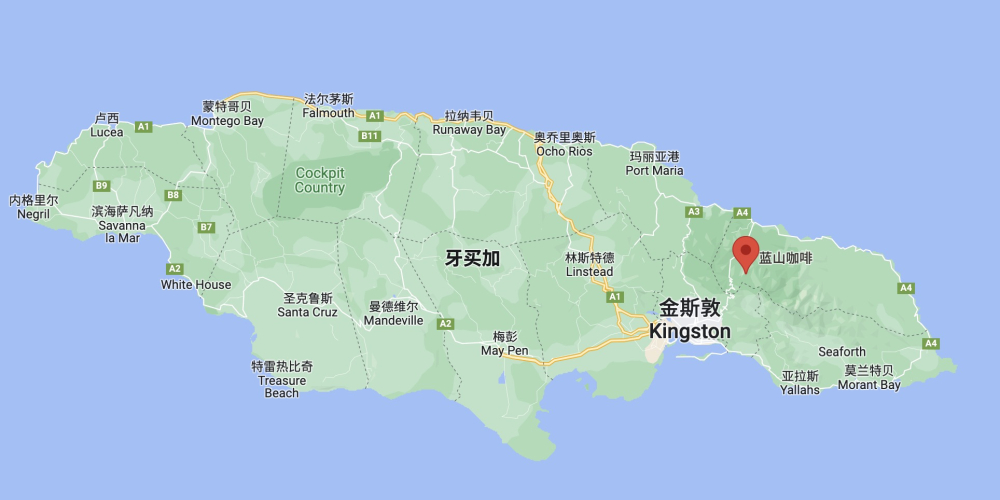
The geographical environment of the Blue Mountains in Jamaica is unique. Though the mountain range is not large, it boasts an exceptionally favorable microclimate suitable for cultivating top-tier Typica varieties within the Arabica family. However, only planting areas above 910 meters in elevation can produce coffee with both aromatic freshness and layered complexity. Notably, areas above 1700 meters are designated as government-protected nature reserves where commercial crop cultivation is entirely prohibited, further limiting the potential for expanding Blue Mountain coffee production.
The officially certified Blue Mountain coffee growing regions in Jamaica are limited to four districts in the eastern part of the country: St. Andrew, St. Mary, St. Thomas, and Portland. These four regions cover approximately 6,100 hectares, with annual production maintained at around 300 to 600 tons. Due to the island’s location surrounded by sea, the area is frequently affected by natural disasters such as hurricanes, and its climate, which favors coffee pests, means annual yields heavily depend on weather conditions, posing very high risks.
In 1969, Jamaica was hit hard by a hurricane, causing a downturn in its coffee industry. Later, with technical support from Japan's UCC Ueshima Coffee, ecological farming techniques were introduced, gradually restoring production. To show gratitude for Japan’s assistance, the Jamaican government signed an agreement in 1971 agreeing to prioritize exporting 90% of its annual Blue Mountain coffee production to Japan, making it long difficult for other markets to access. This restriction was not lifted until 2012, after which the international market began to have more opportunities to taste authentic Blue Mountain coffee.
Nowadays, the barrier to purchasing Blue Mountain coffee has been lowered somewhat, but consumers still need to pay special attention to the authenticity of the origin when buying. In fact, the supply chain for Blue Mountain coffee is relatively closed, with all genuine products being produced by the four processing plants certified by the Jamaica Coffee Industry Board (CIB) and some independent farms. Therefore, there is no single brand that can claim to have the “best” Blue Mountain beans — the key lies solely in whether they come from an authentic region and are certified. Additionally, many products on the market labeled as “Blue Mountain flavor” or “Blue Mountain blend” have no relation to genuine Blue Mountain coffee, and consumers should be especially wary.
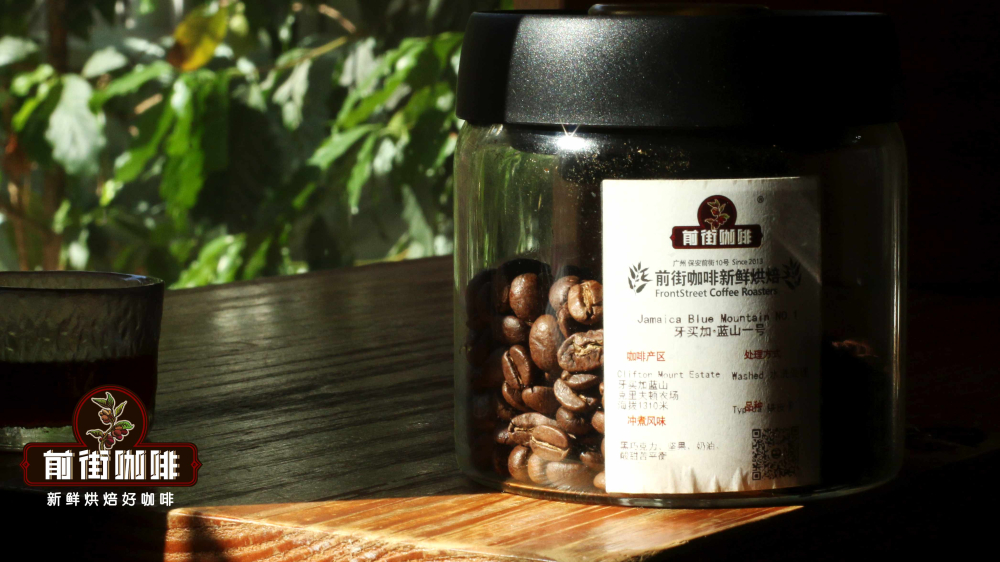
Authentic Blue Mountain coffee beans are all exported in whole-barrel wooden packaging. Buyers can apply to the Jamaican CIB or relevant estates for a certification document as proof of Blue Mountain origin, and such documents can sometimes be seen in specialty coffee shops as well. Taking the commonly available Clifton Estate Blue Mountain No. 1 as an example, its cultivation location is at an altitude of 1310 meters in the Blue Mountains, within the classic elevation band for Blue Mountain coffee. This estate has a long history and is one of the oldest coffee plantations in the Blue Mountain region. The Typica variety planted here has an exceptionally high degree of purity. The coffee beans are meticulously sorted, with a screen size between 17 and 18, and a defect rate controlled below 2%. The beans are plump and uniformly sized.
To fully bring out the richness and layered complexity of Blue Mountain No. 1, roasters typically opt for a medium-dark roast level. This roasting approach allows the coffee beans to undergo moderate caramelization, releasing deep aromas reminiscent of dark chocolate while enhancing the overall body’s fullness and smooth mouthfeel. Over-light roasting may fail to elicit the rich depth of Blue Mountain coffee, while too dark a roast can easily mask its delicate acidity and sweetness balance. Therefore, medium-dark roasting is considered the roasting strategy that best interprets the character of Blue Mountain.
If you want to brew the best flavor of Blue Mountain No. 1 at home, freshness is crucial. It is recommended to choose coffee beans roasted within five days, during which the beans’ flavors are at their peak. In terms of grinding and extraction, it is advised to use a medium-fine grind with a 20-number standard sieve passing rate of 70–75%, paired with a 1:15 coffee-to-water ratio — that is, 15 grams of coffee powder to 225 milliliters of water, with water temperature controlled at around 88°C.
In practice, you can use a Kono filter cup with a three-stage pouring method: first, perform a 30-second bloom with 30 grams of water to activate the coffee grounds; then pour in a slow, circular motion up to 125 grams and pause. When the liquid level is about to expose the coffee bed, proceed with the second pour to reach a total of 225 grams of water. The entire extraction time, including the bloom, is about 2 minutes. This method effectively highlights the layers and rich aroma of Blue Mountain No. 1.
The final brewed Clifton Estate Blue Mountain No. 1 features a flavor profile centered on dark chocolate and nuts, accompanied by a soft creamy texture. It is smooth on the palate with distinct layers. The acidity is bright yet not sharp, the sweetness is naturally full, the bitterness is mild and dissipates quickly, and the overall profile shows a very high balance — making it a classic choice that single-origin coffee enthusiasts should not miss.
The above content is compiled by CoffeeHunters, a coffee news website.


