







Introduction:Did you know that Myanmar also grows coffee? This Southeast Asian country, often in the news for political and economic instability, actually possesses high-altitude mountainous regions ideal for growing Arabica. This article takes you through the origins of Myanmar’s coffee during the colonial period, the UN-backed alternative crop cultivation programs, to its current key production areas primarily in Shan State and Mandalay, while analyzing the variety characteristics and flavor potential of coffees grown by local smallholder farmers. It provides an in-depth reference for coffee enthusiasts eager to explore lesser-known origins.
When Myanmar is mentioned, many people immediately think of telecom scams in northern Myanmar or its unstable political situation. However, few realize that this Southeast Asian nation also has the potential to develop coffee. With its diverse geography and unique microclimates, especially in its high-altitude mountainous regions, Myanmar has become a promising origin for Arabica coffee. This article will start with Myanmar’s geographical background and delve into its coffee planting history, major producing regions, commonly grown varieties, and the current state of industry development—helping readers gain a comprehensive understanding of this relatively niche yet noteworthy coffee origin.
The full name of Myanmar is the Republic of the Union of Myanmar. Located in Southeast Asia, it shares borders with China, India, Thailand, and other countries, covering a vast land area of 676,578 square kilometers. Geographically, Myanmar is higher in the north and lower in the south, featuring a complex terrain of mountains, plateaus, and plains. The northern and western parts are surrounded by mountain ranges, while the eastern region is home to the famous Shan Plateau. With a coastline stretching 3,200 kilometers, Myanmar has a tropical monsoon climate—hot and humid in the summer, with the rainy season concentrated between June and September, and cool and dry in the winter. Particularly in inland high-altitude areas, the significant day-night temperature variation creates ideal environmental conditions for coffee tree growth.
Myanmar’s coffee cultivation history dates back to the late 19th century during British colonial rule, when coffee was introduced along with colonial activities. However, systematic planting truly began in the 1930s, initiated by Catholic missionaries experimenting with coffee cultivation in the northern Shan State region. It wasn’t until the 1980s, under government-led initiatives and in collaboration with the United Nations, that policies substituting illicit poppy cultivation with coffee gradually took shape—providing a more notable impetus for the coffee industry’s development. This initiative not only improved the agricultural structure in certain regions but also laid an important foundation for Myanmar’s coffee industry today.
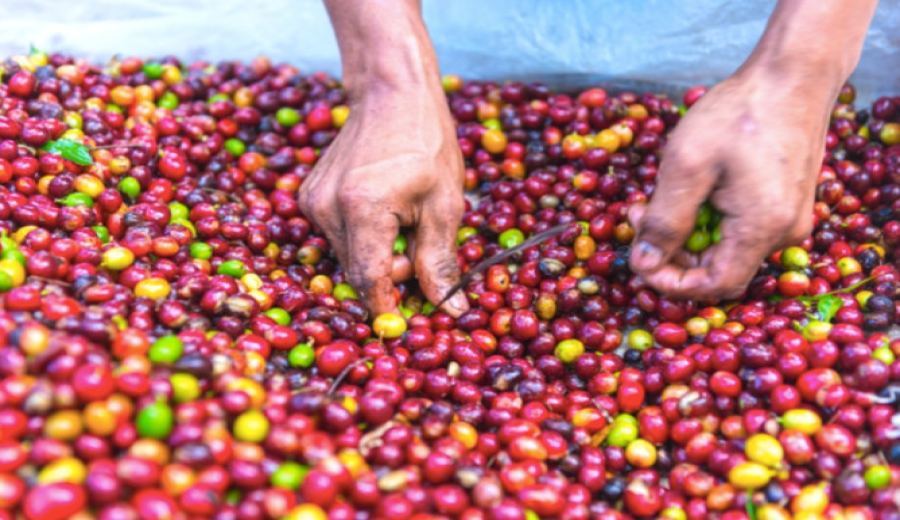
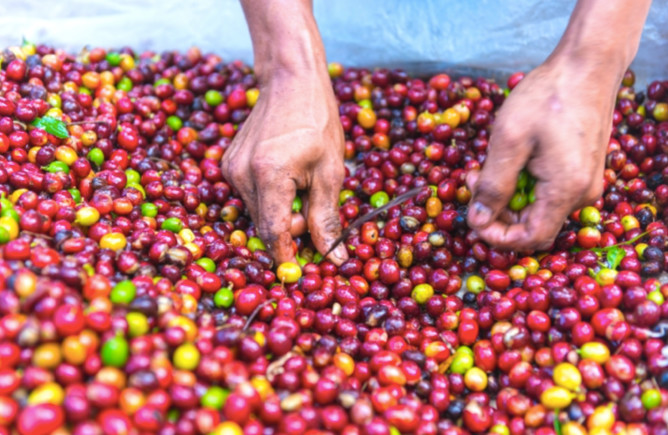
Currently, Myanmar’s coffee production is dominated by small-scale farmers, with the vast majority cultivating on farms smaller than one hectare. Statistics show that approximately 80% of the coffee grown in Myanmar is Arabica, mainly destined for export markets, while the remaining 20% consists of Robusta, largely consumed domestically. Commonly grown varieties include Caturra, Catimor, Bourbon, Typica, S795, and SL34—all of which generally exhibit good cup quality and a strong ability to adapt to high-altitude environments. After harvest, the coffee cherries are manually sorted and graded before being sent to processing stations for further treatment.

Coffee cultivation in Myanmar is primarily concentrated in several specific regions, with Shan State and Mandalay Province being the most significant producers. Located in northern Myanmar and bordering China’s Yunnan Xishuangbanna, Shan State is the country’s largest and most populous state. Surrounded by the Yunnan-Guizhou Plateau and traversed by the Salween River, coffee is grown here at altitudes ranging from 800 to 1,800 meters—an elevation highly suitable for Arabica. In addition to areas such as Nawnghkio, Ye-U, and Pokoktu in Shan State, the Pyin Oo Lwin region of Mandalay Province is also an important production hub. The province features a diverse terrain of plateaus, mountains, and plains. Its soil, enriched by past volcanic activity, is fertile, with elevations mostly between 900 and 2,000 meters, offering varied and favorable growing conditions for coffee.
Beyond these primary regions, other areas such as Chin State, Bago Region, the Tanintharyi Region, and some additional parts of the hilly regions have also gradually begun experimenting with coffee cultivation in recent years, indicating a continuous expansion trend for the coffee industry in Myanmar. Although overall production remains modest, the microclimates and soil conditions of these highland areas hold great potential for developing high-quality coffee.
In terms of the current industry landscape, Myanmar is actively promoting the expansion and upgrading of coffee cultivation. According to data from 2024, the country’s coffee-growing area has expanded to 279,000 acres (approximately 170,000 hectares), with plans to further increase it to 300,000 acres (about 182,000 hectares). The goal is to significantly boost total coffee output within the next five years. These expansion efforts are mainly focused on existing high-quality production zones, while encouraging greater participation from smallholder farmers. Through technical training and infrastructure improvements, the aim is to gradually enhance coffee quality and its international competitiveness.
In summary, although Myanmar is not a mainstream coffee-producing country, its unique geography and climate, along with its high-altitude mountainous cultivation environment, give the Arabica coffee from this region considerable untapped potential. For coffee enthusiasts or readers interested in exploring niche origins, Myanmar coffee is not only an origin rich in stories but also offers the possibility of experiencing a diverse range of flavors.
The above content is compiled by CoffeeHunters, a coffee news website.


