







Introduction:Have you ever seen the label “100% Arabica” in a coffee shop but only had a vague idea of what it actually means? This article delves into the production regions, growing environments, flavor profiles, and market positioning of the world’s three primary coffee species—Arabica, Robusta, and Liberica—to help you truly understand the characteristics of different coffee beans. We’ll also debunk common misconceptions, such as why Blue Mountain refers to a region and not a coffee variety, and what really distinguishes a $10 cup from a $30 one.
Walk into any coffee shop, and you’re likely to see “100% Arabica” on the menu. But Arabica isn’t a specific type of coffee drink—it’s one of the three main coffee species in the world. Besides the well-known Arabica, the other two are Robusta and Liberica (formerly known as Liberian). These three types differ significantly in terms of growing regions, environmental adaptability, flavor characteristics, and commercial use. This article will detail each of their unique traits so you can better understand the story and value behind your cup of coffee.
First, let’s clear up a common misunderstanding: Arabica is a coffee species, not a specific cup of coffee. The coffee beans cultivated around the world mainly fall into three species: Arabica, Robusta, and Liberica. Among them, Arabica accounts for about 60% to 70% of global coffee production, making it the market leader, with many well-known sub-varieties such as Bourbon and Typica. Robusta makes up 30% to 40%, mostly used in commercial blends and instant coffee. As for Liberica, also known as the large-bean variety, it has almost disappeared from the mainstream market due to its rare production (less than 1% of total output), unremarkable flavor profile, and weak disease resistance, appearing only in some research contexts.
Next, we’ll focus on analyzing the two most representative varieties: Arabica and Robusta.
Arabica, also known as the small coffee bean, originates from Ethiopia in Africa. This variety prefers high-altitude environments, typically grown at elevations between 1,000 and 2,000 meters, thriving in areas with an average annual temperature of 15 to 24°C and at least 1,500 millimeters of rainfall. Compared to other varieties, Arabica has stricter growth requirements, being intolerant to cold, pests, and leaf rust. Its coffee trees are medium-sized shrubs with dark green elliptical leaves, usually bearing fruits containing two beans each. These beans are slightly flattened ovals, with a long, slender S-shaped seam in the middle and a smoother back. Its caffeine content is relatively low, around 0.8% to 1.5%.
Precisely because of these growth constraints, Arabica accumulates richer flavor compounds. Whether it’s the pronounced fruity and floral notes of a light or medium roast, or the caramel and chocolate tones of a dark roast, it showcases remarkable complexity. Renowned regions such as Jamaica Blue Mountain, Indonesia Mandheling, Ethiopia Yirgacheffe, and Brazil are all classic representatives of single-origin Arabica coffees. However, Arabica is extremely sensitive to environmental changes and prone to pests and diseases, so farmers often need to invest more effort in varietal improvement and meticulous management.
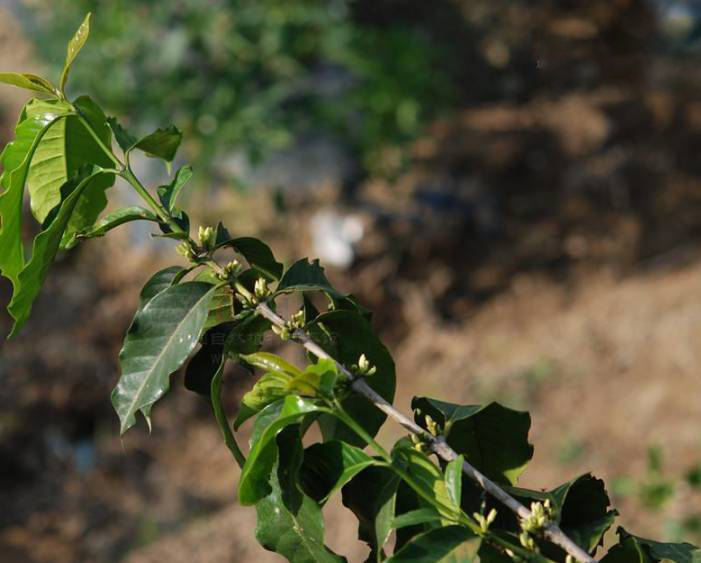
In contrast, Robusta is much hardier. Originating from the Congo region of Africa, Robusta coffee trees can thrive in low-altitude environments, generally growing between 200 and 800 meters. They tolerate higher temperatures (around 24 to 29°C) and can survive with lower rainfall. Robusta trees are taller, some reaching up to 10 meters, with broad, bright green leaves. Their fruit is plump, with seeds that have a vertically split seam and a hard, pebble-like texture. Most importantly, Robusta contains a high caffeine content of 2% to 2.7%, offering stronger disease resistance—especially to leaf rust—far surpassing that of Arabica.
However, these advantages come at the cost of flavor. Robusta usually has a heavier earthy or woody taste, and can even be noticeably bitter and astringent, which is why it’s less favored in the specialty coffee market. Nonetheless, it plays a key role in commercial blends, especially in espresso, where a small amount of Robusta can enhance the coffee’s body and the richness of the crema (coffee foam), giving it a fuller mouthfeel when paired with milk. Many Italian coffee brands carefully balance the ratio of Robusta to Arabica in their blends to achieve the ideal flavor profile.
When it comes to pricing and market positioning, a common question arises: why do some coffees sell for just $10, while others cost $30 or more? The key lies in coffee bean grading. Market-available coffee beans can be broadly divided into two categories: commercial beans and specialty coffee beans. Robusta mostly falls under commercial beans, which are low-cost and primarily used in instant coffee, canned coffee, or mass-market espresso. Their international futures price is about $1,686 per ton, translating to roughly 11.5 RMB per kilogram, hence offering relatively larger profit margins. However, such coffees often lack distinct regional flavor characteristics, with a rather one-dimensional taste, mainly serving as a basic base.
In contrast, specialty coffee beans are typically high-altitude-grown Arabica varieties. Not only are their harvesting and processing methods more meticulous, but they also exhibit various unique layers of fruit acidity, sweetness, and aroma depending on post-harvest processing methods like washed or natural. These coffee beans are usually named after a single origin, such as “Colombia Huila” or “Ethiopia Yirgacheffe,” allowing consumers to experience a distinct “regional personality.” Although pricier, their flavor depth and drinking enjoyment far surpass those of commercial beans.
Finally, let’s debunk two common myths. The first involves “Blue Mountain coffee” and “kopi luwak.” These are both well-known coffee drinks, not coffee varieties. Blue Mountain coffee refers to coffee brewed from Arabica beans produced in Jamaica’s Blue Mountain region, renowned for its balanced flavor and scarce production. Kopi luwak, on the other hand, is a special processed coffee made from beans excreted by civets after consuming coffee cherries, and then collected and processed manually. It’s unrelated to coffee variety.
Secondly, many people mistakenly assume that “Arabica” automatically equals “high-quality coffee,” but that’s not the case. While Arabica is indeed the dominant variety in specialty coffee, not all Arabica coffee qualifies as premium. What truly determines coffee quality are comprehensive factors such as origin, altitude, processing method, and roasting technique. Therefore, when selecting coffee, it’s advisable to pay attention to specific origin names and processing methods, rather than judging solely based on the “100% Arabica” label.
The above content is compiled by CoffeeHunters, a coffee news website.


