








Introduction:Costa Rica is renowned for its eight major coffee-growing regions, each producing uniquely flavored coffee beans due to differences in terrain, altitude, and climate. This article delves into the terroir characteristics of each area, compares washed and honey-processed coffees, highlights the actual performance of Tarrazú washed beans and Brunca Blueberry Anaerobic Heavy Honey beans, and explains in detail the processing steps for white honey, yellow honey, red honey, and black honey. Practical pour-over parameters are also provided to help you find your own preferred coffee flavor.
Costa Rica is an important origin for specialty coffee in Central America, divided into eight main coffee-growing regions across the country: Tarrazú, West Valley, Tres Ríos, Guanacaste, Turrialba, Orosi, Brunca, and Central Valley. These regions produce coffee with distinct flavor profiles due to variations in altitude, microclimate, and soil conditions — ranging from bright fruity notes to rich chocolatey tones. By understanding the natural conditions and processing methods of each region, one can more accurately grasp the origins of coffee flavors.
In Costa Rica, regardless of the region, both the government and industry strictly require only ripe coffee cherries to be harvested to ensure coffee quality. As a result, almost the entire country plants only Arabica varieties, which is also a key reason for the generally stable high quality of its coffee. Among these, planting areas above 1,500 meters in altitude benefit from lower temperatures and significant day-night temperature variations, which help coffee cherries mature slowly and accumulate richer flavor compounds and brighter acidity.

Take the Tarrazú region as an example — it is one of Costa Rica’s most famous coffee-growing areas, located southeast of the capital, San José. It consists of numerous small farms, averaging about 2.5 hectares in size, with a total planted area of approximately 22,000 hectares and an annual production of around 650,000 quintals. Most farms in this region are situated in high-altitude mountain valleys and slopes, enjoying excellent ecological conditions ideal for cultivating high-quality coffee. Tarrazú coffee typically features solid acidity, bright citrus notes, and a finish of dark chocolate and nuts, making it a popular choice for many coffee enthusiasts.
In this coffee shop’s selection, the Tarrazú washed bean is a classic everyday option. It uses the Caturra and Catuaí varieties, grown at altitudes exceeding 1,500 meters, and is graded as SHB (Strictly Hard Bean). The washed processing method effectively removes the pulp layer, making the regional characteristics of the coffee clearer — with bright acidity and a clean taste, suitable for those who prefer refreshing flavors and distinct regional profiles. This bean is usually medium-light roasted, showcasing delicate berry and stone fruit notes, along with a soft chocolatey finish.
Compared to washed processing, honey processing retains some or all of the mucilage (sticky layer) of the coffee cherry. Through varying levels of mucilage retention and drying methods, it imparts a richer sweetness and fruitiness to the coffee. In Costa Rica, honey processing is generally divided into four types: white honey, yellow honey, red honey, and black honey, with the main differences lying in the proportion of mucilage retained and the drying conditions.
White honey processing removes 80% to 90% of the mucilage, and the beans are dried quickly on raised beds at high temperatures. The parchment has a lighter color, and the flavor is closer to that of washed coffee but with slightly enhanced sweetness. Yellow honey retains about 50% of the mucilage and requires drying under moderate sunlight and ventilation, usually taking about a week with 3–4 turnings per day. It offers a balanced flavor with a soft caramel note. Red honey retains 80% to 90% of the mucilage and is usually dried in shaded or low-light environments with less frequent turning, resulting in a more intense flavor, with pronounced sweetness and fruitiness. Black honey retains nearly all the mucilage and is dried slowly in complete shade, sometimes for up to three weeks, creating an extreme level of sweetness and rich berry and wine-like notes.
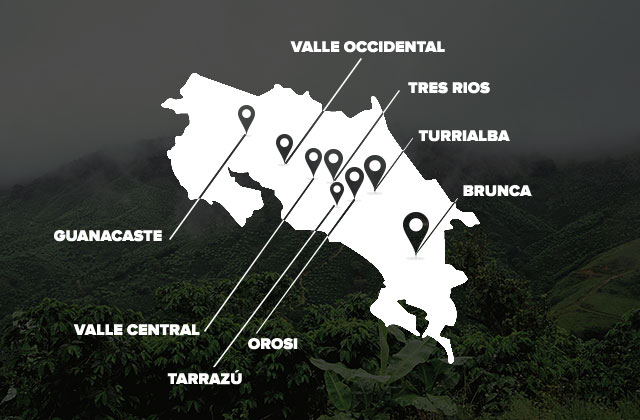
In addition to traditional honey processing, some farms in Costa Rica also adopt anaerobic fermentation techniques to further enhance flavor complexity. For example, the Granja La Esperanza estate in the Brunca region produces a “Blueberry” anaerobic heavy honey-processed bean using an innovative anaerobic fermentation process. This region is located in southern Costa Rica and comprises the cantons of Coto Brus, Buenos Aires, and Pérez Zeledón. Its mountainous terrain, humid climate, and stable temperatures (around 18–26°C) are highly suitable for coffee cultivation.
The anaerobic heavy honey process involves first removing the coffee pulp but retaining the full mucilage layer. The beans are then placed in sealed containers for fermentation in an oxygen-free environment, typically lasting about four days. Afterward, they are moved to raised beds for a lengthy 18-day drying period, during which the temperature must be maintained above 21°C. This technique enhances the layered complexity of flavors and delivers a burst of unique fruitiness and sweetness — making it an excellent choice for advanced coffee enthusiasts looking to explore deeper flavor profiles.
If brewed using the same pour-over parameters, the flavor differences between washed and anaerobic honey-processed beans become clearly apparent. It is recommended to use a V60 dripper, with a water temperature set at 91°C, a brew ratio of 1:15, a coffee dose of 15 grams, and a grind size passing through a Chinese No. 20 sieve at 80%. The specific pour-over steps are as follows: pour 30 grams of water for a 30-second bloom, then pour in a circular motion with a slow stream until reaching 125 grams for the first pour. When the water level is about to expose the coffee bed, continue pouring to 225 grams, then stop. Once the water level drops again and is about to expose the bed, remove the dripper. The total extraction time is around two minutes.
Under these parameters, the Tarrazú washed bean exhibits a clear and clean acidity, with a flavor profile centered on citrus and berries, and a stable dark chocolate finish. The overall profile is balanced and easy to enjoy, making it ideal for daily drinking. In contrast, Brunca’s Blueberry Anaerobic Heavy Honey bean offers intense blueberry and tropical fruit aromas, standout sweetness, gentle acidity, and distinctive wine-like and caramel notes in the finish. With its rich flavor layers, it’s perfect for coffee enthusiasts who enjoy bold fruitiness and unique processing methods.
The above content is compiled by CoffeeHunters, a coffee news website.


