







Introduction:Costa Rican Tarrazú SHB washed beans are renowned for their high altitude and bright, clear acidity, making them a top choice for many pour over enthusiasts. This article delves into the geographical environment of the Tarrazú region, the characteristics of the SHB grade, and offers practical pour over brewing parameters. It also provides a flavor comparison with a blueberry anaerobic honey-processed bean from the Brunca region, helping you understand the differences in aroma, sweetness, and body between washed and honey processed coffees. Additionally, it details the processing methods for white honey, yellow honey, red honey, black honey, and anaerobic fermentation, giving you a comprehensive grasp of the diverse profiles of Costa Rican coffee.
Costa Rican coffee is well known for its clean sweetness and distinct layering, especially excelling in high-altitude regions. This article focuses on one of the country’s eight renowned coffee-growing regions—Tarrazú—and takes an in-depth look at the growing conditions and grading system of its SHB grade washed beans. It also offers useful pour over brewing recommendations, allowing you to replicate origin-level flavors at home.
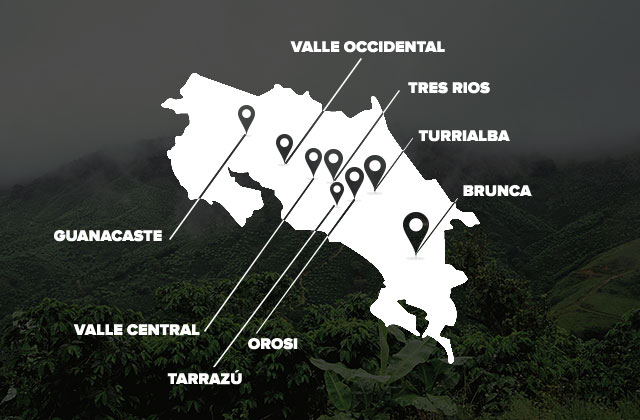
Coffee cultivation in Costa Rica is mainly concentrated in eight designated regions: Tarrazú, West Valley, Tres Ríos, Guanacaste, Turrialba, Orosi, Brunca, and Central Valley. These regions all participate in quality improvement programs, with growers committing to harvesting only fully ripe coffee cherries, ensuring the highest baseline quality before processing. Notably, Robusta is almost non-existent in the country, with the planting focus almost entirely on Arabica.

Among these eight regions, some areas have lower altitudes, but many are located above 1,200 meters, and even higher. Generally speaking, the higher the altitude, the slower the ripening of coffee cherries, allowing more time for flavor compounds to accumulate. This results in brighter acidity and a richer aromatic complexity. The star of this article, the Tarrazú region, has coffee farms predominantly situated in high mountainous areas and small valleys above 1,500 meters, representing a classic high-altitude, fine cultivation environment.
Tarrazú is located southeast of the capital, San José. This area, surrounded by the Pacific mountain range, boasts an outstanding ecological environment and serves as a habitat for numerous rare birds and native forests. Within the region, coffee is primarily grown on high-altitude small valleys and sloped terrain, which facilitates excellent drainage and significant day-night temperature variations—ideal for flavor development. According to statistics, the Tarrazú region produces approximately 650,000 quintals of coffee annually, across a total planted area of about 22,000 hectares. The area is made up of many small farms with an average size of just 2.5 hectares, and around 95% of its exported coffee is graded as Strictly Hard Bean (SHB).
The SHB grade means these coffee beans are grown at altitudes above 1,200 meters. They are hard and dense, not only capable of withstanding high-temperature roasting but also more likely to exhibit sharp, bright acidity and complex aromas. The Costa Rican Tarrazú coffee beans introduced in this article are mainly of the Caturra and Catuaí varieties, grown at altitudes exceeding 1,500 meters, using the washed processing method—making them ideal for pour over lovers seeking classic flavor profiles.
Why choose the washed process? Because the washed method uses fermentation and washing procedures to remove most of the mucilage, highlighting the bean’s inherent terroir characteristics—what we call “regional flavor.” Compared to other processing methods, washed coffee often presents a cleaner, brighter acidity and clearer fruity notes, making it a very suitable choice for those who want to experience the true essence of a coffee-growing region.
Of course, aside from washed processing, Costa Rica has also developed a variety of innovative methods in recent years, among which “honey processing” is extremely popular. Honey processing retains varying degrees of fruit mucilage (pulp), followed by sun drying, imparting the coffee with richer sweetness, body, and unique fruit tones. Honey processing can be further divided into white honey, yellow honey, red honey, and black honey, with each type differing mainly in the amount of mucilage retained and the drying conditions.
White honey processing typically removes 80%–90% of the mucilage. The beans are dried under relatively high temperatures and ample sunlight, resulting in fast drying times. The final parchment appears whiter, and the cup profile is cleaner and crisper, with lower sweetness. Yellow honey retains around 50% of the mucilage, requiring low wind speeds and moderate sunlight during drying, along with turning the beans 3–4 times daily. The entire process may take up to a week, yielding balanced flavors with subtle sweetness. Red honey retains 80%–90% of the mucilage, usually dried at low temperatures in shaded or cloudy conditions, turned only once or twice per day to enhance sweetness and fruitiness. Black honey removes almost no mucilage at all and is dried slowly in shaded and low-temperature environments, sometimes taking up to three weeks. This method produces the most intense and sweetest flavors, along with rich wine-like and fermented notes.
In addition, there is an even more innovative processing method—anaerobic honey processing. This approach combines elements of washed and natural processing by placing depulped beans (with all mucilage intact) into sealed containers for fermentation in an oxygen-free environment, enhancing the formation of specific flavor compounds. After fermentation, the beans are transferred to raised beds in a greenhouse for prolonged sun drying, with temperatures maintained above 21°C. The total drying time can be up to 18 days, depending on climate and altitude. This technique yields uniquely fruity and intensely sweet profiles, representing a highly notable innovation in Costa Rican coffee in recent years.
To directly experience the differences between processing methods, we can compare a washed Tarrazú bean with a blueberry-flavored anaerobic honey-processed bean from the Brunca region. Using a standard V60 filter, set the water temperature to 91°C, with a brew ratio of 1:15, 15 grams of coffee, and a grind size passing through a Chinese No. 20 sieve at 80%—approximately medium-fine. Recommended pour over steps: start with a 30-gram bloom for 30 seconds, then pour in a circular motion with a slow stream until reaching 125 grams for the first pour. When the water level is about to expose the coffee bed, continue pouring to 225 grams, then stop and let it drip naturally. Total extraction time should be controlled around 2 minutes.
In actual tasting, the Tarrazú washed bean displays a classic clean flavor profile, with soft and rounded acidity and subtle dark chocolate notes. The overall mouthfeel is refreshing and balanced—a very typical representation of high-altitude washed Costa Rican coffee. In contrast, the anaerobic honey-processed blueberry bean exhibits a distinctly different personality, with flavors clearly pointing toward blueberry gummy candy, mint herbs, and a blend of various berries. It delivers intense sweetness, a full body, and noticeable fermented wine-like notes, making it ideal for drinkers who enjoy unique and layered flavor experiences.
The above content is compiled by CoffeeHunters, a coffee news website.


