







Introduction:Dirty coffee, with its distinctive visual appeal and layered flavor profile, has become a highly notable coffee beverage in recent years. But what exactly is Dirty? How does it differ from common drinks like lattes or flat whites? This article will delve into the inspiration behind Dirty, its preparation methods, origin story, and how to savor its three-phase flavor transition. We’ll also provide practical parameters and debunk common misconceptions to help you better understand this “dirty” yet logically delightful coffee.
The combination of espresso and milk has long been a source of inspiration in Italian-style coffee creations, and Dirty coffee is one of the most talked-about examples. Though it may appear to be just a simple iced small latte, Dirty actually features a unique layered structure and drinking strategy. From the dynamic sight of coffee cascading down to the shift from hot to cold and intense to mild upon sipping, every mouthful is full of surprises.
The preparation of Dirty isn’t complicated, but every step affects its final visual and taste performance. Taking common preparation parameters as an example, a pre-chilled glass cup with a capacity of about 200 milliliters is typically used, into which 160 to 170 milliliters of iced milk is poured first. If there are noticeable bubbles on the surface, it is recommended to gently skim them off with a spoon to ensure the coffee can smoothly flow in and form a clear layer. Next, the cup is placed directly under the coffee machine’s group head, allowing the extracted espresso to slowly drip onto the iced milk. It’s important to note here that the cup should be as close as possible to the spout of the portafilter to avoid strong liquid impact that could cause the coffee and milk to mix instantly, thereby disrupting the layered effect.
The origins of Dirty can be traced back to Tokyo, Japan, in 2009. At that time, barista Katsuyuki Tanaka opened a shop called Bear Pond Espresso in Kita-Shimokita, and Dirty was one of the shop’s signature drinks, listed on the menu as B.P Dirty. Katsuyuki Tanaka created a unique espresso recipe for this coffee—“Angle Stain (Angel’s Stain)”—and used a bottomless portafilter for extraction, allowing him to visually observe the flow rate and color to judge the extraction status. This technique causes the espresso to leave tear-like traces on the inner wall of the cup as it falls in, adding to the visual layers. Additionally, he used dark roasted beans, a high dose of coffee grounds, extremely high concentration, and a relatively low extraction rate, which made the double shot espresso descend slowly. Even without pre-chilling the cup, it could still maintain good layering.
Although Dirty originated in Japan, its true popularization and evolution occurred in Hong Kong and later on the Chinese mainland. As early as 2014, some cafes in Beijing, inspired by Hong Kong baristas, had already launched similar layered coffees. These were referred to by various names at the time, such as “Amber,” “Stain,” “White Night,” and “Dirty Coffee,” but they remained niche. It wasn’t until 2018–2019, with the explosive popularity of “dirty”-themed foods like dirty toast, that Dirty quickly captured consumer attention due to the visual tension created by “hot espresso dripping onto cold milk,” becoming a popular drink for social media photos.
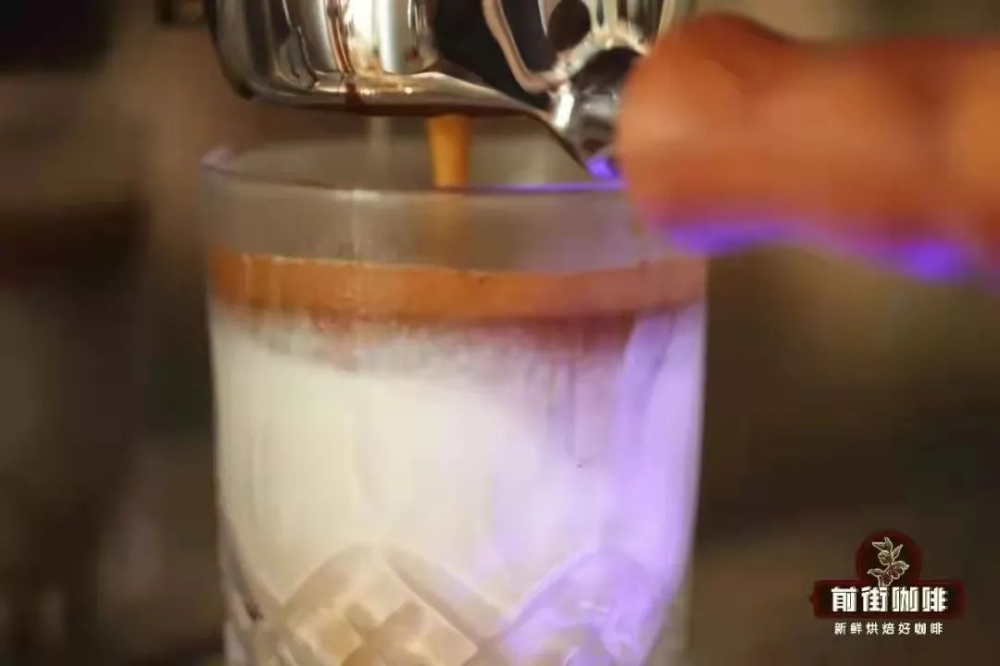
The widespread appeal of Dirty isn’t solely due to its eye-catching appearance. First, it aligns with the visual logic of viral drinks—using the contrast between espresso and iced milk to create a “dirty” visual effect, a design that was highly novel at the time. Second, Dirty makes up for the visual monotony of traditional iced coffee. Standard transparent iced coffee cups often only display a gradient from golden to brown, while Dirty showcases the process of espresso slowly seeping into milk, resulting in a dynamic and layered image that’s perfect for sharing on social media.
Most importantly, Dirty offers a highly varied tasting experience. A standard serving of Dirty can usually be finished in just three to four sips, yet each sip delivers a different flavor transition. The first sip is typically the freshly extracted hot espresso, carrying a strong coffee aroma and slight heat, mixed with a small amount of the upper layer of iced milk, offering a direct and vivid taste; the second sip enters the blend zone of espresso and milk, where the flavors tend to balance out, often delivering a rich milk-chocolate-like profile; by the third sip, what remains is mostly cool milk with faint lingering notes of coffee. Since no ice cubes are added to dilute it, the overall flavor remains rich and full-bodied, with a clear transition from hot to cold and from bitter to sweet, showcasing pronounced layering.
In summary, although Dirty shares the same base ingredients as common drinks like lattes and flat whites—espresso and milk—it differs significantly in cup size, temperature design, and drinking method. Lattes generally use hot milk, have a larger cup size (commonly over 300 milliliters), and emphasize a smooth, integrated taste; flat whites have a smaller cup size (around 200 milliliters), with a slightly lower milk ratio and higher temperature, focusing on the close bond between espresso and milk; Dirty, on the other hand, primarily uses iced milk, highlights the contrast between hot espresso and cold milk, and is designed for short-term consumption to deliver a layered tasting experience. It’s a coffee choice that combines both visual and flavor enjoyment.
The above content is compiled by CoffeeHunters, a coffee news website.


