








Introduction:As one of the classic Italian-style coffees, cappuccinos often spark curiosity among coffee enthusiasts regarding the name of their serving cup, standard capacity specifications, and the differences between dry and wet versions. This article delves into the professional terminology for cappuccino cups, analyzes their standard capacity range, compares the texture and taste differences between dry and wet cappuccinos in terms of milk foam, and shares practical tips to help you master the formation of the golden crema ring—enhancing your home brewing quality.
Have you ever wondered why cappuccinos are served in specific cups? Or why some people insist on a “dry” version while others prefer it “wet”? It all goes back to the history and technical development of the cappuccino. With the advent of steam milk frothing technology, people were able to produce fine, dense milk foam while heating milk for the first time, laying the foundation for the later popularization of espresso machines.
It is said that when this rich layer of milk foam covers the dark espresso, its appearance and color resemble the brown habits worn by the Capuchin friars of the Catholic Church, hence the name “Cappuccino,” which is the cappuccino we know today. This is the most widely circulated explanation for the origin of the cappuccino’s name.

Compared to lattes and flat whites, the most notable difference of a cappuccino lies in its milk ratio. Generally, a cappuccino uses less milk, allowing the flavor of the espresso to stand out more prominently—this is also why many coffee lovers are fond of it. However, preferences for the ratio of milk foam to milk can vary greatly among consumers.
Not long ago, at a certain coffee shop, a customer made a special request—they wanted a “dry” cappuccino rather than a “wet” one, and emphasized the presence of a distinct golden crema ring. This sparked further discussion on the differences between the dry and wet versions.
First, let’s clarify the professional name for a cappuccino cup. In Italian coffee culture, such cups are commonly referred to as a “Cappuccino Cup,” but in professional settings, depending on capacity and design purpose, they may also be called an “Espresso with Milk Cup” or a “Traditional Cappuccino Mug.” Their primary design purpose is to hold a shot of espresso along with an appropriate amount of steamed milk and milk foam, with standard capacities typically ranging between 150 to 180 milliliters .
As for the difference between “dry” and “wet” cappuccinos, it mainly lies in the thickness of the milk foam and the proportion of milk. A “dry” cappuccino uses less milk and thicker milk foam, sometimes almost filling the cup entirely with foam, making the coffee flavor more concentrated and the taste crisper. On the other hand, a “wet” cappuccino uses more milk and finer, thinner milk foam, resulting in a smoother texture and an overall drink that is closer to a latte, though still with a lower milk ratio than a standard latte.

In practice, to make a standard cappuccino, it is recommended to use one shot of espresso (about 30 milliliters), paired with 60 to 80 milliliters of steamed milk, along with an appropriate amount of milk foam to bring the total liquid level to approximately 150–180 milliliters. The milk foam ratio in a dry cappuccino will be higher, potentially even exceeding one-third of the total liquid volume; whereas in a wet cappuccino, the foam is thinner, allowing the milk flavor to be more pronounced.
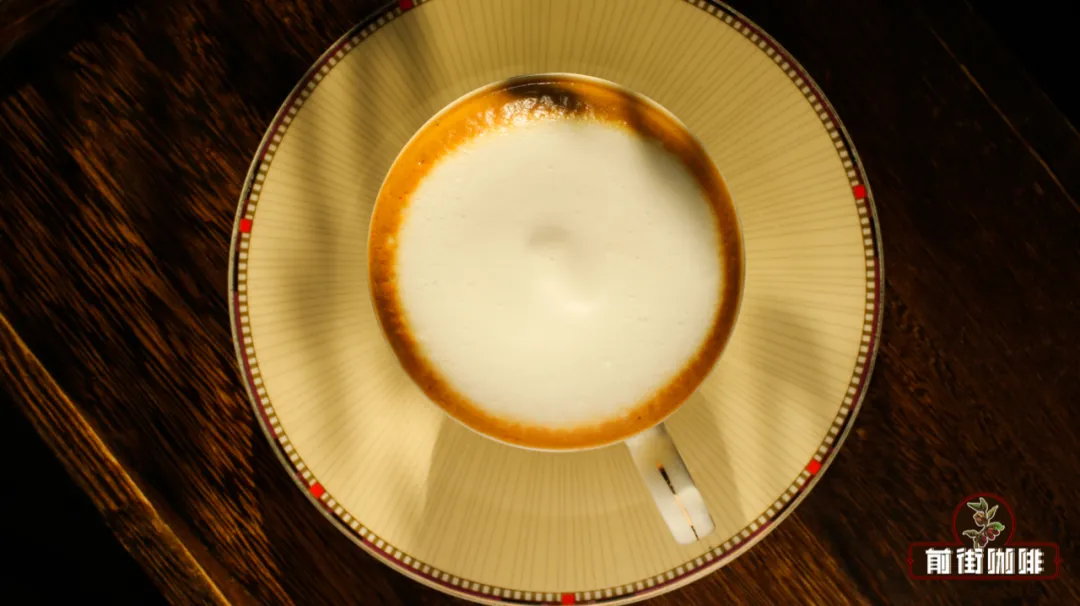
Additionally, the “golden crema ring” that many coffee lovers strive for refers to the golden-hued oily halo at the boundary between the espresso and the milk foam. This is actually the result of the interaction between coffee crema and milk foam. To achieve a distinct golden crema ring, besides using freshly roasted high-quality coffee beans, it’s also important to maintain stable pressure and water temperature during extraction to ensure the quality of the crema.

If you wish to try making a cappuccino at home, it is recommended to choose a ceramic cup with a wide, thick rim and moderate depth—not only does it help retain heat, but it also highlights the layers of the milk foam. Temperature control is equally crucial; the ideal temperature for steamed milk should be between 55°C and 65°C . Temperatures that are too high can affect flavor, while those that are too low may result in poor mouthfeel.
In summary, although there are various terms for a cappuccino cup, its core purpose and standard capacity remain largely consistent. The differences between the dry and wet versions mainly stem from the ratio of milk foam to milk, which in turn affects taste and flavor presentation. No matter which you prefer, mastering the basic parameters and techniques will allow you to enjoy a cappuccino close to professional standards at home.



The above content is compiled by CoffeeHunters, a coffee news website.


