








Introduction:Want to brew rich and captivating espresso-style coffee at home with your Bialetti Moka Pot? This beginner-friendly guide not only explains the essential techniques such as operating the Moka Pot, water-to-coffee ratio, and heat control, but also teaches you how to choose the right coffee beans and avoid common mistakes. It even recommends a freshly roasted Italian-style blend to help you easily extract a layered and crema-rich coffee experience.
The Bialetti Moka Pot has long become a go-to brewing tool for many coffee enthusiasts at home, thanks to its uniquely intense extraction flavor. However, what seems like a simple process—adding water, placing coffee grounds, and heating—actually involves multiple details. Improper operation can not only affect the final flavor of the coffee but may also pose potential safety risks. This article will comprehensively introduce the usage process of the Moka Pot, step-by-step analyzing everything from water level settings, grind size, and heat intensity to safety precautions, making it easy for beginners to get started with confidence. It also delves into the characteristics of coffee beans that suit the Moka Pot, and recommends a well-balanced, fresh, and beginner-friendly Italian-style blend to help you successfully brew a fragrant and crema-rich cup.

In recent years, the BIALETTI Moka Pot from Italy has rapidly gained popularity among coffee lovers around the world. Both professional baristas and home users have added it to their essential gear. The operating principle of the Moka Pot is quite intuitive: by heating the water in the lower chamber, the liquid turns into steam, creating enough pressure to force the hot water through the coffee grounds packed in the middle filter basket, ultimately pushing it up into the upper chamber to form a cup of coffee with rich aroma and enticing crema.
To successfully use the Moka Pot and extract an ideal-flavored coffee, the primary task is to master the correct operation process. Generally, the coffee brewed with a Moka Pot tends to have a richer body, so medium to dark roasted coffee beans are particularly suitable. These beans usually have intense flavors and can better showcase a full-bodied taste profile. However, please note: the beans must be fresh. Only coffee beans at their optimal freshness window can fully release their oils and aromas. For beginners, it’s recommended to first choose medium to dark roasted beans that have been recently roasted, as this makes it easier to successfully achieve the desired crema expression.

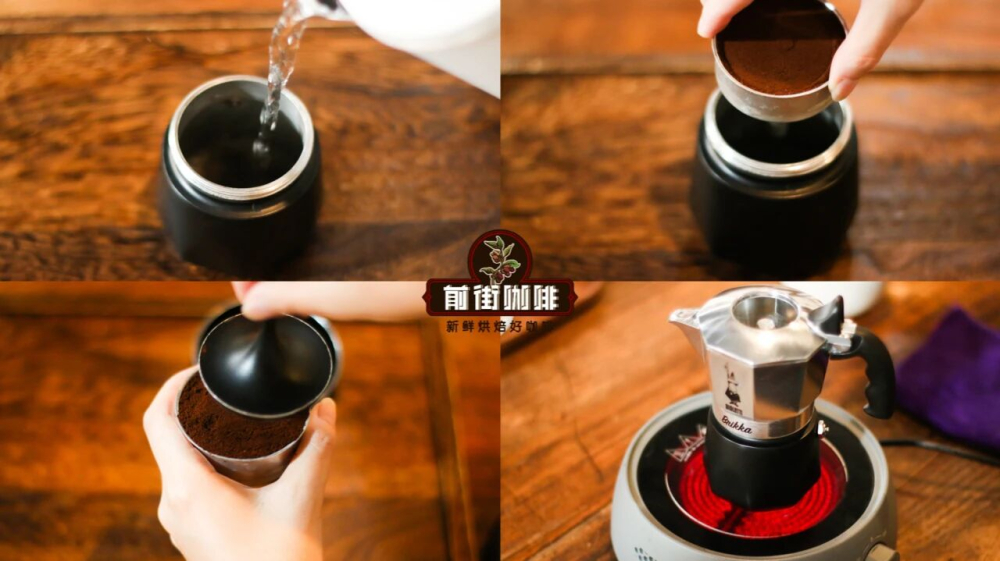
For preparation, you’ll need: a Bialetti Moka Pot (including both the upper and lower chambers), a heating tool (such as an induction or gas stove), freshly roasted coffee beans, a grinder, and clean water. First is the water filling step—pour cold water into the lower chamber, but make sure to keep about 0.5 cm of distance between the water surface and the pressure relief valve. This is to prevent the water from directly contacting the valve, which could prevent proper pressure release and increase the risk of explosion. The pressure relief valve is a crucial safety component of the Moka Pot. If the water level exceeds the valve opening, its function will fail, easily leading to danger.
Next, pour the pre-ground coffee into the filter basket. It’s recommended to gently tap the basket to evenly distribute the grounds. If there’s a noticeable mound on the surface, you can lightly level it, but do not tamp it down. Filling the basket to the brim helps reduce the likelihood of off-flavors during extraction. After filling the basket, tightly screw the upper and lower chambers together to ensure a good seal. Then place the Moka Pot on the heating device and start heating withhigh heat.

As the temperature gradually rises, when you begin to hear a distinct “wuu wuu” sound, it means the pot has reached the appropriate pressure and temperature for extraction. At this point, it is recommended to reduce the heat to low or medium-low, and you can slightly lift the upper chamber lid to observe the extraction. When the coffee liquid in the upper chamber reaches about half of its total capacity, you can turn off the heat. At this stage, you can move the Moka Pot to a table (it’s recommended to place a damp cloth under the base to insulate residual heat), allowing the remaining pressure and heat inside the pot to steadily push the rest of the coffee into the upper chamber, completing the entire extraction process.
Once done, you can pour the coffee into a cup and enjoy. Since Moka Pot coffee is usually bold and strong, if you prefer a milder taste, you can adjust it to your liking by adding hot water or milk. If you have a milk frother at home, you can even try making latte art for added fun.
A special reminder: when choosing grind size, the coarseness needed for the Moka Pot differs from that of a standard espresso machine. Since the pressure in a Moka Pot is far lower than the 9 bar in an espresso machine, grinding the coffee too fine can obstruct water flow, not only reducing extraction efficiency but also potentially causing dangerous levels of pressure. If you notice that no coffee liquid flows out after heating for a while, stop heating immediately to prevent accidents. Conversely, if the grind is too coarse, the water will flow too quickly, resulting in a weak-tasting coffee or even under-extraction. It is recommended to adjust the grind to a fineness similar to fine salt , roughly between scale 3 and 3.5 on an EK-43s grinder. This range provides moderate resistance, helping to stably extract a balanced and flavorful coffee liquid.
The above content is compiled by CoffeeHunters, a coffee news website.


