








Introduction:Yunnan’s small-bean coffee has garnered significant attention in recent years, with the Catimor variety being the main driver of production in the region. This article delves into the background of Catimor’s introduction, its botanical characteristics and cultivation distribution, explores its flavor profile and processing methods, and combines practical washed processing and V60 pour-over parameters to help you master the brewing essentials and flavor profile of this coffee. It’s an essential beginner’s guide to understanding Yunnan coffee.
Yunnan coffee is gradually carving out a place in China’s specialty coffee landscape, and the dominant variety in this rise is none other than Catimor. This article will start with the introduction history of the variety, analyzing its genetic origins and cultivation advantages, while also discussing its performance in Yunnan’s major producing regions—especially in areas like Baoshan with ideal altitude conditions. We will also detail its washed processing method and provide practical V60 three-stage pour-over parameters and flavor evaluations to help coffee enthusiasts fully grasp the representative qualities of this small-bean variety.

With the rise of the domestic coffee consumption market, coffee beans produced in Yunnan have gradually entered the public eye, becoming a top choice for many beginners trying coffee for the first time. Walk into any specialty coffee shop, and you’ll often find Yunnan beans featured on their recommended lists. This article will focus on the most representative variety of Yunnan’s small-bean coffee—Catimor—and take you from the origin of the variety to practical brewing applications, giving you an in-depth understanding of the true character of this domestically produced coffee.
The birth of Yunnan’s small-bean Catimor can be traced back to the early 20th century. In 1904, a French missionary planted the first coffee trees in Zhukula Village, Binchuan County, Yunnan, marking the beginning of China’s coffee cultivation history. In 1952, the Yunnan Academy of Agricultural Sciences introduced seedlings in Ludianba, Baoshan, starting small-scale trials. True large-scale development began in 1988 after Nestlé established a joint venture in Yunnan, leading to rapid expansion of local coffee cultivation. In the same year, the Dehong Tropical Agriculture Research Institute in Yunnan introduced the Catimor variety from Portugal’s Coffee Leaf Rust Research Centre, and it was successfully trialed in Pu’er in 1990. Thanks to its excellent disease resistance and high yield potential, Catimor gradually became the dominant variety in Yunnan coffee, occupying the vast majority of cultivated areas to this day.
Global coffee varieties can generally be divided into two main categories: Arabica and Robusta. Arabica, with smaller beans, is also known as small-bean variety, while Robusta is relatively robust, with strong disease resistance but a simpler flavor profile. Early Yunnan cultivation mainly focused on traditional Arabica varieties such as Typica and Bourbon, but later shifted to Catimor to improve yield and stability. In fact, what is referred to today as “Yunnan small-bean” mostly means Catimor.
Catimor is a hybrid of the Timor variety (which has Robusta genes) and Caturra (a Bourbon mutation), with approximately 25% of its genome derived from Robusta. This hybrid characteristic gives Catimor a compact and short tree structure, with dense branching that is suitable for close planting—even without shade, it can grow healthily. More importantly, it exhibits high resistance to common diseases such as leaf rust, has a high fruit-setting rate, and a short maturation period, making it a highly economical choice for coffee farmers.
However, Catimor’s Robusta genes also bring certain challenges. When grown at low altitudes, it can easily result in pronounced bitterness, astringency, or even moldy off-flavors. Even at higher altitudes (above 1200 meters), its aroma complexity is generally still inferior to pure Arabica varieties such as Caturra or Catuaí. Therefore, to bring out the best flavors in Yunnan Catimor, rigorous cultivation management and refined green bean processing techniques are required.
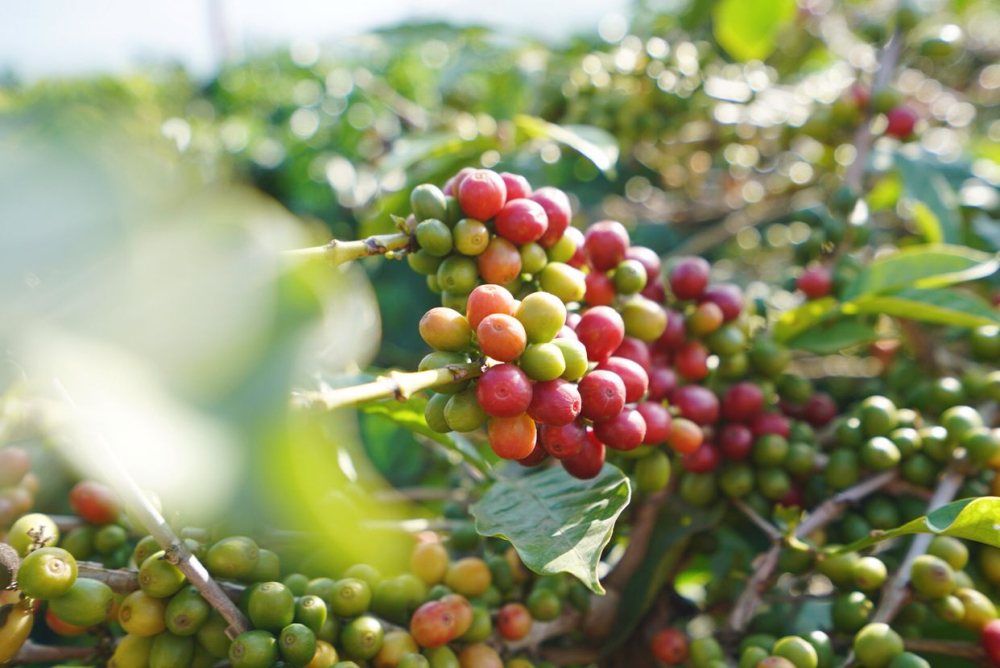
Currently, Yunnan Catimor is mainly distributed in Pu’er, Baoshan, Dehong, and Lincang. Among these, Baoshan has the longest history of small-bean coffee cultivation. As early as the mid-1950s, large-scale coffee planting began in the Nu River Valley of Ludianba, Baoshan. The terrain here is mainly hilly, with altitudes ranging from about 800 to 1800 meters—very suitable for coffee growth. Ludianba is located in a subtropical monsoon climate zone, with abundant sunlight and rainfall, plus a significant diurnal temperature variation, which helps coffee cherries accumulate flavor compounds. The local average annual temperature is around 21.5°C, with almost no frost, providing an ideal growing environment for coffee. Generally speaking, the higher the altitude, the slower the coffee cherries mature, and the more concentrated the flavors become. For example, in Baoshan’s high-altitude areas of around 1200 meters, the harvest season mostly falls between October and November each year.
Due to the long rainy season and unstable sunlight conditions, coffee producers in the Yunnan region mostly adopt the traditional washed processing method. This process first removes the outer skin of the harvested coffee cherries, then soaks them in water tanks for fermentation. The acidity generated during fermentation effectively breaks down the mucilage layer, and residual mucilage can then be removed by manual brushing. Finally, the parchment beans are evenly spread on drying beds until their moisture content drops to standard levels before packaging and storage. Washed processing not only improves cleanliness but also helps highlight the intrinsic flavor characteristics of the coffee, especially suitable for producing regions like Yunnan where sunlight and climate conditions vary.
In terms of flavor profile, Yunnan Catimor doesn’t rely on prominent acidity, but instead presents a balanced taste structure. Well-known roasters often use a medium roast approach when processing this bean—preserving some gentle fruity acidity while enhancing the sweetness of nuts and caramel, resulting in a smoother and more approachable overall flavor. In terms of competition-grade quality, Catimor may be hard to match with pure Arabica varieties, but under reasonable cultivation and refined processing, it can still showcase representative characteristics of Yunnan.
Given Catimor’s relatively flat flavor layers, it is recommended to enjoy it as a hot beverage, especially avoiding the earthy or off notes that might emerge if left sitting too long. To achieve optimal extraction, it’s suggested to use freshly roasted beans within 4 to 7 days of roasting, when aroma and flavor are at their peak. Merchants strictly control the time from roasting to release, ensuring consumers experience the coffee at its most vibrant.
In terms of brewing equipment, the V60 is highly suitable for extracting Catimor due to its fast flow rate and excellent layering performance. Its spiral ridges help extend contact time between coffee grounds and water, and guide the water flow toward the center as the water level drops—enhancing extraction uniformity through gravitational pressure. It is recommended to use a medium-fine grind (approximately 80% passing rate through a Chinese No. 20 standard sieve), with a water temperature of 90°C, and a 1:15 coffee-to-water ratio for a three-stage V60 pour-over. This approach avoids over-extraction while fully highlighting its nutty and chocolatey base tones.
Recommended parameters for V60 three-stage pour-over: Use 15 grams of coffee, a 1:15 coffee-to-water ratio, 90°C water temperature, and a medium-fine grind (80% passing rate through a Chinese No. 20 sieve). Operation steps: Begin with a 30-second bloom using 30 grams of water; then pour in a small circular motion until you reach 125 grams, then pause; once the water level drops to just above the coffee bed, pour again to reach 225 grams, then stop; finally, remove the filter just before the water level is fully drained, with total brew time controlled around 2 minutes. This setup helps balance sweet, sour, and bitter notes, presenting a subtle plum-like acidity with a caramel aftertaste—offering a well-rounded and easy-drinking cup.
In summary, although Yunnan’s small-bean Catimor is limited by its genetics in terms of flavor complexity compared to some Arabica varieties, with appropriate regional selection, rigorous washed processing, and proper brewing methods, it can still showcase unique regional characteristics and drinking value. Whether you’re a coffee beginner or someone looking for a reliable daily brew, Yunnan Catimor is definitely worth a try.
The above content is compiled by CoffeeHunters, a coffee news website.


