







Introduction:The French press is the starting point for many coffee beginners entering the world of pour over brewing, thanks to its simple operation and lack of complicated equipment. This article delves into the historical background and design principles of the French press, explores what types of coffee beans it pairs well with, and uses the classic Huakui coffee beans as an example to provide complete brewing parameters and steps. It also compares the differences between the French press and pour over in terms of grind size, water temperature, coffee-to-water ratio, and steeping time, helping you avoid common issues like over-extraction or under-extraction, and easily brew rich, full-bodied coffee at home.
For many people who enjoy drinking coffee but don’t want to invest in a bunch of specialized equipment, the French press (French Press) may be the most approachable and practical choice. It doesn’t require a pour over kettle, filter dripper, or thermometer—just a kettle of hot water and the right amount of coffee grounds can brew a cup of flavorful coffee. But do you know which types of coffee beans suit the French press? And how should you adjust the grind coarseness and water temperature to avoid the coffee becoming overly bitter and astringent?
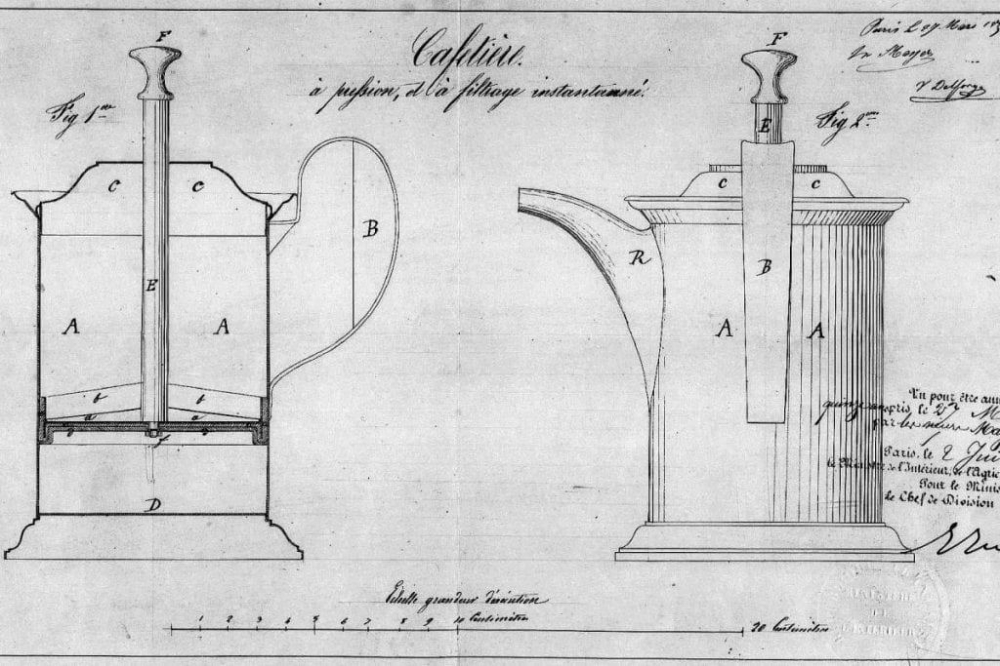
The French press can be traced back to the mid-19th century, when a craftsman and businessman jointly applied for a patent for a “piston-filter coffee device.” This device featured a metal canister with a movable rod inside, connected to a filter at the bottom. By manually pressing down, it separated the coffee grounds from the liquid, resulting in clearer brewed coffee. Over time, by the 20th century, a company in Milan, Italy, further refined the design, establishing the basic shape of the French press we know today.
Interestingly, the French press was originally mainly used for brewing tea. Traditional tea infusers have larger holes compared to coffee filters, and it wasn’t until later that it gradually came to be used for coffee brewing. Precisely because of its ease of use, even without a professional coffee machine, you can still enjoy a cup of coffee with a rich texture and complete flavor profile at home.
Coffee brewed with a French press typically has a fuller body and deeper mouthfeel, making it ideal for showcasing the multi-layered flavors of medium to light roasted coffee beans. Below, we’ll use a widely praised Ethiopian Huakui coffee bean as an example to explain how to achieve the ideal flavor using a French press, and analyze the key parameters and points to note.
The Huakui coffee beans come from the Hambela region of Ethiopia’s Guji zone, processed by the Buku Abel washing station using the natural (sun-dried) method. In 2017, these beans won the sun-dried category championship at the local TOH (Taste of Harvest) competition with their intense strawberry cream flavors, catching the attention of domestic green coffee bean merchants. After being introduced, they were named “Huakui,” symbolizing “the queen of all flowers.” Notably, in the same year’s China Coffee Brewing Championship, contestant Li Jianfei used these beans to achieve second place as a dark horse, defeating many competitors using the Geisha variety, instantly making Huakui famous.
The Huakui coffee beans are released annually in versions like “Huakui X.0”—for instance, Huakui 2.0 in 2018, 3.0 in 2019, up to 5.0 in 2021, with Huakui 6.0 planned for 2022. The currently commonly available versions are Huakui 5.0 and Little Huakui. The latter is a specially treated version by DW Company focusing on smaller beans, offering a more concentrated aroma profile, and is quite popular among coffee enthusiasts.
One brand conducted a cupping comparison between Huakui 5.0 and Little Huakui, finding that Little Huakui is closer to the original sun-dried champion batch’s strawberry cream characteristics, while Huakui 5.0 showcases the citrus, berry, and tea-like flavors commonly found in the Guji zone—suitable for drinkers who enjoy refreshing acidity, sweetness, and layered profiles.
Although you can easily enjoy flavor-rich Huakui coffee in cafes, brewing it at home with complex pour over methods often makes it difficult to reproduce the same results. As a result, many coffee beginners turn to the simpler French press brewing method. However, how to avoid brewing coffee that’s too bitter or astringent remains a common concern.
Below are the recommended parameters and steps for brewing Huakui coffee with a French press, suitable for beginners:
Brewing Equipment:French Press
Water Temperature:90°C (recommended range 88–92°C)
Coffee Dose:15 grams
Coffee-to-Water Ratio:1:15 (i.e., 15 grams of coffee grounds to 225 milliliters of water)
Grind Size:Approximately 70% passing through a Chinese standard No. 20 sieve—relatively coarse, similar to sea salt texture
Steps are as follows:
1. Pour hot water into the French press to preheat it, then discard the water after about 10 seconds to keep the brewer warm.
2. Add 15 grams of coffee grounds, then immediately pour in 225 grams of 90°C hot water, ensuring the coffee grounds are evenly saturated.
3. Place the lid on the French press but do not press down. Let it steep for about 4 minutes.
4. After 4 minutes, gently and slowly press the plunger down to about one-quarter of the way, then pour out and enjoy the coffee.
This brewing method fully highlights the characteristics of a medium-light roast Huakui coffee, bringing out pronounced berry aromas and a creamy smooth mouthfeel, delivering a rich yet layered flavor.
Why does the French press require a coarser grind than pour over? The key lies in extraction time and method. The French press relies on prolonged steeping and higher water temperature to extract flavors. If the grind is too fine, the increased surface area of coffee grounds in contact with water can lead to over-extraction, resulting in noticeable bitterness and astringency. Conversely, if the grind is too coarse, extraction may be insufficient, leaving the coffee tasting weak and overly acidic.
In addition, pour over coffee typically uses a finer grind (such as 80% or higher passing through a No. 20 sieve), paired with pulse pouring techniques to complete extraction within a short period, hence achieving clarity of flavor even with finer particles. The French press, however, is a full immersion brewing method with a 4-minute steeping time, so grind coarseness and water temperature must be adjusted to strike a balance.
In summary, as long as you master the correct grind size, water temperature, and steeping time, the French press isn’t just a great choice for beginners—it can also consistently produce richly flavored, full-bodied coffee. Why not start with Huakui coffee beans to experience the unique charm of the French press?
The above content is compiled by CoffeeHunters, a coffee news website.


