







Introduction:Brazil is the world’s largest producer of Arabica coffee, renowned for its full-bodied, low-acid profile with nutty and chocolatey notes, making it a key component in espresso blends. This article delves into Brazil’s major coffee-growing regions such as Sul de Minas and Cerrado, analyzes the varietal differences between Red Bourbon and Yellow Bourbon, explores the region’s unique pulped natural processing method, and provides practical pour over brewing recommendations and parameters to help you fully grasp the characteristics of this classic coffee.
When it comes to Brazilian coffee, many people are first introduced to it through espresso blends. As the country with the highest global production of Arabica coffee, Brazilian beans are celebrated for their stable flavor profile, low acidity, and rich nutty and chocolatey notes. Their affordability also makes them a staple in café espresso recipes.
The history of coffee cultivation in Brazil dates back to the 1720s. At that time, Portuguese Captain Francisco de Mello Palheta successfully introduced coffee seeds from French Guiana, and coffee began to take root in this land. Initially consumed only domestically, Brazil gradually shifted to large-scale production as coffee demand surged following the American Revolutionary War. By 1850, coffee exports accounted for more than half of the country’s foreign trade, becoming one of its economic pillars.
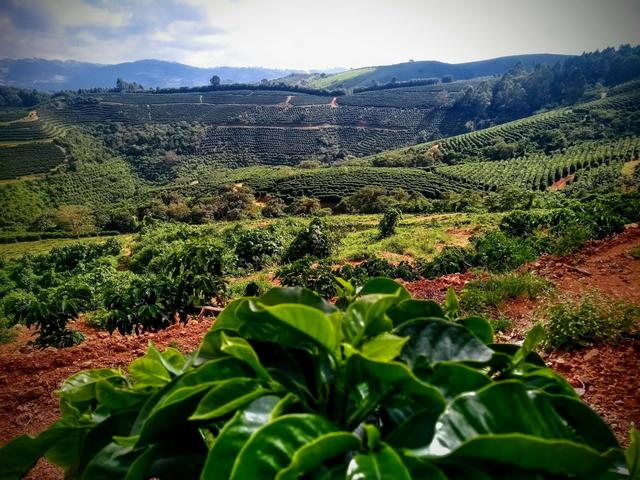
Brazil’s relatively flat terrain and generally low altitude do not favor the formation of complex microclimates, so shade-free, sun-exposed cultivation is commonly practiced. This environment gives Brazilian coffee its “soft bean” style: gentle acidity, intense nutty and chocolate flavors, and a full body, though floral and fruity notes are less pronounced. These balanced and unassuming traits make Brazilian beans a preferred choice for the dark roast component in espresso blends. For instance, in many popular espresso recipes, Brazilian coffee often makes up the largest proportion to stabilize the foundational flavor profile.
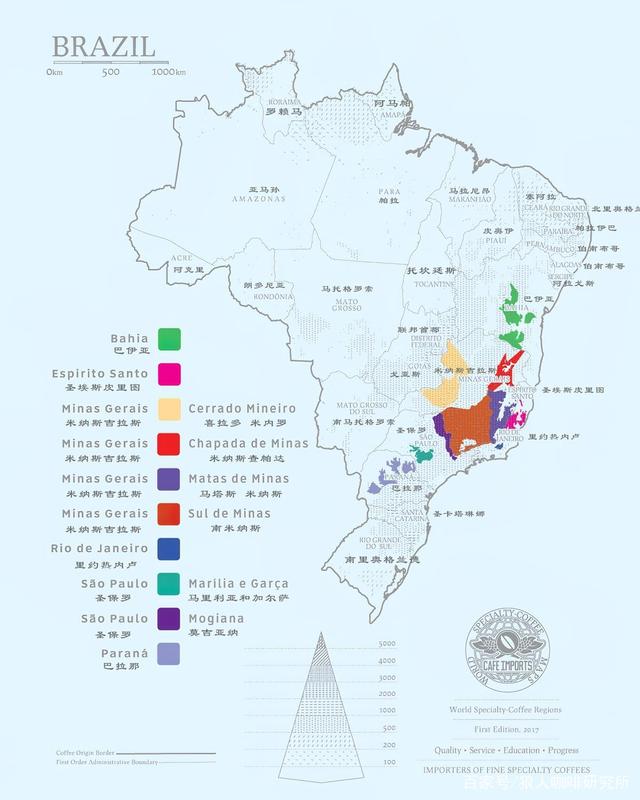
Brazil’s main coffee-growing regions are concentrated in the central and southern parts of the country, spanning seven states and encompassing around 14 well-known producing areas. Among them, Sul de Minas and Cerrado stand out due to their higher altitudes and ability to produce a significant amount of specialty-grade coffee.
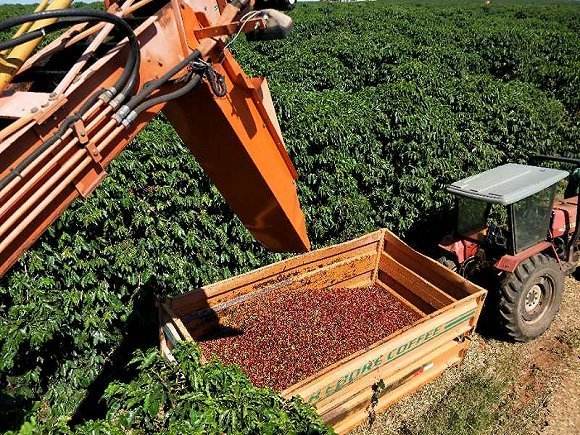
The Sul de Minas region sits at an altitude between 700 and 1200 meters, featuring mainly hilly terrain, and is one of Brazil’s oldest coffee-growing areas. Its varied topography and microclimates above 1100 meters are particularly suitable for high-quality Arabica varieties. Additionally, to improve efficiency, mechanical harvesting is widely used here, making it one of the first regions in Brazil to commercialize coffee production and home to numerous large export-oriented farms.
The Cerrado region, on the other hand, is located on the grassy plains of northwestern Minas Gerais. It features a flat plateau terrain with distinct seasons, leading to relatively uniform ripening periods for coffee cherries, which aids in synchronized harvesting. Notably, Cerrado refers to coffee-growing areas at elevations above 1000 meters within Brazil’s central savanna. The region’s fertile soil produces coffee beans with clear aromas, a rich mouthfeel, and often cleaner, sweeter cup profiles with fewer off-flavors during tasting. As a result, Cerrado is often regarded as the representative of Brazilian specialty coffee and a top choice for coffee enthusiasts trying single-origin Brazilian beans.
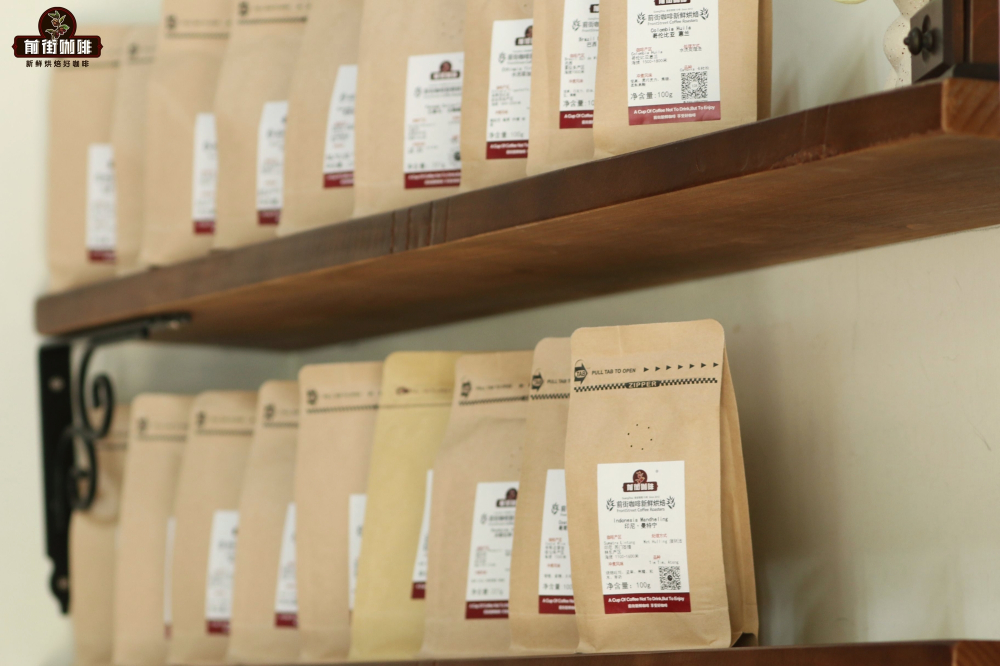
In terms of varieties, this coffee shop’s single-origin Brazilian offerings typically include a Red Bourbon from Cerrado and a Yellow Bourbon from Fazenda Rainha.
Bourbon is a historic Arabica variety, originating as a natural mutation of Typica, and was first planted on the island of Réunion (formerly known as Bourbon Island), hence its name. The Bourbon variety has broad leaves, suited for dense planting, and yields about 30% more per plant compared to Typica. Its beans are shorter and rounder, plumper in shape, and often produce a smooth cup with pronounced sweetness.
Red Bourbon is a type of the Bourbon variety where the fruits turn dark red upon ripening. It boasts bright acidity and aroma, and is one of the most widely grown varieties in Brazil, favored by farmers for its stable and excellent productivity.
In contrast, Yellow Bourbon is a genetic mutation of Bourbon, where the fruits ripen to an orange-yellow color. It is a variety unique to the state of São Paulo in Brazil. Yellow Bourbon is typically grown at higher altitudes, which aids in flavor development. The Yellow Bourbon from Fazenda Rainha, as shown in cupping tests, exhibits intense chocolate and roasted nut aromas, balanced acidity and sweetness, soft bitterness, and a pronounced sweet aftertaste—making it a classic choice for experiencing the flavor of Brazilian Yellow Bourbon.
Regarding processing methods, Brazil’s dry climate is theoretically suitable for traditional natural (sun-dried) processing. However, due to the large production volume, rough sun drying can easily introduce off-flavors such as earthiness. Washed processing can enhance cleanliness but requires significant water usage and is costly. As a result, Brazil developed the “pulped natural” processing method (also called semi-washed), which balances efficiency and quality.
This method first removes the coffee fruit’s skin and pulp, a step that also helps screen out underripe beans to ensure consistent ripeness. The beans, still in their mucilage-covered parchment, are then directly placed on drying patios until they reach the desired moisture content, after which the parchment is removed. Compared to traditional sun drying, this approach significantly shortens processing time and saves a substantial amount of water compared to washed processing, making it a typical representation of Brazilian coffee processing.
In terms of brewing, due to Brazilian coffee beans’ lower density and softer bean structure, along with their predominantly nutty flavor profile, a medium-to-dark roast level is generally recommended to highlight their body and sweetness.
For actual pour over brewing, it is recommended to use a KONO dripper, which employs an immersion-style extraction. This dripper’s ribs extend only halfway up its walls, allowing the filter paper to cling closely to the dripper, restricting water flow and thus extending the contact time between water and coffee grounds. This enhances extraction efficiency and concentration, resulting in a creamier, fuller-bodied cup.
Recommended pour over parameters are as follows: use a KONO dripper, water temperature around 88°C, coffee-to-water ratio of 1:15, 15 grams of coffee grounds, and a grind size passing through a Chinese No. 20 standard sieve at approximately 75% (medium-coarse to medium grind).
The suggested brewing steps involve a three-stage extraction: first, wet the dripper and attach the filter paper, discard the rinse water from the server, then add 15 grams of coffee grounds. After a 30-second bloom with 30 grams of water, begin pouring in small streams in circular motions from the center outward until the total water volume reaches 125 grams for the first pour. Once the coffee bed descends to the middle of the dripper, proceed with the second pour until the total water volume reaches 225 grams. Finally, allow the coffee to fully drip through before removing the dripper.
This Brazilian coffee from Cerrado exudes intense roasted nut and peanut aromas even when grinding. Upon tasting, it delivers a smooth mouthfeel of dark chocolate and creamy peanuts, with a long-lasting sweet aftertaste—making it an excellent choice for experiencing the classic flavors of Brazilian coffee.
The above content is compiled by CoffeeHunters, a coffee news website.


