








Introduction:This article provides an in-depth analysis of two popular wine barrel-fermented coffee beans from Honduras—Sherry and Lychee Orchid—covering their origin backgrounds, processing methods, roast curve comparisons, and pour-over brewing tests. It’s a comprehensive guide for coffee enthusiasts to understand wine barrel fermentation and master practical pour-over brewing techniques.
Driven by the third wave of coffee, wine barrel fermentation has gradually become a new favorite in the specialty coffee scene. Two wine barrel-fermented beans from a certain brand—Honduras Sherry and Lychee Orchid—use whiskey and brandy barrels respectively for post-harvest fermentation, imparting rich wine aromas and complex layers. This article will explore the geographical conditions, variety distribution, and industry development of Honduras’ main coffee regions, helping you understand the basic principles and practical applications of wine barrel fermentation. We’ll also provide detailed analysis on the roast curves, cupping profiles, and various pour-over methods for both beans, assisting you in fully grasping their unique flavor characteristics and brewing essentials.
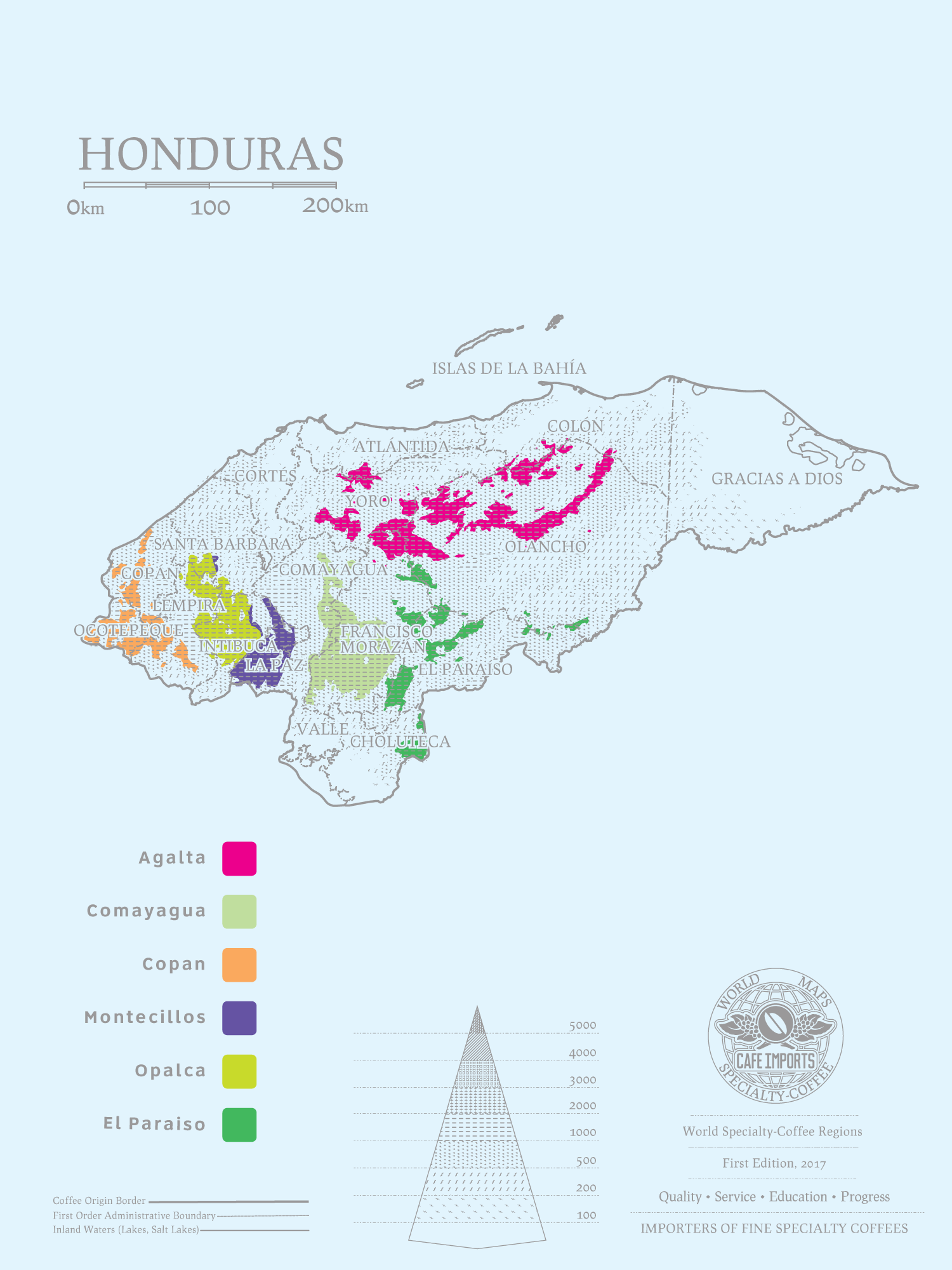
As an important coffee-producing country in Central America, Honduras boasts a uniquely favorable geography, with most of its territory consisting of mountains and plateaus. The typical planting elevation ranges between 1,000 and 1,600 meters. The country’s total coffee-growing area spans 280,000 hectares, and although dominated by small farms, these small-scale plantations contribute to over 60% of the nation’s total coffee output. Among the many producing regions, Honduras’ six major coffee-growing areas are Copan, El Paraiso, Comayagua, Opalaca, Montecillos, and Agalta. These regions, thanks to their unique microclimates and high-altitude environments, produce coffee with rich fruity notes, candy-like tones, and well-balanced acidity and sweetness.
However, one of the focal points of this article—the Mocha Estate—is not part of the aforementioned six major regions. Instead, it is located in Masaguara, Intibuca Department, on the southern side of the Jesús de Otoro Valley. The area features mountainous terrain surrounded by hills. Coffee cultivation is the primary economic activity here, while the relatively flat valley areas are mostly used for grain farming and livestock. Interestingly, according to local records, the name “Masaguara” means “place of deer.”
When it comes to the development of Honduras’ coffee industry, its start was relatively late. Compared to neighboring countries like Costa Rica and Guatemala, Honduras initially lacked a well-developed transportation network and export infrastructure, which severely limited coffee exports. It wasn’t until the 1970s, when the government established IHCAFE (Honduras Coffee Institute) and actively invested in quality improvement and technology promotion—coupled with the country’s naturally suitable conditions for coffee growing—that Honduras surpassed Costa Rica and Guatemala in 2011 to become one of the leading coffee producers in Central America. However, coffee leaf rust and climate change remain major challenges for the industry today.
Honduras’ coffee grading system is primarily based on altitude and defect rate. The altitude classification standards are: Strictly High Grown (SHG, above 1,200 meters), High Grown (HG, above 1,000 meters), and Central Standard (CS, above 600 meters). This system, combined with defect rate evaluations, provides a clear grading basis for each batch of coffee, helping buyers identify quality. Additionally, Honduras regularly holds specialty coffee competitions, which encourage farmers to continuously improve cultivation and post-harvest processing standards.
In terms of varieties, Honduras mainly grows Bourbon, Caturra, Typica, Catuai, and Pacas. Among them, Caturra is a natural mutation of Bourbon, with slightly higher yields but weaker disease resistance; Catuai is a hybrid of Caturra and Mondu Novo, offering good wind and rain resistance, with firm fruit that is less prone to dropping; Pacas is another Bourbon-type mutation, with shorter plants and strong yield potential, suitable for intercropping to boost overall production. These varieties are widely planted across many of Honduras’ coffee regions and are also common base varieties for wine barrel fermentation.
The inspiration for wine barrel fermentation comes from the aging processes of wine and whiskey. After harvest, the coffee cherries undergo meticulous washing to remove pulp and mucilage, then are placed in wooden barrels previously used for aging alcoholic beverages (such as sherry or brandy barrels) for low-temperature fermentation, typically maintained between 15–20°C for about 30 to 40 days. The barrels themselves have moderate oxygen permeability, facilitating slow and thorough oxidation reactions in the coffee beans, thereby developing wine-like aromas and complex flavors. Additionally, tannins from the wood can seep into the beans, adding layers of richness and body. A certain brand’s sherry barrel-fermented beans are fermented in oak barrels previously used for aging sherry in whiskey, and upon opening the bag, one can immediately detect distinct vanilla and wine aromas.
In terms of roasting strategy, since wine barrel-fermented beans already possess rich aromas and sweetness, roasters typically opt for light roasting to preserve their inherent flavors and highlight their complexity. A certain brand experimented with two roast curves for the sherry barrel-fermented beans:Curve OneWith a charge temperature of 190°C, yellowing point at 151.8°C, first crack at 184.2°C, development time of 2 minutes and 10 seconds, and drop temperature of 195°C, it presents notes of vanilla, honey, citrus, and cream, with an overall balanced and smooth profile;Curve Twohas a shorter development time, resulting in intense aroma but a slightly astringent finish. After cupping and pour-over testing, Curve Two was ultimately selected as the main roast parameter for this batch, though individual bean characteristics may still require separate evaluation.
For actual pour-over brewing, using a Hario V60 filter (90°C water temperature, 1:15 coffee-to-water ratio, EK43s grind setting with approximately 80% extraction), with a three-stage pouring method (30g bloom for 30 seconds, followed by 125g and 225g pours), can fully highlight the aroma and sweetness of the wine barrel beans. Alternatively, you can try the KONO filter, which offers slower flow and immersion effects, resulting in a rounder coffee flavor; or use the Japanese iced pour-over method, where hot water is poured over ice to rapidly cool the brew, enhancing the fermentation and fruit notes.
As for the Lychee Orchid wine barrel-fermented beans, also from the Mocha Estate, they are fermented in brandy barrels, delivering a distinctly different flavor profile. These beans are also grown at high altitudes of 1,500–1,700 meters, with the variety being Caturra and Catuai. The Lychee Orchid beans, fermented in brandy barrels, exhibit fresher lychee sweetness and brandy aromas, with a cleaner yet layered flavor and a long-lasting sweet and chocolatey finish.
For roasting and pour-over parameters, Lychee Orchid is also recommended for light roasting. With a charge temperature of 220°C, first crack at 183°C, 2 minutes and 10 seconds of development, and a drop temperature of 195°C, it brings out a combination of lychee, honey, and dark chocolate flavors. When brewing, using a V60 filter with 90°C water and a 1:10 coffee-to-water ratio (for iced pour-over mode) can more fully release its fruit and wine aroma layers, making it ideal for coffee lovers who prefer fresh and sweet profiles.
In summary, Honduras’ Sherry and Lychee Orchid wine barrel-fermented coffee beans showcase two extremes—rich wine aromas and fresh fruity notes. Whether using a V60, KONO, or Japanese iced pour-over, they each reveal their unique flavor charm. Gaining a deeper understanding of their origin backgrounds, processing principles, and optimal brewing methods not only enhances your coffee tasting experience but also adds more enjoyment and variety to your daily pour-over routine.

The above content is compiled by CoffeeHunters, a coffee news website.


