







Introduction:Yunnan coffee has become a hot topic in recent years, but many people still have questions about its varieties and flavor profiles. This article delves into the three waves of Yunnan coffee cultivation, clarifies the relationship between Catimor and Typica, and explains the origin of the term "small-grind coffee." It also introduces a certain coffee brand’s Typica variety planted in Lincang, which, through natural sun-drying and medium roast, showcases unique flavors, helping you fully understand the evolution and characteristics of Yunnan coffee.
In recent years, Yunnan coffee has gradually garnered attention, yet many consumers still have numerous questions about its varieties and flavor characteristics. This article will thoroughly examine the development trajectory of Yunnan coffee from its introduction to its rise, focusing on the evolution of two key varieties—Catimor and Typica—and analyzing the origin of the name "Yunnan small-grind coffee." Additionally, we will introduce how a certain coffee brand built its own estate in Lincang, using natural sun-drying processing and medium roast to present the distinctive flavors of the Typica variety, delivering captivating layers of citrus, berries, and caramel. Whether you're new to Yunnan coffee or looking to explore its varietal background in depth, this content offers a clear and valuable professional perspective.
 With the rise of domestic product consumption trends, Yunnan coffee is also gradually entering the public eye. More and more coffee drinkers are asking in cafés: "Do you have any recommended Yunnan beans?" or "What is Yunnan small-grind coffee?" As the quality requirements for specialty coffee become increasingly stringent, the varietal background of Yunnan coffee naturally becomes a focal point. This article will systematically guide you through the development and varietal evolution of Yunnan coffee.
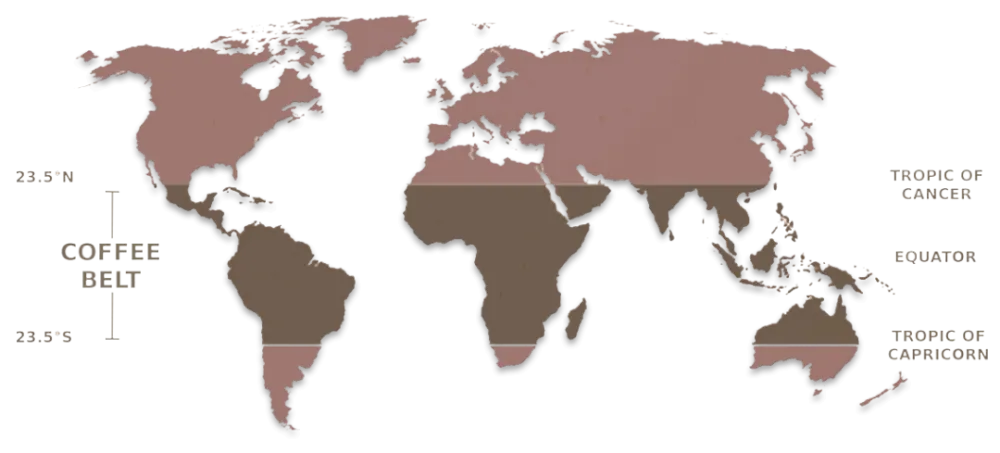
To grow coffee with outstanding flavors, environmental conditions are crucial, especially altitude and climate. Most of the world’s renowned coffee-growing regions are located within the "coffee golden belt" between the Tropic of Cancer and the Tropic of Capricorn. In China, the regions that meet both of these criteria are mainly Yunnan and Taiwan. However, coffee is an introduced crop in China, whereas tea is the traditional native crop. According to historical records, the earliest documented coffee cultivation in China dates back to 1877, when Fujian Governor Ding Richang, in the "Regulations for Pacifying the Aborigines and Opening up the Mountains," suggested that the indigenous people of Ryukyu replace their traditional hunting lifestyle by cultivating cash crops including coffee.
The earliest region in mainland China to cultivate coffee was indeed Yunnan. According to the "Binxian County Annals" and the "History of Catholicism in Yunnan," in 1904, French Catholic missionary Tian Deneng, under the order of the Dali Diocese, traveled to Zhukula Village in Binchuan County. While building a church, he personally planted the first coffee tree, intended solely for personal use. This marked the starting point of Yunnan coffee.
Looking back at the development history of Yunnan coffee, it can generally be divided into three main stages:
The first wave of planting occurred during the 1950s and 1960s. At that time, most people had very limited knowledge about coffee. The coffee beans grown in Yunnan were mainly exported to the Soviet Union as commodities to repay loans. The planting was managed by the agricultural reclamation system, with unified procurement by the national foreign trade department. Major planting areas at the time included Baoshan Lijiang Farm, Xincheng Youth Farm, Dehong Zhefang Farm, Ruili Farm, Wanding Farm, Wenshan Babu Farm, and Tianbao Farm. The primary varieties during this period were locally propagated Typica and Bourbon variants.
However, after the loan repayment task ended, the foreign trade department’s willingness to purchase Yunnan coffee declined. Coupled with the spread of coffee diseases, a large number of coffee trees became infected and died. To control the outbreak, many coffee trees were cut down. As a result, the coffee cultivation area at the time once shrank drastically to less than 3,000 acres.
The second wave of planting began after the reform and opening up in the 1980s. In 1988, Nestlé started actively supporting the Yunnan coffee industry and promoted the Catimor variety locally. This variety offered significant advantages: its yield could be three times that of Typica, and it had stronger disease resistance. Since most farmers were more concerned with yield and profit rather than flavor details, Catimor gradually replaced Typica as the dominant variety in Yunnan, at one point accounting for up to 90% of total production.
The third wave of development occurred after 2000. With the rapid growth of China’s economy, more and more international coffee brands turned their attention to the Chinese market, and the concept of specialty coffee was introduced. As the market demand for high-quality specialty beans increased, Yunnan also began to emphasize varietal selection and improvements in cultivation techniques. The journey toward producing specialty-grade coffee continues to this day.
Speaking of the term "Yunnan small-grind coffee," it actually originates from the early cultivation of the Typica variety. Typica coffee beans are relatively small in size, hence the name "small-grind." However, due to Catimor’s advantages in high yield and disease resistance, many farmers chose to switch to Catimor, resulting in what is now commonly referred to as "Yunnan small-grind coffee" mostly being Catimor.
Catimor was developed in 1959 by Portugal’s CIFC (Coffee Rust Research Centre). Its parent varieties are the Timor variety from Timor Island and Caturra. Because it inherited the Robusta gene from the Timor variety, it exhibits good resistance to coffee berry disease, leaf rust, and certain pests. However, due to the Robusta gene, Catimor can occasionally exhibit earthy or fermented off-flavors, a trait often mentioned. Nevertheless, with advancements in cultivation techniques and post-harvest processing methods, the overall flavor profile of Yunnan-grown Catimor has improved significantly.
It is worth mentioning that a certain coffee brand established its own coffee estate in Lincang, Yunnan, dedicated to exploring the terroir characteristics of the region. Lincang is located in the southwestern part of Yunnan, where the Tropic of Cancer crosses its southern edge. It borders Pu’er, Dali, and Baoshan, and its southwest is adjacent to Myanmar, making it an important coffee-producing area in the southwestern border region. The region’s planting altitude exceeds 1,000 meters, with an average annual temperature of around 17°C, distinct dry and wet seasons, and abundant sunshine, providing an ideal growing environment for the Typica variety.
At its estate in Lincang, a certain coffee brand uses the natural sun-drying method to process Typica. Ripe coffee cherries are evenly spread on raised drying beds and regularly turned to ensure even drying and avoid fermentation off-flavors. By fully retaining the fruit pulp, more sugars can penetrate the green beans, thereby enhancing aroma intensity and sweetness.
In terms of roasting, the roasters at this coffee brand chose a medium roast to balance aroma, sweetness, and mouthfeel, fully showcasing the characteristics of Yunnan small-grind coffee. It is recommended to use a Hario V60 filter, with water temperature controlled at 87°C, a coffee dose of 15 grams, a coffee-to-water ratio of 1:15, and a grind size passing 75% through a standard Chinese No. 20 sieve. Since the coffee beans are usually freshly roasted within 5 days, having undergone 4 to 7 days of rest upon arrival, it is suggested to perform a 30-second bloom before brewing, followed by pouring in a thin stream in circular motions. Total extraction time is approximately 2 minutes.
The final brewed natural Typica delivers a rich mouthfeel, balanced acidity and sweetness, with pronounced notes of citrus and berries, along with subtle fermented wine-like aromas and caramel sweetness. The finish is creamy like butter, accompanied by a tea-like sensation reminiscent of black tea, showcasing the unique charm of Yunnan coffee.
The above content is compiled by CoffeeHunters, a coffee news website.


