







Introduction:This article delves into how Colombia became a key pillar of global specialty coffee, starting from the origins of coffee cultivation in the 16th century, analyzing the distribution and microclimate characteristics of its two major northern and southern producing regions, and detailing the legendary journey of the Geisha variety from Ethiopia to Panama's Hacienda La Esmeralda. Through regional maps, harvest season divisions, and flavor profiles, it takes you on a comprehensive journey to understand the planting wisdom and terroir secrets behind this "green gold."
Colombia is the world’s second-largest coffee producer after Brazil, renowned for its stable, high-quality Arabica beans. Since coffee was introduced during Spanish colonization in the 16th century, it has developed over centuries into a production landscape centered around the three main branches of the Andes Mountains. The northern region primarily supplies stable commercial beans, while the southern region has given rise to numerous specialty coffees that compete on the international competition stage. Understanding Colombian coffee is not just about learning about regions and grading—it’s about exploring how a country, leveraging its geographic advantages and farmers’ ingenuity, has crafted its uniquely flavored "green gold."
There are various accounts of the history of coffee cultivation in Colombia. Some suggest that coffee was introduced via the Caribbean island of Haiti, then through El Salvador in Central America, and finally by waterway; other records indicate that in 1808, a clergyman from the French Antilles brought coffee seeds to Colombia via Venezuela, with some entering through the department of Santander. The most reliable historical documentation comes from the Spanish missionary Jose Gumilla’s work 《The Illustrated Orinoca》, where he recorded coffee plantations in the Meta River basin in 1730 and noted that by 1787, missionaries had expanded coffee cultivation to broader areas of Colombia.
Colombia’s mountainous terrain features the Andes Mountains splitting into three main branches—western, central, and eastern—collectively known as the Cordillera mountain system. Between these mountain ranges lie two major valleys: the Cauca River valley, which runs through Cauca Department, and the Magdalena River, Colombia’s largest. These highlands and valleys create diverse microclimates, shaping the unique character of Colombia’s coffee-growing regions. In this land of undulating mountains, coffee is not just an economic crop but also a cultural symbol.
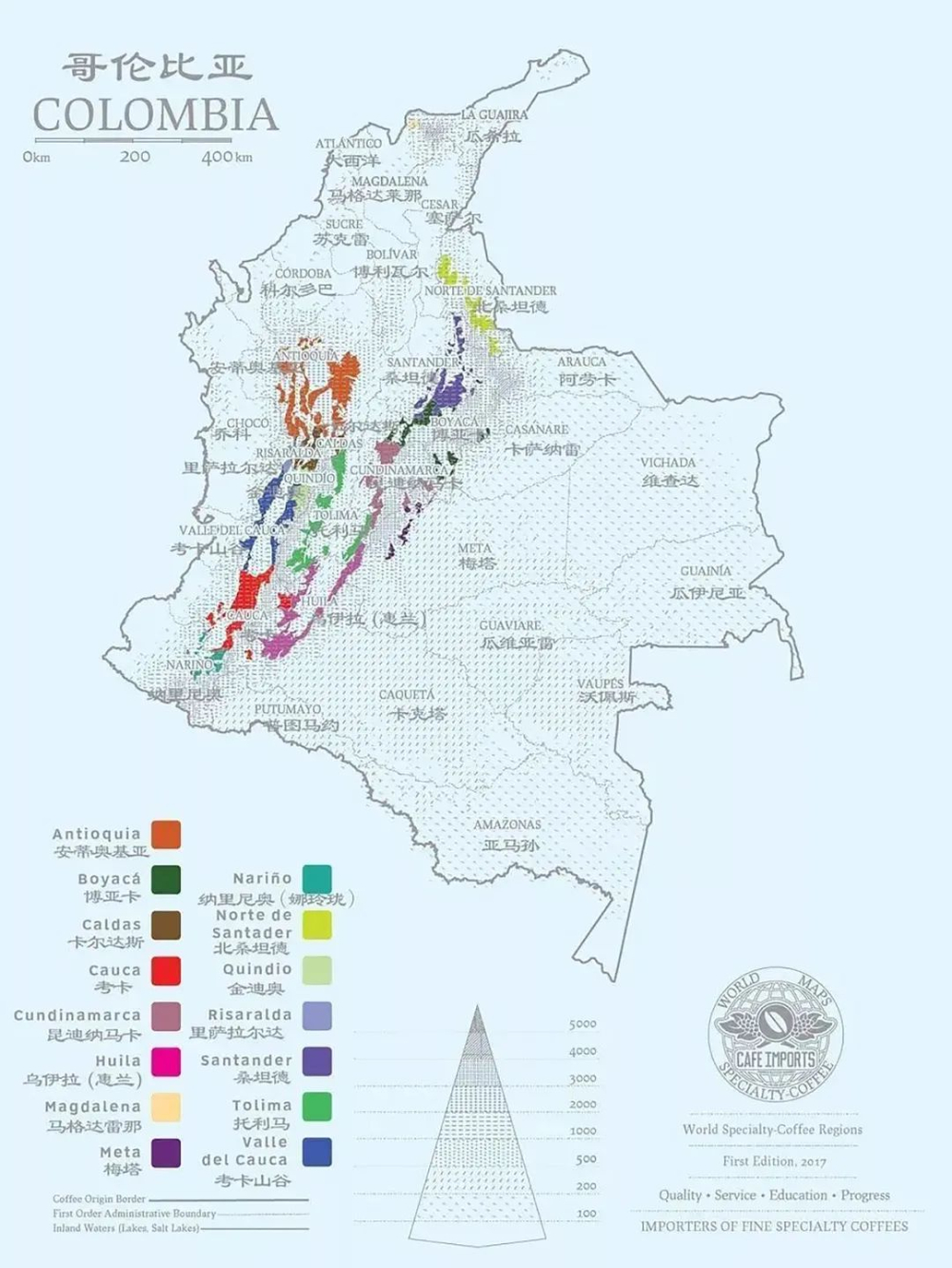
Due to its proximity to the equator and high-altitude mountainous regions, Colombia follows a typical double harvest system, with some areas even having a "mitaca" secondary season. Generally, northern regions like Antioquia have their main harvest from September to December and a secondary harvest from April to June; southern regions such as Nariño and Huila have their main harvest from April to June and a secondary harvest from September to December. Variations in altitude, slope orientation, and microclimate lead to slight differences in harvest times across regions, giving Colombia the unique advantage of supplying fresh coffee year-round.
Colombian coffee varieties are predominantly Arabica, with high-quality mutations of Coffea arabica being especially prized. The country’s coffee grading system is highly detailed, with over 200 grades, among which "Supremo" is the highest, requiring 18-size beans with a diameter of 18/64 inches or more to meet specialty coffee standards. The central highland regions of Medellín, Armenia, and Manizales, collectively referred to as "MAM," are traditionally known for high-quality production; meanwhile, southern high-altitude Nariño is famed for its intense flavors and bright, high acidity, becoming a focal point in the specialty market in recent years.
When discussing specialty coffee, one cannot overlook the legendary Geisha variety. Often mistakenly called "Geisha" (the Japanese term), this variety originated in the village of Gesha or Gecha in Ethiopia in 1931. It was first sent to the Kenya Coffee Research Institute, then subsequently introduced to Uganda and Tanzania, and didn’t arrive in Costa Rica until 1953 or Panama until 1963. Interestingly, Geisha was initially overlooked in Panama due to its low yield and unremarkable appearance; many farmers used it only as a windbreak or mixed it with other varieties for sale. It wasn’t until it was planted at Hacienda La Esmeralda that this variety truly revealed its astonishing potential.

Hacienda La Esmeralda is located in Panama’s Boquete region, nestled in the volcanic mountains and enjoying significant microclimate advantages. The area experiences large diurnal temperature variations, with abundant sunlight during the day and cool nights, which helps slow the ripening process of coffee cherries, allowing the beans to accumulate richer sugars and flavor compounds. After years of trial planting and cupping competitions, the Geisha variety from Hacienda La Esmeralda has repeatedly won international awards. Its distinctive jasmine floral notes, tea-like acidity, and delicate citrus finish have captivated coffee lovers worldwide.
Cupping records from a certain coffee brand show that Geisha has an instantly recognizable blackcurrant juice-like profile, accompanied by berry aromas such as blueberry, dark plum, and orange. As the temperature drops, it reveals a wine-like, full-bodied finish. This layered and long-lasting flavor expression is the result of high altitude, meticulous varietal management, and refined processing methods. For coffee enthusiasts, tasting a Geisha from Colombia or Panama is not just a flavor experience, but also a profound encounter with coffee terroir and history.
The above content is compiled by CoffeeHunters, a coffee news website.


