







Introduction:The Canet Estate in Costa Rica’s Tarrazú region is renowned for its high altitude and meticulous management. This Bahía coffee variety is processed using the grape raisin honey method, which fully preserves the mucilage to deliver intense tropical fruit and berry aromas. This article delves into the terroir of the region, the characteristics of the variety, and the honey processing technique, while also providing professional roasting profiles and V60 pour over parameters to help you fully experience the layers and aftertaste of this specialty coffee.
Costa Rican coffee is celebrated for its pronounced sweetness and bright acidity, and the honey processing method takes these sweet and aromatic qualities to the next level. This article focuses on the Canet Estate in the Tarrazú region, exploring its Bahía coffee beans. From the geographical environment and microclimate features of the region, to varietal selection and innovative processing methods, we break down the unique charm of these beans step by step. We also share practical roasting and pour over parameters so you can replicate a professional-level result at home.
The History and Status of Costa Rican Coffee
Coffee was introduced to Costa Rica in 1808 and has a history of over two hundred years. As an important coffee-producing country in Central America, coffee exports account for about 25% of the country’s total exports. With approximately 400 million coffee trees nationwide, though the land area is not large — only ranking behind a few other countries in Central America — the coffee industry makes remarkable contributions to the economy and employment. The fertile volcanic soil, especially the multi-layered volcanic ash in the central highlands, creates great potential for the depth of coffee flavors.
Tarrazú Region: A Representative of High Altitude and Meticulous Management
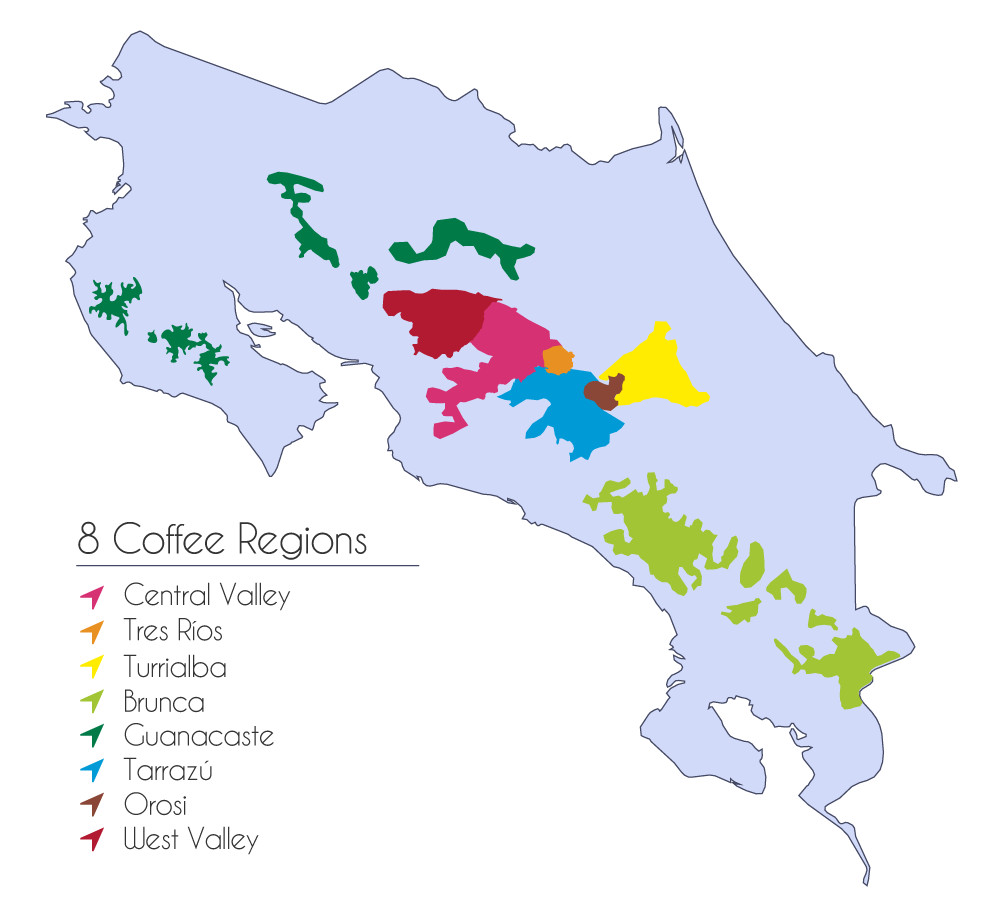
Tarrazú, located south of the capital San José, is one of the world’s most well-known specialty coffee regions. This area not only has a relatively high latitude but also boasts exceptionally well-draining, fertile soil. Although overall production is not high, the quality is consistently outstanding. The region has a thriving fruit-growing industry, particularly passion fruit, while coffee is primarily cultivated in specific micro-blocks using high-standard processing techniques. This results in coffees that generally feature bright acidity, rich berry notes, and excellent sweetness and body.
Canet Estate: Small-Scale and Exquisite Cultivation
The Canet Estate (Finca Canet) is situated in the San Marcos area of Tarrazú, covering just 5 hectares and operated jointly by the three Robles brothers. They own a small washed processing plant and are dedicated to growing small quantities of exceptionally high-quality coffee at high altitudes. The estate’s main crop is passion fruit, with coffee planted only in specific microclimatic zones, where only ripe red cherries are carefully selected to ensure a high-quality starting point.
Varietal Characteristics: Bourbon Mutant Caturra and Yellow Catuai
This coffee uses the Bourbon mutant Caturra (Bourbon Caturra) and Yellow Catuai. Caturra is a single-gene mutation of Bourbon, originating in Brazil in 1937. It has a shorter plant height, making it suitable for dense planting and mechanical harvesting. Though it has an "on-off" yield characteristic, it generally has good disease resistance and adapts well to high-altitude environments. Yellow Catuai is a hybrid of Mundo Novo and Caturra, with strong disease resistance and is also suitable for high-altitude mountain cultivation. It showcases delicate acidity and aroma. Both varieties are known for their clear fruit acidity, pleasant sweetness, and diverse flavor profiles.
Grape Raisin Honey Processing: 100% Mucilage, No Wash Fermentation
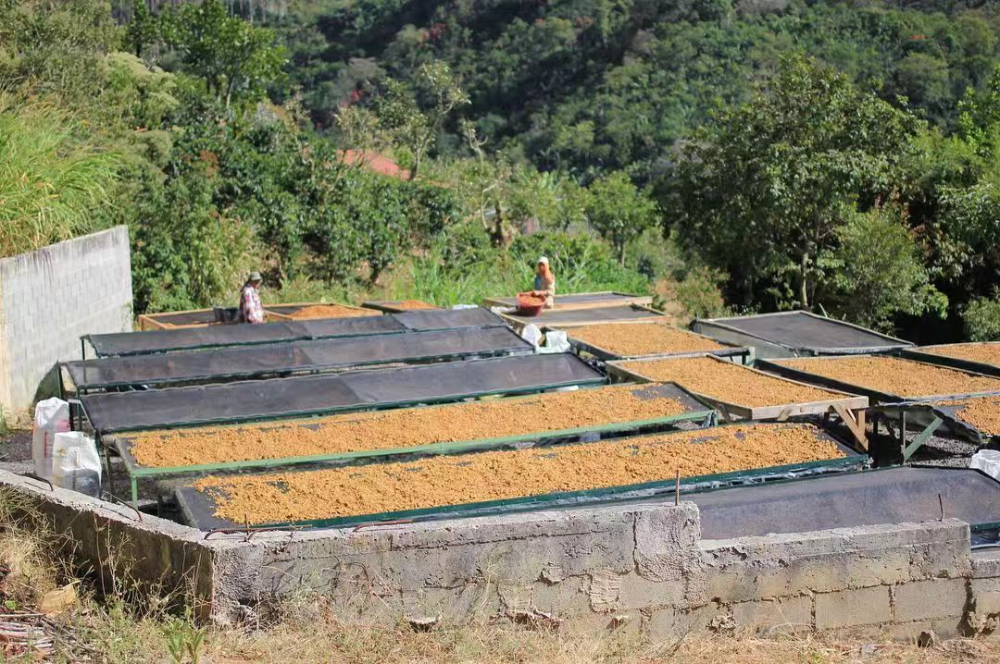
This batch of coffee beans is processed using the grape raisin honey method (Honey Process), whose most distinctive feature is:No water washing and full mucilage retention. On the day of harvest, floatation is used first to remove underripe or overripe beans. Then, the parchment-covered beans are placed on raised beds to dry for at least three days before the outer skin is removed, keeping the complete mucilage layer for subsequent drying. This method demands very high standards for weather and drying control, requiring constant turning of the beans to ensure even fermentation and to avoid over-fermentation or mold. The result is intense sweetness and fruity character.
Roasting Profile and Parameter Settings
Using a Taiwanese Yangjia Feima 800N semi-direct-fire roaster, the charge temperature is 180°C. The turning point is at 1 minute 43 seconds / 94.2°C, the yellowing point is at 6 minutes 15 seconds / 151.5°C, first crack starts at 9 minutes 40 seconds / 183.3°C, with a total roasting time of about 11 minutes 25 seconds, development time of 1 minute 45 seconds, and exit temperature of 196°C. The Agtron bean color value is 67.7, the roast color value is 78, and the Roast Delta value is 10.3, making it a typical medium roast that balances fruity aroma, sweetness, and body richness.
The roasting strategy focuses on extending the drying phase and gradually reducing the heat, fully bringing out the fermentation aromas and fruit layers from the grape raisin honey process, while preserving the round and full mouthfeel unique to honey processing.
Flavor Profile and Cupping Notes
During cupping, this coffee emits distinct rice wine fermentation aromas. The cup presents a sweet and tangy interplay of mature tropical fruits and berries. The mid-palate reveals nutty and creamy textures, while the finish lingers with caramelized sweetness and a hint of floral notes. The overall flavor profile is clear, layered, and the aftertaste is long-lasting.
Recommended V60 Pour Over Parameters
Equipment: Hario V60
Water temperature: 90°C
Coffee-to-water ratio: 1:15
Grind size: Medium-fine (close to the fineness of white sugar)
Method: Bloom for 30 seconds (using 30g of water), then pour in a small circular motion to 125g for the first pour. Once the water level drops slightly, continue pouring to 225g. Total extraction time is around 2 minutes 15 seconds. Be sure to control the water flow steadily to avoid over-extraction or channeling.
Through the above processing method, roasting settings, and pour over techniques, this Bahía coffee bean from the Canet Estate in Costa Rica’s Tarrazú region fully showcases its unique honey-processed flavors and high-altitude potential. It’s a must-try specialty choice for coffee lovers who enjoy fruity tones and sweet aromatic layers.
The above content is compiled by CoffeeHunters, a coffee news website.


