







Introduction:The Geisha coffee from Panama’s Hacienda Esmeralda is world-renowned for its unique flavors, but the grading system of its Red Label, Green Label, and Blue Label often confuses coffee enthusiasts. This article delves into the origins, altitudes, processing methods, and flavor profiles of these three label grades, and provides optimal pour over parameters for lightly roasted Geisha, helping you choose the most suitable Geisha beans based on your taste preferences.
The Geisha coffee beans produced by Hacienda Esmeralda in Panama have topped numerous international coffee competitions for years, making them a star variety in the global specialty coffee market. However, when faced with the estate’s various grades—Red Label, Green Label, and Blue Label (now called the New Blue Label Volcanic Stone)—many consumers often find it difficult to choose. These “labels” may seem to differ only in color, but they actually represent different growing regions, altitudes, processing refinement levels, and pricing tiers. Understanding their differences can help you select the Geisha coffee that best suits your taste.
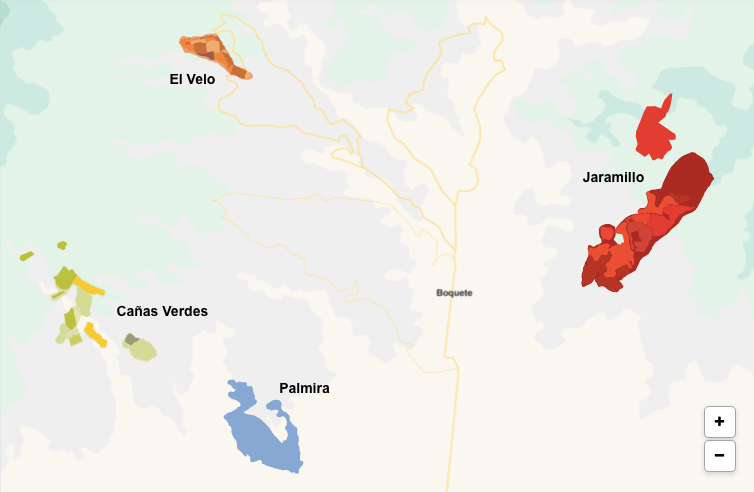
Hacienda Esmeralda is located in the Boquete region of Panama and is a large-scale comprehensive coffee plantation. In addition to Geisha, it also grows varieties such as Caturra and Catuai, and even has cacao trees. The estate includes four major sub-farms: Cansa Verdes, El Velo, Jaramillo, and Palmira, each of which is further divided into multiple micro-lots. Based on the origin, altitude, and cupping scores of the Geisha coffee, the estate categorizes them into different grades, which are commonly known in the market as Red Label, Green Label, and Blue Label.
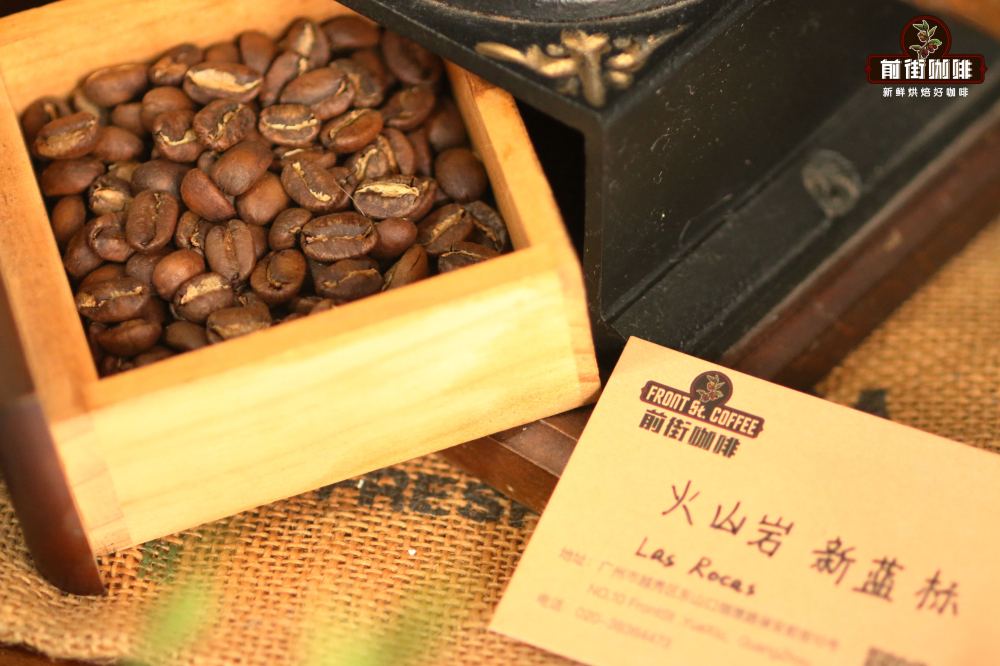
Let’s first talk about the Blue Label Geisha, often considered an “entry-level” option. Its official name is “Geisha 1500.” Since the product listing on the Hacienda Esmeralda official website displays a blue background for this item, it is commonly referred to as the Blue Label in Chinese-speaking communities. This grade of Geisha is mainly sourced from three sub-farms: Jaramillo, Cansa Verdes, and El Velo, at an altitude of around 1500 meters, making it a relatively more affordable choice among Geisha coffees. It should be noted that since 2021, Hacienda Esmeralda has no longer listed the Blue Label in its product catalog. The 1500-meter-altitude Geisha beans from that batch were subsequently taken over by a green coffee trader and rebranded under the “Las Rocas (Volcanic Stone)” brand. It is now referred to in the market as the New Blue Label Volcanic Stone. According to actual cupping and green bean appearance analysis, it still retains distinct characteristics of Hacienda Esmeralda Geisha.
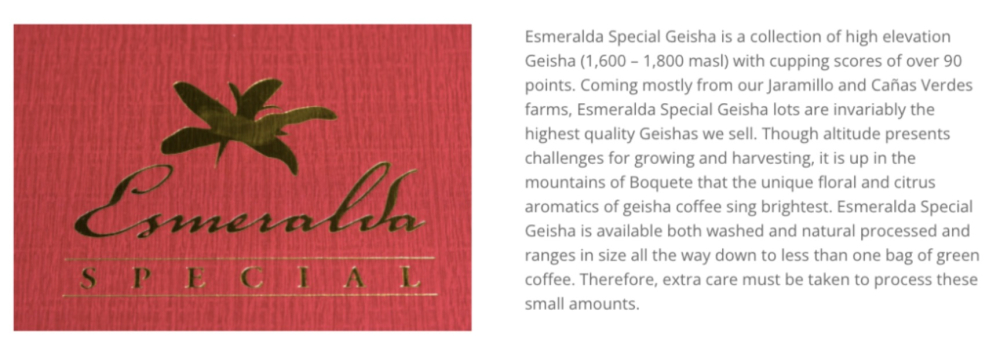
In contrast, the Red Label Geisha is considered the flagship representation of Hacienda Esmeralda. Its official name is “Esmeralda Special.” This Geisha is sourced exclusively from carefully selected lots located between 1600 and 1800 meters above sea level, and each batch must pass rigorous cupping tests, achieving a score of 90 or higher. The most distinctive feature of the Red Label is its “single-lot” origin—each batch comes from a specific small block, such as the Mario lot. Furthermore, each Red Label batch has an independent number. If consumers purchase directly from the estate, they can even select batches from specific lots based on their flavor preferences, making it an exceptionally refined product.
As for the Green Label Geisha, its official name is “Private Collection.” Although the name sounds exclusive, it does not imply limited availability or private sales. Instead, it indicates that this Geisha is a blend of multiple high-altitude lots ranging from 1600 to 1800 meters, without being tied to a single producing area. Compared to the Red Label, the flavor profile of the Green Label is slightly broader, but it still retains the distinctive citrus, floral, and tea-like characteristics of the Geisha variety. It serves as a great entry point for many coffee lovers looking to explore the Hacienda Esmeralda Geisha series.
In summary, the Red Label Geisha emphasizes “single-lot” origin and extremely high cupping scores, making it the top choice for those seeking ultimate flavor and terroir expression. The Green Label combines the essence of multiple lots, showcasing the diverse facets of the Geisha variety. The Blue Label (or the New Blue Label Volcanic Stone) offers the fundamental characteristics of 1500-meter-altitude Geisha at a relatively more accessible price, suitable for everyday drinking or for consumers trying Geisha for the first time. It’s worth noting that while price is often seen as an indicator of quality, actual flavor performance ultimately depends on individual taste preferences. It’s recommended to choose based on your preference for acidity, sweetness, and aroma.
In terms of brewing, since Hacienda Esmeralda’s Geisha beans are mostly lightly roasted, their flavors are characterized by bright fruit acidity, delicate floral notes, and a tea-like aftertaste. To fully highlight these characteristics, it is recommended to use the pour over method, with a medium-fine grind size similar to that of granulated sugar, and extract with water at 90–91°C. A V60 filter cone is recommended, using about 15 grams of coffee grounds with a brew ratio of 1:15, and a total extraction time of approximately 2 minutes and 10 seconds to 2 minutes and 20 seconds.
In practical operation, you can use the classic three-stage pouring method: first, pour 30 grams of hot water for a 30-second bloom to allow the coffee grounds to expand evenly; then, pour 95 grams of water from the center outward in circular motions at a water height of 3–5 centimeters, bringing the total water volume to 125 grams; finally, slowly pour an additional 100 grams of water until the extraction is complete. This technique balances the extraction of flavor layers and helps avoid over-extraction or excessive acidity.
In terms of flavor profile, the Red Label natural-process Geisha often exhibits complex layers of rose, strawberry, citrus, black tea, and honey. The washed Green Label showcases a fresh profile of jasmine, ginger flower, citrus, Ti Kuan Yin tea, and honey. Meanwhile, the New Blue Label Volcanic Stone (originally the 1500-meter Geisha) features white floral notes, citrus, green tea, and honey as its main characteristics, offering a relatively refreshing and straightforward flavor. By understanding these details, consumers can more accurately select the Geisha coffee beans that match their drinking habits.
The above content is compiled by CoffeeHunters, a coffee news website.


