








Introduction:Want to more accurately describe the citrus, berry, or chocolate notes in your pour over coffee? This article is based on the latest version of the SCAA Coffee Taster’s Flavor Wheel, systematically analyzing the relationship between the four major taste profiles and roast levels. It breaks down the molecular characteristics and proportions of acidity, sweetness, bitterness, and saltiness, and provides a detailed classification of the nine major flavor groups. It also offers practical training methods and tasting techniques to help you advance from a beginner to a connoisseur capable of precisely identifying subtle coffee flavors.
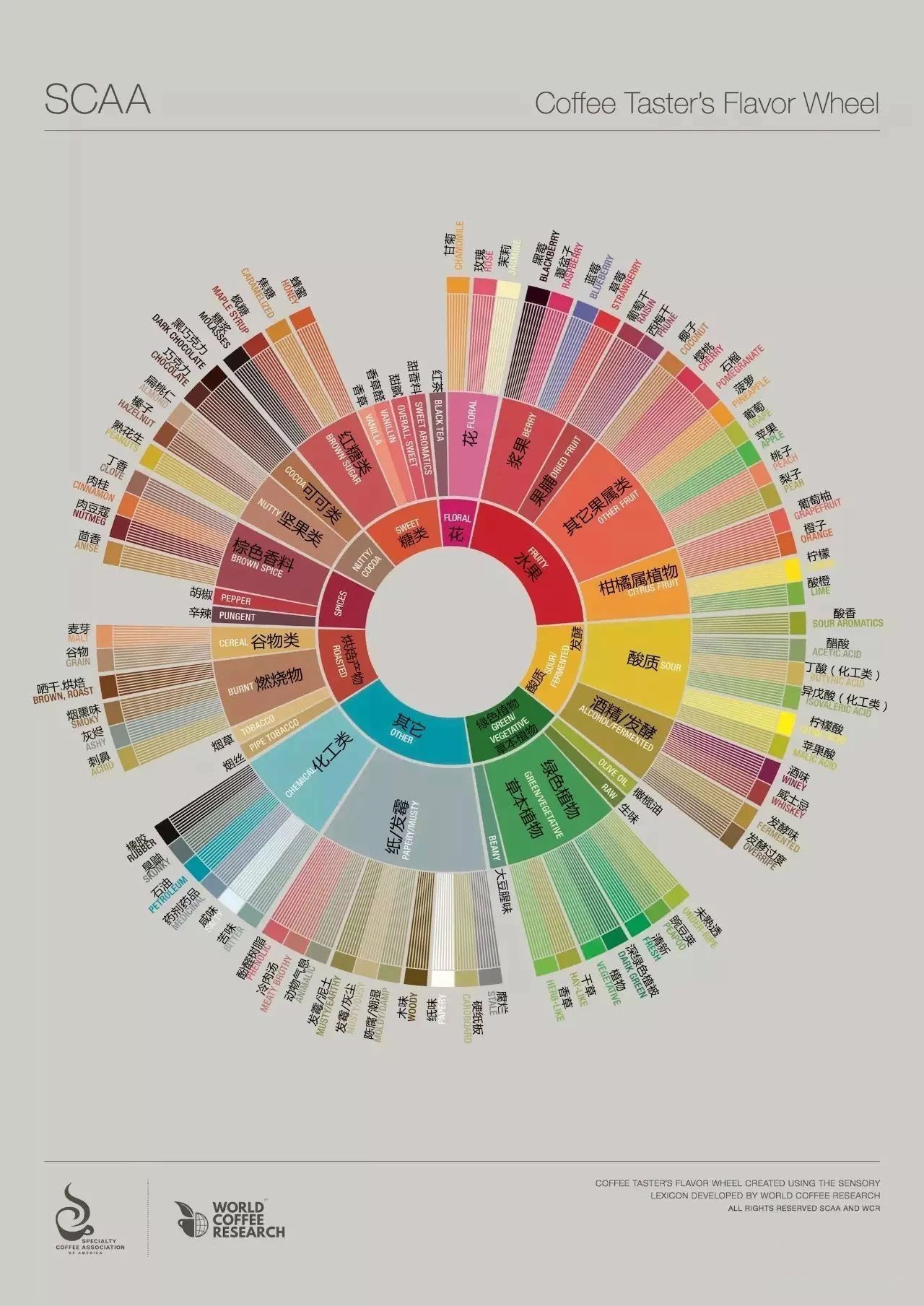
The Coffee Taster’s Flavor Wheel is an industry-standard tasting tool, but when faced with abstract descriptors like citrus, berries, nuts, and chocolate, many people often struggle to match them to actual flavors. Centered around the high-resolution image of the latest SCAA Coffee Taster’s Flavor Wheel, this article explains the logic behind coffee flavor composition in an accessible way — from the relationship between the four basic tastes (acidic, sweet, bitter, salty) and roast levels, to scientific data such as molecular weight, polarity, and water solubility of flavor compounds. It then progressively dissects the nine major flavor groups on the wheel, including floral & fruity, green/herbal, nutty & cocoa, sweet, spicy, sour & fermented, alcoholic fermentation, roasted, and other special flavors.
The four major tastes — acidic, sweet, bitter, and salty — are closely related to roast levels. According to the Flavor Wheel classification, light to medium roast coffees are dominated by low and medium molecular weight acidic and sweet compounds. These flavor compounds have smaller molecular weights, higher polarity, and good water solubility, and are typically released during the first half of the extraction process. In contrast, bitter and salty substances, due to their larger molecular size, lower polarity, and poor water solubility, usually only become apparent in the latter half of extraction. It’s worth noting that if a light to medium roast coffee exhibits unpleasant bitter or salty notes, it may be due to excessive defective beans or improper roasting. Dark roast coffees, on the other hand, are primarily characterized by high molecular weight bitter and salty compounds. However, when handled skillfully, they can still deliver an optimal experience described as “intense yet not bitter, mellow and smooth on the palate.”

In roasted coffee beans, the weight proportion of soluble flavor compounds is as follows: sweet components make up the largest share, at approximately 39%; bitter compounds come second at 26.4%; saltiness ranks third at 14%; and acidity is the least, usually not exceeding 5.4%. Together, these four types of flavor compounds account for about 84.8% of the total, with the remainder consisting of trace amounts of minor components. However, even though sweetness has the highest proportion, it doesn’t mean black coffee will taste as sweet as honey, because bitterness, acidity, and saltiness interact in complex ways of mutual suppression and complementarity, often interfering with the expression of sweetness.
We can further break down the four major tastes into four distinct flavor profiles for better understanding. The first is the acidity profile: acidity is a prominent characteristic of light to medium roast coffees. Coffee beans contain a variety of organic acids, especially phenolic acids, aliphatic acids, and amino acids, which have the greatest impact on flavor. Additionally, as sucrose degrades during roasting, the concentrations of acetic acid and lactic acid initially rise from light to medium roasts, but rapidly decline after reaching a certain critical point. Therefore, light to medium roasts typically exhibit more pronounced acidic characteristics.
The second is the bitterness profile: coffee bitterness can be divided into smooth and harsh categories. The former mainly comes from natural trace compounds such as caffeine, trigonelline, aliphatic acids, and quinine lactones; the latter originates from chlorogenic acid degradation products like chlorogenic acid lactones, defective beans, and carbonized particles, all of which can produce unpleasant heavy bitterness.
The third is the sweetness profile: although the sweetness in black coffee is often masked by acidity, bitterness, and saltiness, it can still be captured through retronasal olfaction techniques, especially volatile aromas like caramel. Light to medium roasted coffees often display a flavor interplay of acidity and sweetness, particularly in high-altitude washed beans where sufficient sugar content can balance with fruit acids, resulting in a lively, fruit-like acidity-sweetness sensation — what’s referred to as an “acidity-sweetness vibrancy.”
The fourth is the saltiness profile: saltiness in coffee is usually subtle, but when acidic and sweet organic compounds have fully oxidized, inorganic saltiness may emerge. This is often a sign that the coffee has gone stale or is no longer fresh. Therefore, if you detect a noticeable salty taste, it’s wise to consider the coffee’s freshness.
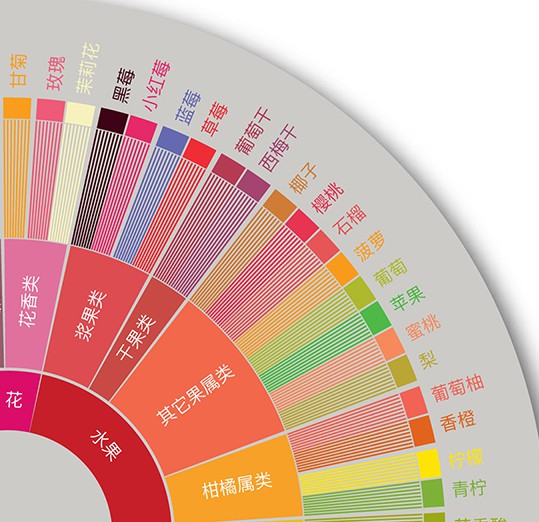
The first step to understanding the Flavor Wheel is to familiarize yourself with its overall structure. The Flavor Wheel divides coffee flavors into nine major groups: floral & fruity, green/herbal, nutty & cocoa, sweet, spicy, sour & fermented, alcoholic fermentation, roasted, and other. Each group is further subdivided into multiple specific descriptors to help tasters more precisely articulate the flavors they perceive.
Take floral and fruity notes as an example: floral aromas like chamomile or osmanthus fall under the heavy floral category, which can seem slightly pungent upon first encounter, with examples like Guatemala Porssa. Roses and lavender belong to the subtle floral type, offering soothing qualities, with Colombian Rose Valley being renowned for this trait. Jasmine and coffee blossoms are classified as fresh floral, exuding bright and vibrant scents — both Panama Geisha Blue Label and Yirgacheffe Aricha showcase such flavors. Furthermore, Yirgacheffe Red Cherry is noted for its rich fruitiness, featuring notes like plum, strawberry, and lemon. Huagui exhibits grassy and dark plum acidity, with a distinct berry aftertaste. Yirgacheffe, meanwhile, presents layers of lemon, kumquat, and caramel.

Green/herbal flavors often require a bit of explanation. For instance, unripe fruit may carry a tartness akin to grapefruit peel; fresh grass smells like newly cut lawn; deep green vegetables resemble cooked spinach; plant-like aromas are similar to the sharpness of asparagus; herbal notes are close to spices like bay leaves or basil; and pod-like flavors carry the distinctive aromatic acidity of legumes.
Nutty and cocoa flavors are commonly found in medium roasted coffees, resulting from Maillard reactions. These include roasted almond, peanut, hazelnut, walnut, and other nutty notes, as well as cocoa-related flavors like dark chocolate. Brazilian Queen Estate coffee, for example, showcases intense chocolate, smoky, nutty, and buttery aromas, along with caramel and berry sweetness.
For sweetness, the medium roast process sees the breakdown of acidic compounds and sugar browning reactions that produce caramel aromas. Coffee sugars can be divided into high-viscosity sweet types like toffee, caramel, honey, and maple syrup, as well as varying purities of sweetness like brown sugar, cane sugar, and white sugar. The former, such as Flower Butterfly natural beans, present a composite profile of floral, citrus, honey, and hazelnut notes. The latter are distinguished by their sweetness and intensity, delivering different layers of sweet taste experiences.

Spicy flavors often appear in dark roast coffees, such as the pungent orange essential oil aroma common in aged Mandheling and Tiger Mandheling beans. Acid and fermentation flavors include clear acidic notes like aromatic acids, citric acid, and malic acid, as well as complex odors like butyric acid and isovaleric acid that evoke aged cheese characteristics. Geisha Village CHAKA, for instance, displays such traits.
Alcoholic and fermentation flavors are often associated with overripe fruits or special processing methods, such as the slightly acidic and moist feel of overripe fruit, the berry aroma of wine, the richness of whiskey, and the beer-like qualities of fermented beans. Honduras Sherry and Lychee & Lan are representative examples — the former carries aftertastes of vanilla, butter, berries, and dark chocolate, while the latter blends lychee, honey, and brandy notes, showcasing the unique charm of barrel fermentation.
Roast flavors include bitterness, smokiness, and browning aromas, such as charred bitterness, charcoal smoke, and pure roasted notes. Other flavors encompass negative traits like staleness, mold, dust, and phenolics. Among these, woody notes stem from the dry distillation process during dark roasting, and opinions on them tend to be sharply divided.

In summary, the 85 coffee flavors do not refer to 85 different types of coffee, but rather to the diverse flavor expressions resulting from variations in cultivation, processing, roasting, and other stages — influenced by factors such as environment, genetics, processing methods, storage and transport, and roasting techniques. To truly understand coffee, one needs to build up relevant taste and smell memory. It’s recommended to taste coffee once it’s slightly cooled to allow fruity notes to emerge, and adjust strength according to roast level — for instance, light roast beans can be diluted moderately to enhance layering. Additionally, it’s advisable to take small sips, gently stir the coffee liquid, feel the flavor evolution brought by temperature changes, and make full use of the cup’s bottom notes to deeply appreciate the coffee’s complex layers.



The above content is compiled by CoffeeHunters, a coffee news website.


