








Introduction:Although Panama is a small Central American country, it is an indispensable player in the global specialty coffee landscape. From the birth of the Geisha variety to the emergence of sky-high auction prices, what lies behind these achievements is not only its geographical advantages but also a commitment to meticulous management and industrial transformation. This article will delve into Panama’s three core coffee regions, its auction competition system, and share pour over recommendations for washed Geisha, helping you fully grasp the allure of these fascinating beans.
Among the many Central American coffee-producing nations, Panama has earned the respect of the global specialty coffee community with its compact territory and exceptional coffee quality. From the initial arrival of coffee in the early 19th century to the 21st-century Geisha variety setting consecutive auction records on the international market, Panama’s volcanic soil, dual-ocean airflow, and highly refined cultivation and post-harvest practices have together created an unforgettable coffee flavor profile.
The Origins and Early Development of Coffee in Panama
Coffee was first introduced to Panama in 1742, reportedly by a ship departing from Martinique in the French Caribbean, which docked at Portobelo carrying a batch of coffee beans. However, meaningful coffee cultivation did not begin until 1780, when Pedro Antonio de Ayarza started planting. Initially, he experimented in Portobelo but found the local environment less than ideal. It wasn’t until the 1820s that coffee gradually took root in other areas, slowly replacing cacao as the primary beverage and competing in the market with Europe’s popular tea.
Panama is situated in the narrow isthmus of Central America, bordered by Costa Rica to the left and Colombia to the right—both globally renowned coffee-producing countries, providing Panama with a natural advantage. More crucially, Panama is influenced by the interplay of the Caribbean Sea and Pacific Ocean currents, coupled with the Boquete Valley’s elevation exceeding 6,500 feet and its mineral-rich volcanic soil, resulting in a coffee flavor structure of remarkable complexity.
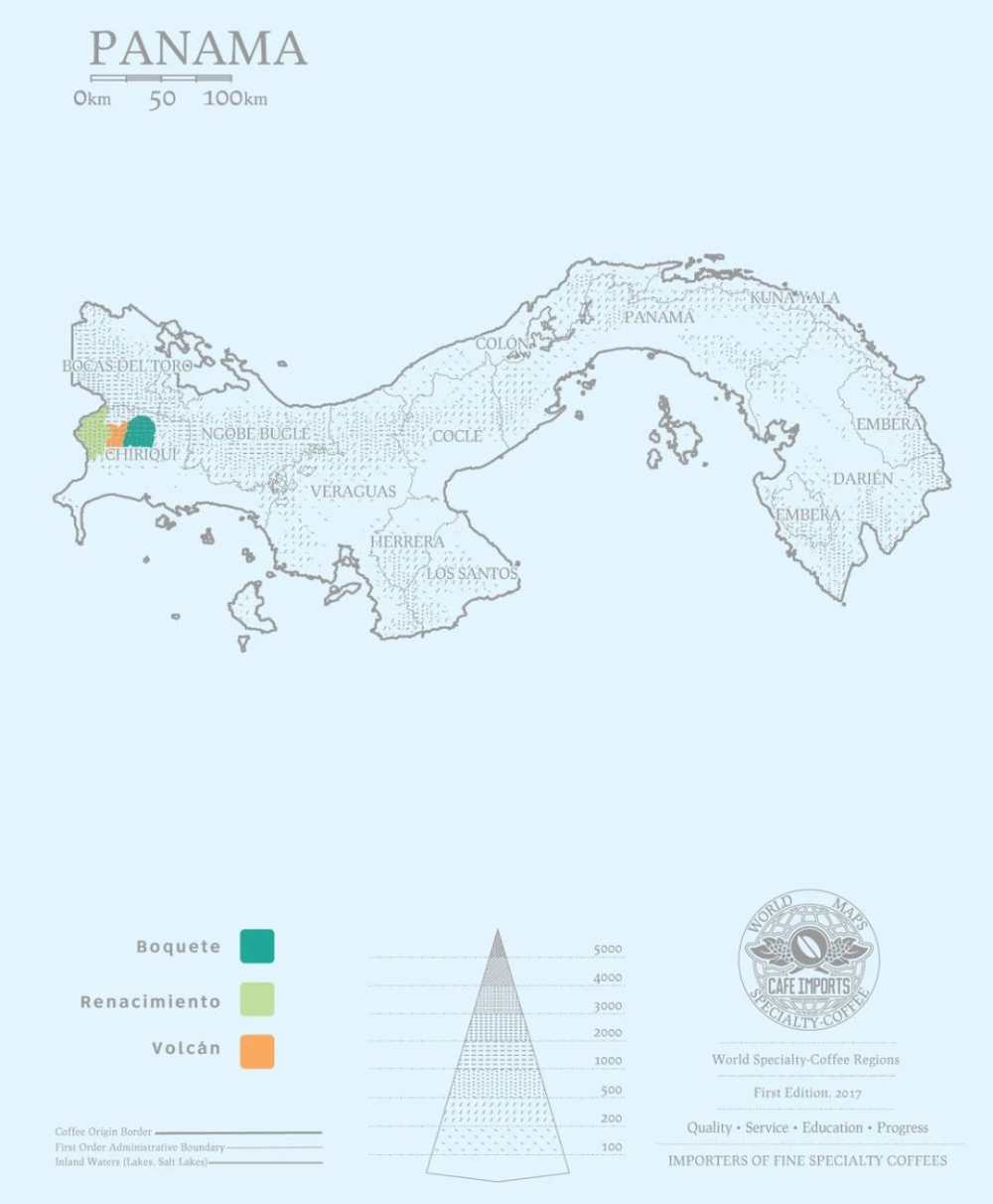
Three Core Regions: Boquete, Volcán, and Renacimiento
Coffee cultivation in Panama is primarily concentrated in the western Chiriquí Province, home to three highly representative regions: Boquete, Volcán, and Renacimiento. These three areas lie along the Central American Ridge, featuring cool climates, significant altitude variations, and fertile soils—an ideal environment for growing high-quality Arabica coffee.
Among them,the Boquete Valley is regarded as the birthplace of Panama’s coffee industry. In the late 19th century, a large number of European immigrants, including those of Swiss, German, Swedish, and Yugoslav descent, settled here and discovered the area was exceptionally well-suited for coffee cultivation, leading them to engage in production. To this day, the Boquete region still hosts around 50 to 75 coffee farms and 15 processing facilities, serving as a key pillar of Panama’s specialty coffee.
Covering an area of approximately 514 square kilometers with a population of just over 15,000, the Boquete region grows not only coffee but also flowers, citrus, strawberries, and a variety of vegetables. Most coffee-growing areas are located at elevations around 1,600 meters, with soils almost entirely consisting of nutrient-rich volcanic earth. Coupled with the unique summer mist and microclimate, the ripening process of coffee cherries slows down, aiding the accumulation of richer flavor compounds, ultimately delivering a cup with medium to high acidity and a layered taste profile.
From the Collapse of the International Coffee Agreement to the Specialty Coffee Transformation
Before 1989, Panamanian coffee prices were long constrained by the International Coffee Agreement, with exports mainly targeting the Western European market. However, following the agreement’s collapse, green coffee bean prices plummeted sharply in the early 1990s, once dropping from $1.20 per pound to $0.74, dealing a severe blow to the local coffee industry.
Faced with the crisis, Panama turned to the specialty coffee market for a breakthrough. In 1996, seven local estate owners jointly established the “Panama Specialty Coffee Association” and held the first coffee bean competition and online auction, marking Panama’s official step into the high-end market. These founders included Ricardo Koyner, Price Peterson, Hans Collins, and others, who led the industry’s transformation by leveraging refined management and auction models to gradually elevate Panamanian coffee onto the international stage.
The Best of Panama (BOP) Auction Competition
The “Best of Panama (BOP)” is one of the world’s earliest specialty coffee bean competitions and auction systems. Each year, estates submit their finest coffee lots, which are then cupped by a professional judging panel according to strict standards. The beans are scored and grouped by variety and processing method, with the final lots auctioned to global buyers.
In recent years, the winning bids for BOP champion lots have repeatedly reached new heights, with some batches even surpassing $1,000 per pound. During judging, the Geisha variety is typically grouped separately and further subdivided by sun-dried or washed processing methods to ensure fair competition. In 2022, the sun-dried Geisha from Guava Yam Estate scored 95.96 points to claim the championship, while the washed Geisha from Aurora Estate secured the top spot in the washed category with 96.15 points.
The Unique Flavor of Panamanian Geisha and Characteristics of Washed Processing
Panama is seen as the birthplace where the Geisha variety truly shined, with its washed Geisha coffee renowned for its clean, bright acidity and complex floral and fruity aromas. A well-known coffee brand’s washed Boquete Geisha, for instance, highlights its fresh characteristics through a medium-light roast. The washed processing method, which involves pulping, fermentation, washing, and drying, preserves more delicate flavors while enhancing the overall stability of the beans.
This processing method often brings out distinct acidic notes of citrus, lemon, and bergamot, accompanied by subtle green tea aromas, with a honey and white floral finish. To fully showcase these layers, a well-known coffee brand recommends using a V60 filter cone with medium-light roasted Geisha, employing a water temperature of 91–92°C, a 1:15 coffee-to-water ratio, and a grind size similar to granulated sugar (approximately 80% passing through a #20 sieve) for a three-stage extraction to achieve the optimal flavor balance.
In summary, Panama is not only famed for its Geisha but also serves as a model for the global specialty coffee market through its exceptional geographical environment, specialized regional division of labor, and the establishment of a competitive auction system. Whether you’re a pour over enthusiast or someone eager to explore the stories behind the regions, Panama’s coffee narrative is well worth savoring.
The above content is compiled by CoffeeHunters, a coffee news website.


