







Introduction:Want to understand how specialty coffee beans from Ethiopia’s Sidamo region are graded? Especially the story behind the popular G1 grade and the Huā Kuí (花魁) coffee? This article delves into the geography and flavor profiles of the Sidamo and Guji regions, analyzes how the ECX grading system distinguishes grades from G1 to G9, and shares brewing recommendations and flavor notes for the 2025 new crop Huā Kuí, taking you on a comprehensive journey from origin to cup with this best-selling pour over bean.
Sidamo is one of Ethiopia’s most representative specialty coffee regions. Though it shares fame with Yirgacheffe, it is often overshadowed by its neighbor. This article will explore Sidamo’s natural environment and microclimates to introduce its diverse coffee flavors, while also tracing how the Guji region became independent from Sidamo, and how Huā Kuí coffee rose to global popularity after winning the TOH competition. We’ll also decode Ethiopia’s coffee grading system—from early defect counting to the ECX’s dual physical and cupping score system—so you clearly understand the G1 standard and value. Finally, we provide expert brewing tips to help you fully appreciate the charm of this popular pour over bean.
When it comes to Huā Kuí coffee, many coffee beginners may be less familiar, but mention Yirgacheffe and most will immediately think of Ethiopia. In fact, Huā Kuí also comes from this genetic treasure trove of coffee and is a highly sought-after specialty option in the market. In some well-known coffee shops, washed Yirgacheffe and Huā Kuí 5.0 consistently rank high on popularity lists. Yirgacheffe is famed for its bright acidity and floral notes, as widely recognized in the coffee world as Blue Mountain, though its acidity can be more intense and not to everyone’s taste. In contrast, Sidamo coffees often present a rounder, juice-like body with softer acidity and citrus and stone fruit aftertastes, making them ideal for coffee lovers wanting to explore different flavor profiles.
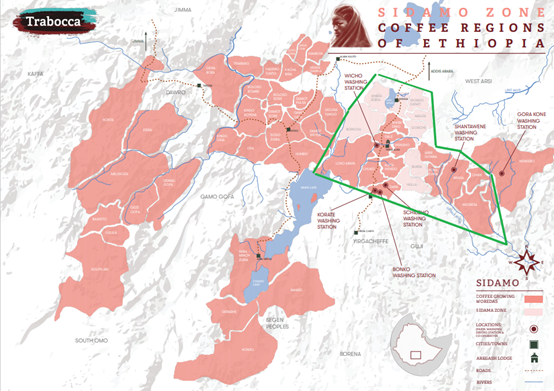
Sidamo is located in southern Ethiopia, spanning administrative regions such as Arsi, Bale, and Gamogofa, with planting altitudes ranging between 1400 and 2000 meters. It lies within an important coffee belt around the East African Rift Valley. The region’s coffee flavor diversity stems from differences in soil, microclimates, and numerous native coffee varieties. Among these, Guji and West Arsi are the two most representative sub-regions within Sidamo, and Guji is the very cradle that gave birth to Huā Kuí coffee.
The Guji region was originally part of Sidamo until 2010, when it was officially designated as an independent region by the Ethiopian Commodity Exchange (ECX). Geographically, Guji is located southeast of Yirgacheffe, featuring diverse terrain with high mountains, deep valleys, and expansive plains. Its soil is primarily fertile, deep black clay (Vertisol), which can reach depths of two meters, and altitudes generally exceed 1800 meters. The region experiences significant day-night temperature variations, providing ideal conditions for sugar accumulation and flavor development in coffee—making it a prime location for specialty beans.
So, what exactly is Huā Kuí coffee? Its original name is “Hambella,” a high-altitude sub-region within Guji, located in the Oromia State adjacent to Kochere in Yirgacheffe. It is separated by a plateau at 3200 meters in elevation and also borders other sub-regions such as Shakisso, Uraga, and Kercha, making it one of the highest-altitude coffee-growing areas in Ethiopia. The coffee here benefits from these exceptional conditions and often possesses tremendous flavor potential.
The name “Huā Kuí” was given by domestic green coffee importers. In 2017, Ethiopia’s DW coffee company submitted a natural batch from the “Buku Abel” processing station in the Hambella area to the TOH (the Taste Of Harvest) green coffee competition hosted by the African Fine Coffees Association. The lot won the championship with its intense strawberry and cream aroma. Later introduced to China, these beans were used by barista Li Jianfei in the China regional competition of the World Brewers Cup, where he took second place—standing out among many Geisha entries. Thus, the name “Huā Kuí” was bestowed, symbolizing excellence akin to the top-ranking geisha (courtesan). Since then, DW has continued to expand processing stations in the core area of Hambella, Dimtu, including Buku Abel, Buku Saysay, Haro Soresa, and Tirtiro Goye, with an annual output of about 1100 tons. However, it’s important to note that only the natural lots produced by the “Buku Abel” processing station can be considered authentic Huā Kuí coffee beans.
Due to climate variations, the flavor of Huā Kuí coffee varies slightly each year. To differentiate, versions such as Huā Kuí 2.0, 3.0, 3.1, 4.0, 5.0, and even 6.0 have been labeled to help consumers identify the year and batch.
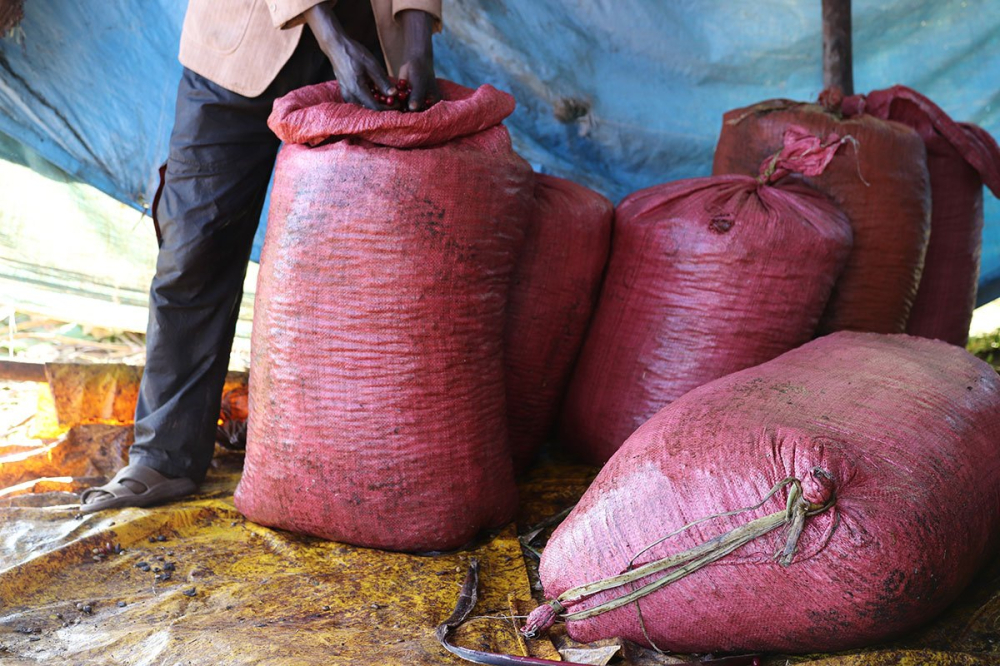
Coffee processing methods in the Sidamo region are diverse. Though washed processing has become more common, traditionally sun-drying remains the primary method. Industry insiders point out that sun-drying can impart richer fruit aromas and a fuller body to the coffee. During harvest season, farmers pick only fully ripe red cherries, which are manually sorted to remove unripe or overripe ones before being evenly spread on raised African beds for natural drying. The cherries must be frequently turned to prevent mold or off-flavors. Once dried, the beans are hulled and undergo final sorting before grading. The 2025 new crop Huā Kuí falls under the highest G1 grade, indicating minimal defects and outstanding flavor performance.
Before the establishment of ECX, Ethiopia’s coffee grading mainly relied on the CLU department of the Ministry of Agriculture, using the number of defects in a 300-gram sample as the primary criterion. Typically, washed beans were mostly graded G1 to G2, while natural beans, due to technical limitations, often fell into G3 to G5. With advancements in natural processing techniques, today’s natural beans can also achieve G1 and G2 grades.
After ECX was established in 2008, a new grading system was introduced, combining physical characteristics and cupping performance to categorize coffee into three classes: Specialty, Commercial, and Local/Domestic. Only Specialty and Commercial grades are suitable for export, with the Specialty grade requiring low defect counts and excellent cupping flavors. ECX further divided coffee by processing method into washed and non-washed categories, evaluating them based on both physical traits (such as defect count, bean size, color, and aroma) and cupping flavors, with the former accounting for 40% and the latter 60%, resulting in a total of nine grades.
Within the physical scoring criteria, washed beans are evaluated based on 20% defect count, 10% bean size, 5% color, and 5% aroma; non-washed beans place more emphasis on defect count (30%) and aroma (10%). Batches graded G1 to G3 undergo additional SCAA-standard cupping evaluations—those scoring above 85 are rated Q1, 80 to 85 as Q2, and below 80 as G3. Only Q1 and Q2 are considered Specialty grade, while G4 to G9 are all classified as Commercial grade.
Now that we’ve covered the background of the Sidamo and Guji regions, the origins of Huā Kuí, and the grading system, let’s look at how to brew the 2025 new crop sun-dried Sidamo Huā Kuí coffee to fully unlock its flavor potential. Industry experts emphasize that coffee bean freshness is key—the freshest roasted beans can showcase the most layered profiles. The beans offered are typically shipped within five days post-roast to ensure customers receive them at their optimal drinking window. The coffee beans have a resting period of about 4 to 7 days, allowing the flavors to mellow and round out.
If you choose to buy pre-ground coffee, though you can skip the resting step, be aware that ground coffee oxidizes faster and should be used promptly to preserve its best flavors. To highlight Huā Kuí’s rich layers, it’s recommended to use a V60 filter, with water at 90°C and a 1:15 coffee-to-water ratio (15 grams of coffee to 225 ml of water). Grind size should be set to 80% passing through a Chinese No. 20 sieve, equivalent to a medium-fine grind. Use a pulsed pouring technique: start with a 30-second bloom using 30 grams of water to release CO₂; then pour in small streams up to 125 grams, followed by a final pour to 225 grams, keeping the total brew time around 2 minutes. These parameters balance sweetness, acidity, and body, highlighting Huā Kuí’s signature berry, citrus, honey, and black tea finish.
[2025 New Crop Sun-Dried Sidamo Coffee Flavor Profile]
Floral, berry, citrus, plum, and other sweet-tart fruit notes, paired with juicy mango-like texture and honey sweetness, with a soft black tea finish. The overall profile is bright and layered.
The above content is compiled by CoffeeHunters, a coffee news website.


