








Introduction:Costa Rican coffee is renowned for its balanced and delicate flavor profile, with a well-harmonized combination of acidity, sweetness, and bitterness, making it a top choice for both novice and experienced coffee enthusiasts. This article delves into the distinctive characteristics of Costa Rica’s major coffee-growing regions, with a special focus on the high-altitude Tarrazú region. It introduces classic varieties such as Bourbon and Caturra, compares the impact of washed and honey processing methods on flavor, and provides practical pour over parameters to help you brew clean, bright, and layered Costa Rican flavors at home.
Costa Rican coffee has consistently received high praise in the international market. Its most notable characteristic is its balanced and layered flavor, with bright acidity that is not overly sharp, and a pronounced sweetness often accompanied by soft notes of chocolate and nuts. It appeals to coffee lovers who enjoy a smooth mouthfeel without compromising on personality. This “well-rounded” performance has made Costa Rica a classic representative of fine coffee in the Americas.

The history of coffee cultivation in Costa Rica dates back to 1729, when coffee was introduced from Cuba and quickly adapted to the country’s high-altitude environment. With a mountainous terrain, there are numerous coffee-growing areas above 1,500 meters in elevation. High altitude not only slows the ripening process of coffee cherries but also promotes the accumulation of flavor compounds, resulting in brighter acidity and richer body. Currently, coffee is cultivated across a wide area of the country, and coffee exports account for a quarter of total exports, making it an important cash crop.
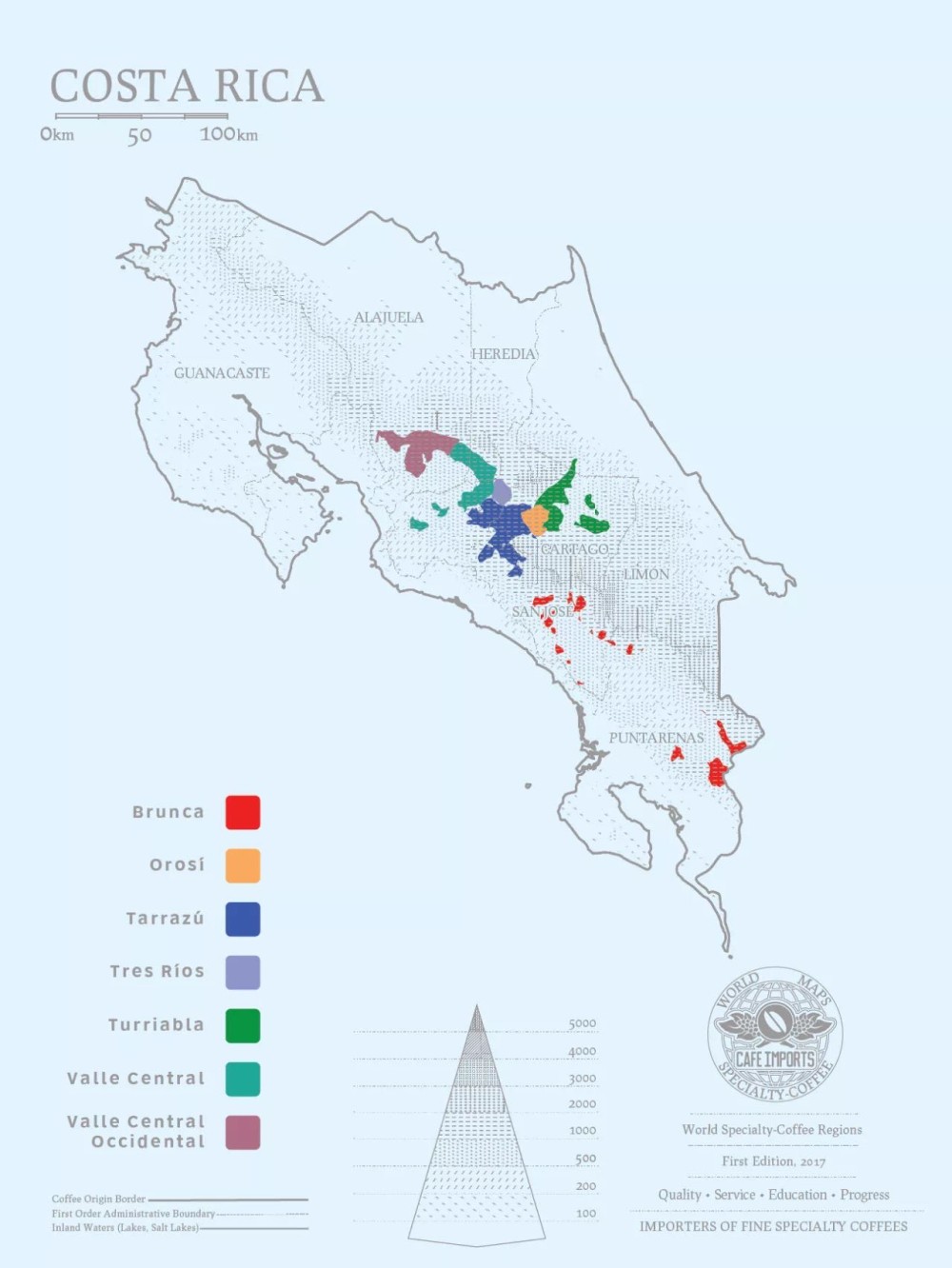
Costa Rica has eight major coffee-growing regions: Brunca, Turrialba, Tres Ríos, Orosi, Tarrazú (Tarrazu), Central Valley, West Valley, and Guanacaste. Each region produces coffee with a distinct flavor profile due to differences in altitude, microclimate, and soil. Among them, the Tarrazú region not only has the highest elevation but is also known for producing high-quality Strictly Hard Bean (SHB) coffee, making it one of the must-visit origins for global specialty coffee enthusiasts.

Located in the central volcanic zone of Costa Rica, Tarrazú boasts fertile volcanic soil and abundant rainfall. Coupled with cool year-round temperatures and good shading conditions, these factors create ideal conditions for slow cherry maturation and concentrated flavors. Over 95% of the coffee beans from this region are Strictly Hard Beans, typically grown at elevations above 1,500 meters. Not only do they perform exceptionally well in cupping evaluations, but they also frequently achieve top results in international competitions such as the Cup of Excellence (COE). In 2014, for example, 17 of the selected COE lots came from Tarrazú.
The main Arabica varieties planted in Costa Rica include Bourbon, Caturra, Catuaí, and Villalobos. Among them, Bourbon is one of the earliest introduced key varieties in Central and South America. Its beans are round in shape and are known for their prominent sweetness, soft acidity, and nutty and caramel tones. Caturra is a natural mutation of Bourbon, with shorter plants and higher yields. Though slightly less resistant to disease, it can exhibit bright acidity and citrus notes in high-altitude environments. Catuaí, a hybrid of Caturra and Mundo Novo, has compact fruit that is wind-resistant and suitable for mechanical harvesting, though its flavor profile tends to be somewhat simpler.
The most well-known coffee processing methods in Costa Rica are washed and honey processing. Washed processing originated in the 1830s and remains a classic technique for ensuring coffee cleanliness and consistency. The process involves removing the pulp, breaking down the mucilage using fermentation tanks, rinsing with clean water, and then drying either in the sun or by machine. This method significantly reduces defect rates, resulting in clear acidity and a refreshing mouthfeel, making it ideal for those who prefer a layered flavor profile.
In contrast, honey processing retains part of the mucilage layer. Depending on the amount of mucilage left, it is categorized into white honey, yellow honey, red honey, and black honey. These processes generally yield more pronounced sweetness and body, often accompanied by tropical fruit and syrupy aftertastes. Although honey-processed beans may appear darker in color, this is not due to roast level but rather the oxidation of mucilage sugars.

When brewing Costa Rican coffee at home, it is recommended to use freshly roasted beans, ideally after the 4 to 7-day resting period. For pour over equipment, a V60 or other stable-flow dripper can be used. A medium-fine grind (approximately 75%–80% through a #20 sieve) paired with 90°C water and a 1:15 coffee-to-water ratio can fully highlight its bright acidity and sweetness.
Taking the Caturra variety from the Tarrazú region as an example, light to medium roasting can accentuate aromatic notes of sweet orange, nuts, and toffee. Recommended pour over parameters are as follows: use a V60 dripper, water temperature at 90°C, 15 grams of coffee, a 1:15 coffee-to-water ratio, and a medium-fine grind (75% through a Chinese #20 sieve). The resulting brew is clean and refreshing, suitable for those who prefer a balanced flavor profile.
As for other regions or processing methods such as those from Miramar, Mozart, and Bahía, similar pour over settings can be applied: maintain a water temperature of 90°C, use 15 grams of coffee, a 1:15 ratio, and adjust the grind slightly finer to medium-fine (80% through a #20 sieve). This can bring out unique notes of berries, floral, fermented wine, or fruit tea, showcasing the diverse charm of Costa Rican coffee.
The above content is compiled by CoffeeHunters, a coffee news website.


