







Introduction:Want to understand why Mandheling is considered a representative of Asian coffee? This article delves into the growing environment of Indonesian Mandheling, the uniqueness of the wet-hulled processing method, and how dark roasting affects its acidity and flavor profile. It also compares the differences between Golden Mandheling and regular Mandheling, and explains the brewing methods suitable for each, helping you choose the coffee beans that best suit your taste.
When it comes to representative coffee varieties in Asia, Indonesian Mandheling is undoubtedly a top choice for many coffee beginners. Its deep and rich flavor, paired with a steady and restrained aroma, has secured its place on the world coffee stage. This article will take you through a comprehensive understanding of Mandheling’s unique charm—from its growing environment and processing methods to the formation of its dark roast flavors. We’ll also explore the origins of Golden Mandheling and explain the key differences between it and the commonly available Mandheling, helping you select the coffee experience that best suits your palate.
Among the many coffee options, female consumers often prefer the bright fruity acidity of Ethiopian coffee, while males tend to lean toward the boldness and layered complexity of Mandheling. As a classic among Asian coffees, Mandheling is not just a single product but also symbolizes a steady and profound coffee culture. Especially before Blue Mountain coffee became widely known, Mandheling was already hailed as one of the richest coffees in the world due to its bold and full-bodied flavor. The smooth mouthfeel upon entry, coupled with subtle acidity, allows the overall flavor to unfold like a symphony in the mouth, with a long-lasting and unforgettable aroma.
The unique flavor of Mandheling is inseparable from the geographical and climatic conditions of its origin, the island of Sumatra. Strictly speaking, only coffee grown in the Lake Toba region in the northwest of Sumatra qualifies as “Mandheling.” Among these, the Lintong area is one of the most renowned producing regions in Sumatra, located by Lake Toba at an altitude of about 1,200 to 1,500 meters. The climate is tropical rainforest type, with high temperatures and humidity year-round, providing an ideal environment for coffee growth. Local smallholder farmers mostly plant coffee trees among native forests, and the boost from the natural environment lays a solid foundation for the robust flavor profile of Mandheling.
However, the weather in Sumatra is not always conducive to common processing methods like sun-drying or washed processing. Frequent rainfall and a humid climate make it difficult for coffee beans to dry thoroughly through traditional sun-drying methods. Coupled with limited economic conditions, the equipment and technical support required for washed processing are also not easily accessible. For this reason, a globally unique processing method—the wet-hulled process (Giling Basah)—was developed locally. This special technique not only overcomes the limitations of the climate but also directly shapes the distinctive flavor profile of Mandheling.
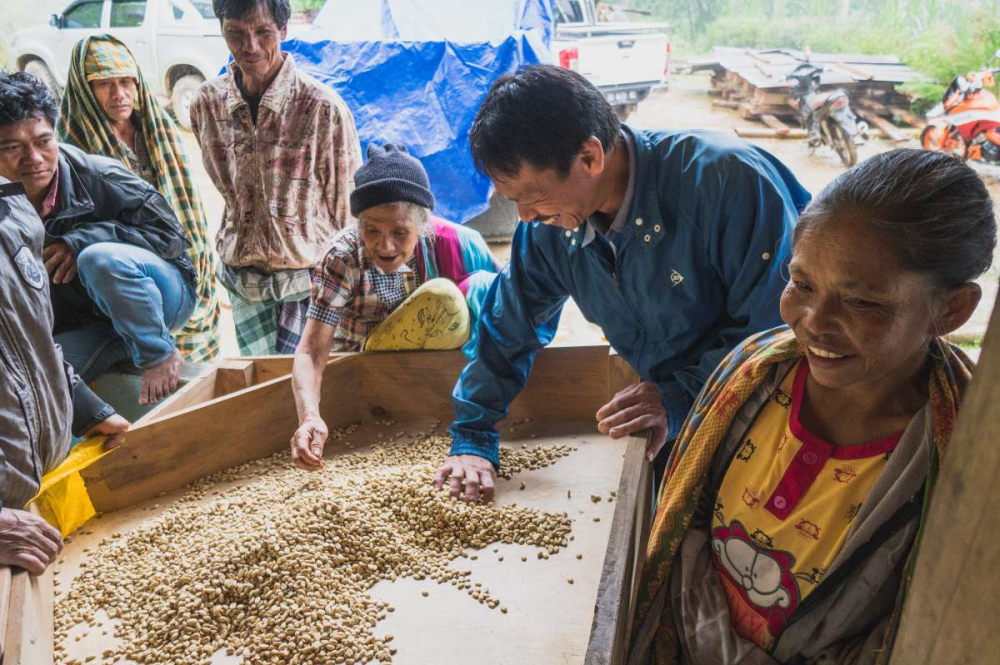
The wet-hulled processing procedure is as follows: after harvesting the coffee cherries, the outer skin and pulp are first removed using a wooden pulper. After about 3 hours of fermentation, the beans undergo initial drying to reduce the moisture content to a semi-dry state of 30% to 50%. At this point, the mucilage layer and part of the parchment are peeled off, and drying continues until the moisture content reaches about 12% to 13%, at which point the process is complete. This method of removing the outer protective layer midway and early removal of the parchment not only accelerates the drying process but also makes it easier for the coffee beans to exhibit rich low-tone aromas such as soil, herbs, and spices during subsequent roasting.
When discussing the roasting flavors of Mandheling, the role of dark roasting cannot be overlooked. In the past, before acidic coffees became popular, dark roasting was the mainstream choice—not only enhancing the aroma of the coffee but also bringing out a rich flavor and full-bodied texture. It is against this backdrop that Mandheling, through dark roasting, showcases a flavor combination of toasted bread, nuts, caramel, and pine, with a flavor profile that is bold yet balanced, making it suitable for beginners exploring single-origin coffee. At this level of roasting, acidity is significantly suppressed, replaced by a stable balance of bitterness and sweetness along with a rich aftertaste. Even when used to make iced coffee or kept warm for extended periods, it is less likely to produce unpleasant sour or astringent notes.
As for “Golden Mandheling,” its name often leads people to assume it represents a higher-grade producing region. In fact, it does not refer to roast level or regional grading but is a registered trademark owned by Indonesia’s PWN (Pusat Penyangga dan Pemasaran Kopi Nusantara). Established in 1957, PWN was one of the first companies in Indonesia to export coffee to Japan, Taiwan, and the United States, successfully establishing Mandheling’s reputation in the Japanese and Taiwanese markets. Since 1977, the company has focused on exporting high-quality coffee, and its Golden Mandheling must undergo at least three rounds of manual sorting, with bean size reaching 18 mesh or above. Each 300-gram sample must contain no more than 3 defective beans, classifying it as G1, the highest grade. These coffee beans are dark green in color, regularly shaped, mostly flat beans, and come with official PWN certification and labeling to ensure consistent quality.
The flavor profile of Golden Mandheling is more delicate and mellow compared to regular Mandheling. Its aroma features distinct herbal and dark chocolate notes. Upon tasting, it delivers a rich and smooth mouthfeel, with a lingering finish that emits sweet notes of nuts and caramel, offering a pronounced and long-lasting aftertaste. For drinkers who do not prefer strong acidity and favor rich, mellow flavors, Golden Mandheling is undoubtedly an extremely appealing choice. Whether using pour over, French press, or siphon brewing, as long as the appropriate extraction parameters are mastered, its layered and complex flavor profile can be fully showcased.
The above content is compiled by CoffeeHunters, a coffee news website.


