








Introduction:Nicaraguan coffee has gradually emerged in recent years as a notable specialty coffee origin in Central America. This article delves into the development trajectory of Nicaraguan coffee, from its historical background and regional distribution to its grading system. Taking the Red Catuai from Finca Divina in Nueva Segovia as an example, it provides complete pour over parameters and flavor evaluation to help you better appreciate this coffee bean with its rich flavor profile.
Located in Central America, Nicaragua boasts fertile volcanic soil and a climate well-suited for cultivating high-quality coffee. However, past wars and frequent natural disasters long posed challenges to the local coffee industry, making farm operations difficult and traceability of origins hard to achieve. It wasn’t until the early 21st century, with gradual social stabilization and improved transportation networks, that the quality and traceability of Nicaraguan coffee significantly improved, drawing renewed international market attention.

Looking back at history, between 1840 and 1940, Nicaragua experienced its first wave of coffee planting enthusiasm. The government actively promoted the industry, attracting substantial foreign investment and establishing many large-scale coffee estates, making coffee one of the country’s major export crops. However, starting in 1936, dictator Somoza implemented a coffee cooperative system, which was later overthrown in 1979 by the Sandinista National Liberation Front, leading to political instability and severely impacting the coffee industry.
Subsequently, the Contras, anti-government forces supported by the U.S. Central Intelligence Agency, attacked coffee infrastructure and transport vehicles, further worsening the situation. Despite this, coffee remains Nicaragua’s most important cash crop. Entering the 21st century, the country also faced multiple setbacks including the coffee price collapse in the early 2000s, hurricanes, and prolonged droughts.
Currently, Nicaragua has around 40,000 coffee farmers, most of whom practice near-organic farming methods due to limited capital. In recent years, with growing consumer emphasis on production traceability and coffee traceability, Nicaraguan coffee farmers have gradually shifted toward improving quality and transparency, and the overall industry is steadily recovering.
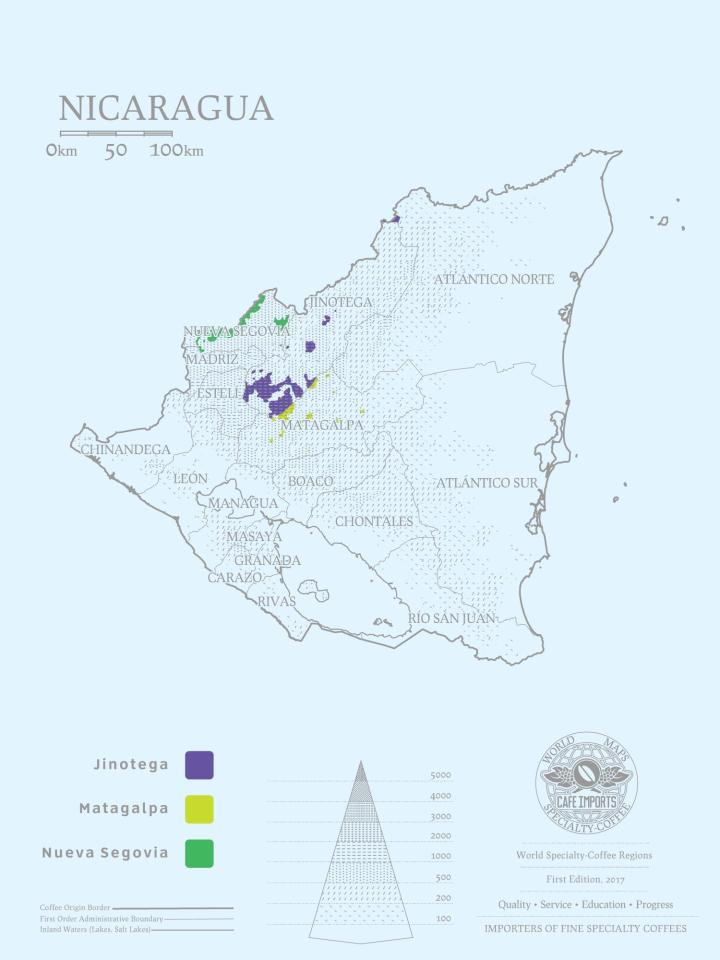
Nicaragua classifies coffee into four grades based on planting altitude:
- Strictly High Grown (SHG): Altitude 1500–2000 meters
- High Grown (HG): Altitude 1300–1500 meters
- Medium Grown (MG): Altitude 1000–1300 meters
- Low Grown (LG): Altitude 500–1000 meters
Generally, the higher the altitude, the brighter the acidity and the richer the flavors of the coffee.
Geographically, Nicaragua can be divided into four main coffee-producing regions:
- Nueva Segovia: A high-altitude region with a cool climate, producing complex and delicate coffees, and serving as an important source of specialty beans
- Matagalpa/Jinotega: Nicaragua’s most renowned coffee region, with abundant production and balanced flavors
- Boaco: A relatively niche area but with potential for developing high-quality coffee
- Pacific Coast: Lower altitude region, typically yielding more intense flavors
Among them, Nueva Segovia, with its high altitude and cool microclimate, is particularly suitable for cultivating premium Arabica varieties and is home to many specialty coffee estates.
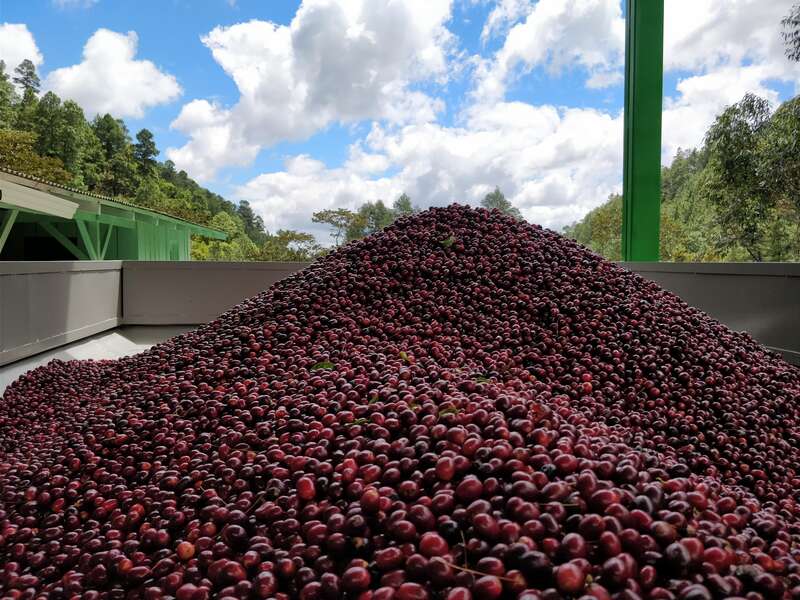
Take the Red Catuai from Finca Divina in Nueva Segovia as an example. This coffee is grown at altitudes between 1450–1700 meters and processed using the natural (sun-dried) method, giving it a rich sweetness and fruity character. Its flavor profile includes prominent berry aromas, caramel sweetness, and grapefruit acidity in the aftertaste. The acidity is bright and layered, with an overall balanced and pleasing expression.
In terms of brewing recommendations, since the freshness of the coffee beans directly affects flavor performance, it is advised to choose beans roasted within five days to fully experience their flavor potential. Generally, coffee beans enter their optimal flavor period, known as the “resting period,” 4–7 days after roasting, during which the coffee usually exhibits the richest aromas and layers.
The following are reference parameters for brewing this Nicaraguan Red Catuai using a pour over method:
- Filter dripper:V60 #1
- Brewing water temperature:90–91°C
- Coffee-to-water ratio:1:15
- Grind size:Medium-fine grind (approximately 80% passing through a Chinese No. 20 sieve)
For pour over, it is recommended to use a three-stage extraction method: First, perform a bloom with twice the weight of the coffee grounds in water (e.g., 60g water for 30g coffee), for about 30 seconds; then pour in a small circular motion until reaching 125g for the first pour; when the water level is about to expose the coffee bed, continue pouring to a total of 225g. The entire extraction process should be controlled to around 2 minutes. This method helps achieve even extraction and fully showcases the bean’s flavor layers.
In summary, although Nicaraguan coffee has faced multiple challenges, it is now gradually reclaiming its place on the specialty coffee stage. Its flavor profile tends to be mellow—not as bold or high-toned as some Central American origins—but rather presents a unique charm through soft acidity, interplaying notes of berries and caramel, along with a refreshing grapefruit finish. It is highly suitable for coffee lovers who enjoy a balanced fruitiness and sweetness.
The above content is compiled by CoffeeHunters, a coffee news website.


