








Introduction:Colombian coffee is renowned for its diverse flavor profiles, ranging from bright fruity notes to rich chocolatey undertones. This article delves into the variety characteristics, processing differences, and altitude influences of the country’s four major renowned coffee regions. It also provides a detailed breakdown of the flavor profiles of four classic bean varieties, and concludes with practical medium roast pour over brewing steps and parameter recommendations to help you extract the best flavors.
Colombian coffee has long been celebrated for its diverse flavors, not only offering a large volume of stable commercial-grade beans but also featuring many specialty coffees from small regions that demonstrate remarkable potential. Especially after the 2008 volcanic eruption in Huila Province, the local soil nutrients significantly increased, driving the region’s coffee to achieve remarkable success in international competitions and further clarifying the image of Colombian specialty coffee.
Colombia’s volcanic soils are rich in essential minerals such as iron, calcium, magnesium, potassium, and phosphorus. These nutrients not only promote the healthy growth of coffee plants but also form an important foundation for shaping the delicate flavors of the coffee. Particularly in the high-altitude southern regions, close to the equator with cool climates, the coffee produced often features bright acidity and rich floral and fruity aromas, making it highly favored by coffee enthusiasts worldwide.

If compared to wine-producing regions, Colombia’s coffee industry is akin to Champagne—boasting both large-scale commercial production and many small estates with distinctive personalities and characteristics. Overall, Colombian coffee leans toward fresh flavor profiles, with particularly outstanding fruitiness, making it ideal for drinkers who prefer bright-tasting brews.
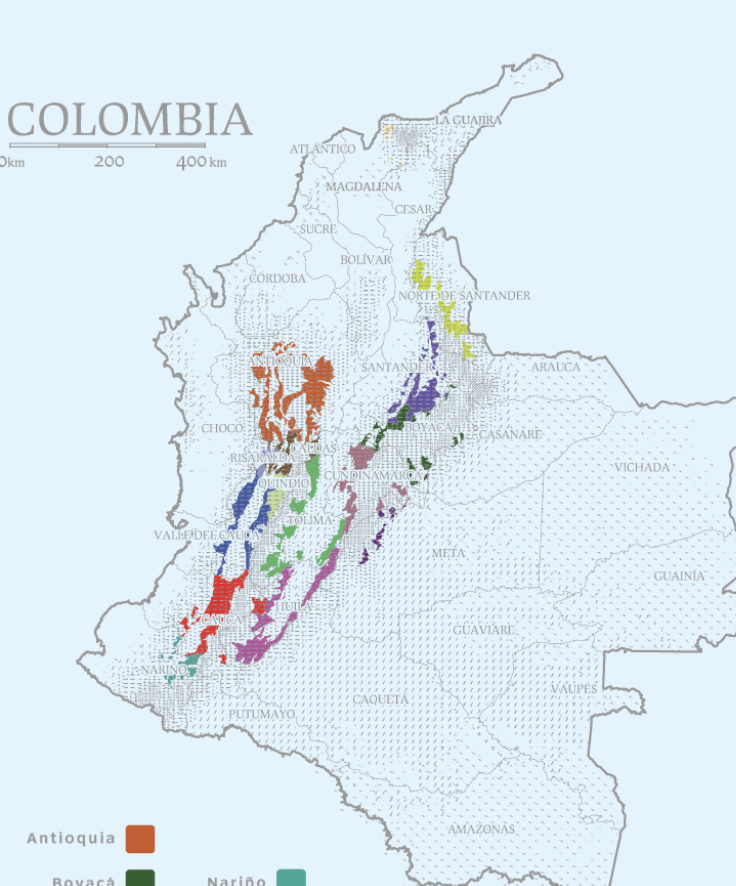
Among Colombia’s many coffee regions, the southern areas, blessed with fertile volcanic soils and higher altitudes, have become a primary source of specialty coffee. Regions such as San Augustín in Huila Province, Popayán in Cauca Province, Nariño, and Tolima are all well-known for high-quality production. These locations not only mostly sit at elevations above 1,500 meters but also benefit from extensive volcanic ash coverage, resulting in highly fertile soils that help coffee cherries accumulate a richer array of flavor compounds.
Through multiple cuppings, it has been found that coffee from these southern regions generally exhibits delicate acidity, berry-like tones, and pronounced caramel sweetness. Whether using traditional washed processing or the increasingly popular anaerobic methods, these regions consistently showcase their unique flavor characteristics.
Below are four commonly available medium roast specialty beans from different regions of Colombia, each with its own distinct flavor profile:
The first comes from the Huila region, grown at an altitude of 1,500–1,800 meters, with the Caturra variety and washed processing. This “Huila Coffee Bean” offers a clean and refreshing taste thanks to the washed process, faithfully presenting the inherent flavor characteristics of the beans. Typical profiles include gentle fruit acidity, nutty aromas, dark chocolate, and caramel sweetness.
The second also hails from Huila, grown at 1,800 meters with the Caturra variety, but uses anaerobic natural processing. Marketed as “Flower Moon Night Coffee Beans,” the anaerobic fermentation enhances the fruitiness and fermentation aromas, giving this bean notes reminiscent of strawberry wine or rich fruit jam, with a caramel and chocolate sweetness lingering in the aftertaste.
The third comes from the Mont Blanc Estate in Huila Province, grown at 1,900 meters, featuring a mix of Caturra, Catuai, and Geisha varieties, also using washed processing, and named “Hanami Coffee Beans.” This bean offers a complex and captivating flavor profile, including herbal chamomile notes, slightly sharp pink peppercorn spice, vibrant Yuzu acidity, honey-like sweetness, and a mild almond finish.
The fourth is from the Paradise Estate in the Cauca region, grown at an impressive altitude of 2,050 meters, with the Castillo variety and double anaerobic washed processing, marketed as “Cherry Blossom Coffee Beans.” This bean features a richly layered flavor profile, including mugwort, berries, spices, fermentation aromas, and a strong strawberry jam character, making it ideal for coffee lovers who enjoy deep and complex flavors.
So, how can you use the pour over method to brew the best flavors out of these medium roast Colombian coffees? Below is a set of practical pour over steps and parameter suggestions:
First, prepare the necessary equipment: freshly roasted coffee beans, a professional grinder, a pour over kettle, a thermometer, a digital scale with a timer, filtered water, a V60 dripper, filter paper, a server, and an electric kettle. It is recommended to fold the filter paper before placing it in the V60 dripper and evenly wetting it with hot water. This not only removes the paper taste but also preheats the equipment.
It is recommended to use 15 grams of coffee beans, adjusting the grinder to a medium grind size suitable for medium roast, roughly similar to white sugar (if tested with a Chinese No. 20 sieve, the passing rate is about 75%). This grind size ensures that the coffee’s flavors and sweetness are fully extracted within a moderate brewing time.
Place the ground coffee into the pre-wetted dripper, gently shake it to level the surface. Then, heat the water to approximately 90–91°C, which is the ideal temperature range for brewing medium roast coffee. It is suggested to use a 1:15 coffee-to-water ratio, meaning 15 grams of coffee beans to 225 grams of water.
To begin pouring, first wet the coffee grounds with a small amount of hot water (about twice the weight of the coffee, i.e., 30 grams) to form a bloom, then let it rest for about 30 seconds. Afterward, pour water in a slow, steady spiral motion from the center outward. When the total water poured reaches 125 grams, pause to allow the coffee bed to settle. Once the water level drops to about half the height of the dripper, continue pouring with the same fine stream until the total reaches 225 grams, with the entire brewing process controlled to around 2 minutes.
After brewing, it is recommended to gently swirl the server to ensure the coffee liquid is evenly mixed, then pour it into a pre-warmed cup to enjoy. Depending on personal taste, you may also add sugar or milk in moderation to adjust the flavor.
The above content is compiled by CoffeeHunters, a coffee news website.


