








Introduction:As the main coffee variety cultivated in Yunnan, Catimor has long been favored for its adaptability and high yield, yet it has also repeatedly faced criticism for its lackluster flavor performance. This article will comprehensively outline the breeding origins, global distribution, and cultivation characteristics of Catimor, analyze its cupping performance in depth, with a special focus on how the Yunnan growing region has overcome limitations to showcase unique strengths. It will also share tested pour over recommendations for Golden Mandheling and introduce key Catimor sub-varieties.
In Yunnan, there is a coffee variety that, although not native, has long become a pillar of the local coffee industry — it is Catimor. Although in the minds of many coffee enthusiasts, Catimor is often regarded as having mediocre flavor, the fact is, this variety holds significant potential for improvement, especially in specific environments like Yunnan, where its performance is improving year by year. This article will start with the origin of Catimor, take you through its global development trajectory, cultivation traits, and cupping flavors, and further explore how the Yunnan growing region has overcome limitations through technology and management to create representative coffee flavors. Finally, it will also share tested pour over parameters for Golden Mandheling and introduce some Catimor sub-varieties.

The cultivation history of Catimor in Yunnan is already quite long. Although this variety has poor adaptability at high altitudes and certain innate limitations, its high yield, disease resistance, and ease of management have made it the top choice for many coffee farmers. More importantly, through continuous variety improvement and refined processing, Yunnan’s Catimor coffee is gradually revealing surprisingly good flavor potential. I’ve always believed that rather than obsessing over its drawbacks, it’s better to deeply understand its characteristics and uncover and leverage its advantages.
Catimor was first bred in Portugal in 1959 by researchers, with the goal of creating a dwarf variety that combines high yield, strong disease resistance, and suitability for dense planting. It is a hybrid offspring of the Timor Hybrid (which carries Robusta genes, thus resistant to leaf rust) and Caturra, belonging to the pure-line cultivar group of Hibrido de Timors and Caturra, and has been gradually promoted since the 1980s. This variety is known for its high yield, resistance to leaf rust, and coffee berry disease (CBD). Among them, CR95 (Costa Rica 95) was one of the first widely planted varieties, and other common strains include Catimor 129 and Catimor F6.
This variety was first introduced to Brazil in 1970, and subsequently spread rapidly across Latin America, particularly welcomed by coffee farmers seeking high yield and disease resistance. However, Catimor has certain altitude requirements and often performs poorly at extremely high or low elevations, with the most ideal planting height being around 700 to 1000 meters. Because it is mostly grown at mid-to-low altitudes, it is more susceptible to pests and diseases such as coffee berry borer, and the trees generally have a shorter lifespan (e.g., averaging only 10 years in Indonesia), making cultivation quite challenging. Additionally, Catimor trees are short in stature, with branches resembling those of Robusta, and young leaves initially appear reddish-brown. Management requires intensive fertilization and shading, resulting in relatively higher input costs.
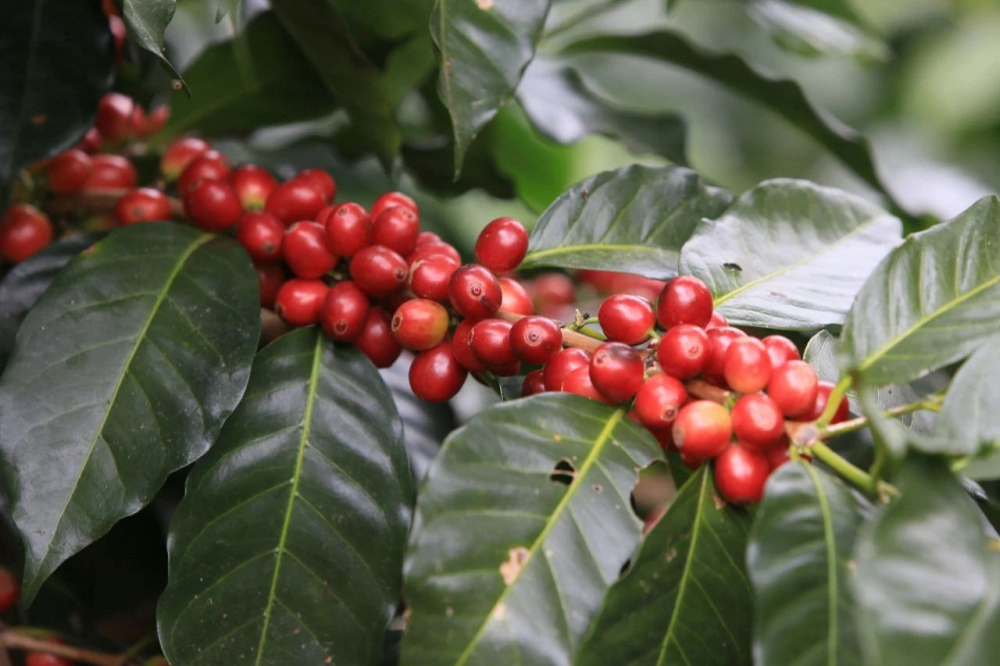
Currently, Catimor is very common in Indonesia and Vietnam, and after the coffee leaf rust crisis in Central America, it has gradually expanded to high-altitude regions in countries such as Mexico and Peru. However, the most frequently discussed aspect of Catimor is its cupping flavor. Generally speaking, at low altitudes, its flavor is not much different from other Arabica varieties, and may even be hard to distinguish; but when planted at altitudes above 1200 meters, its flavor performance may change. Many evaluators prefer traditional varieties such as Caturra, Bourbon, or Catuai, but there are exceptions — for instance, some have tasted Indonesian-grown Catimor with exceptionally good flavor performance, namely their Golden Mandheling.
Familiar readers should know that the variety used in the new season’s Golden Mandheling is called ‘Ateng,’ which is actually the local Indonesian term for Catimor. For example, the Indonesian word timtim corresponds to the well-known Timor, while Ateng is the local colloquial name for Catimor.
Pour over recommendation as follows: Use a Kono filter, control water temperature at 86°C, use 15 grams of coffee grounds, with a coffee-to-water ratio of 1:15, and a medium-fine grind (recommended reference: 70% extraction rate through a 20-mesh sieve). Use a staged extraction method: first bloom with 30 grams of water for 30 seconds, then pour in small circles until reaching 125 grams for the first pour. When the water level drops and is about to expose the coffee bed, pour again up to 225 grams, then stop. When the water level drops again and is about to expose the coffee bed, remove the filter. The total extraction time is approximately 2 minutes.
This brewing method can fully showcase the unique flavors of Golden Mandheling — premium herbal aromas, distinct caramel sweetness, paired with steady fruit acidity and a rich mouthfeel, with an intriguing spicy note in the aftertaste. This shows that with proper cultivation management and refined post-processing, Catimor can also deliver surprisingly impressive cupping results.
Here is a brief introduction to some Catimor sub-varieties: Catimor T-8667 is a dwarf variety with larger berries and seeds; Catimor T-5269 is robust and thrives at altitudes of 600 to 900 meters, requiring annual rainfall of over 3000 millimeters; Catimor T-5175 is a high-yield and vigorous strain, commonly found in higher-altitude regions.
 Back to Yunnan, this variety has taken root here for many years and has gradually been developed into a locally distinctive specialty coffee representative. In recent years, Yunnan coffee has not only gained recognition domestically but also emerged on the international market, for instance being selected for the “National Portrait” at the 2018 Specialty Coffee Association of America Trade Show, and hosting the first Specialty Coffee Association event in Pu'er, Yunnan. Yunnan’s Catimor coffee typically exhibits rich wine-like aromas, abundant sweetness, and balances classic citrus acidity with a creamy mouthfeel. Due to Yunnan’s relatively high latitude, the nighttime temperatures in high-altitude areas are lower, slowing down the bean growth rate and thereby extending the development period, resulting in richer sweetness and complexity.
Yunnan’s geographical and climatic conditions are uniquely favorable — low latitude, high altitude, ample rainfall, and suitable sunlight, all contribute to a unique flavor profile that is strong yet not bitter, aromatic yet not overpowering, with a hint of fruity notes. Such an environment is rare globally, giving Yunnan coffee an irreplicable mellow character. The discussion on Catimor’s cupping flavors really hinges on the match between variety and environment — Catimor is inherently a commercially oriented variety, and as long as it is grown in a suitable environment and processed well, it can demonstrate potential that rivals traditional varieties.
In summary, through technology introduction, farmer training, and quality management upgrades, Yunnan is gradually enhancing the overall performance of Catimor. In the future, the development of Yunnan coffee still requires collaboration among government, coffee farmers, and enterprises, through continuous improvement and international exchange, so that the coffee beans from this land can showcase China’s unique flavors on the world stage of specialty coffee.
The above content is compiled by CoffeeHunters, a coffee news website.


