








Introduction:Delving into the Java variety coffee beans grown at Alpaca Estate in the La Paz region of Bolivia, this article explores the high-altitude environment, unique varietal lineage, and the distinctive processing method of cocoa sun-drying to analyze the resulting flavor profile of pineapple, berries, and caramel. It also breaks down key extraction elements for light-roast pour over brewing, compares differences with other renowned regions, and helps coffee enthusiasts grasp the flavor logic of this niche single-origin bean.
Although Bolivia is not a major global coffee exporter, its high-altitude mountainous terrain and unique microclimates produce many distinctive specialty coffees, which locals even call the "taste of heaven." This article focuses on the Java variety coffee beans produced at Alpaca Estate in the Caranavi area of the La Paz region in Bolivia, offering a detailed analysis of its origin characteristics, varietal background, green bean appearance, and the craftsmanship of the special cocoa sun-drying process. Through cupping and pour over brewing practice, it showcases the distinct pineapple and berry juice-like flavors, rich caramel finish, and outstanding sweetness.

High altitude has long been one of the crucial factors influencing coffee flavor. The main coffee-growing areas in Bolivia are generally situated at high elevations. Farmers often have to relocate from their residences at nearly 3,600 meters above sea level to mountainous regions around 2,000 meters to cultivate coffee. Typically, coffee trees thrive in high-altitude environments, but excessively high altitudes can stress the trees due to low temperatures and significant day-night temperature variations. As a result, farmers in places like Bolivia choose to plant at altitudes of around 1,600 to 1,900 meters to strike an optimal balance. Even so, such altitudes still fall within the high-altitude range, positively impacting the intensity and acidity structure of the coffee’s flavor.
However, road infrastructure in high-altitude areas is often underdeveloped. After harvest, coffee cherries need initial processing before being transported along rugged mountain roads to higher-altitude processing centers, such as the capital, La Paz. If transportation is delayed or preservation is inadequate, fermentation and spoilage caused by bumpy roads and humid conditions can easily occur, affecting the final flavor quality. Thus, every step of Bolivian coffee—from origin to processing—is fraught with challenges, contributing to the rarity and premium value of its specialty-grade beans.
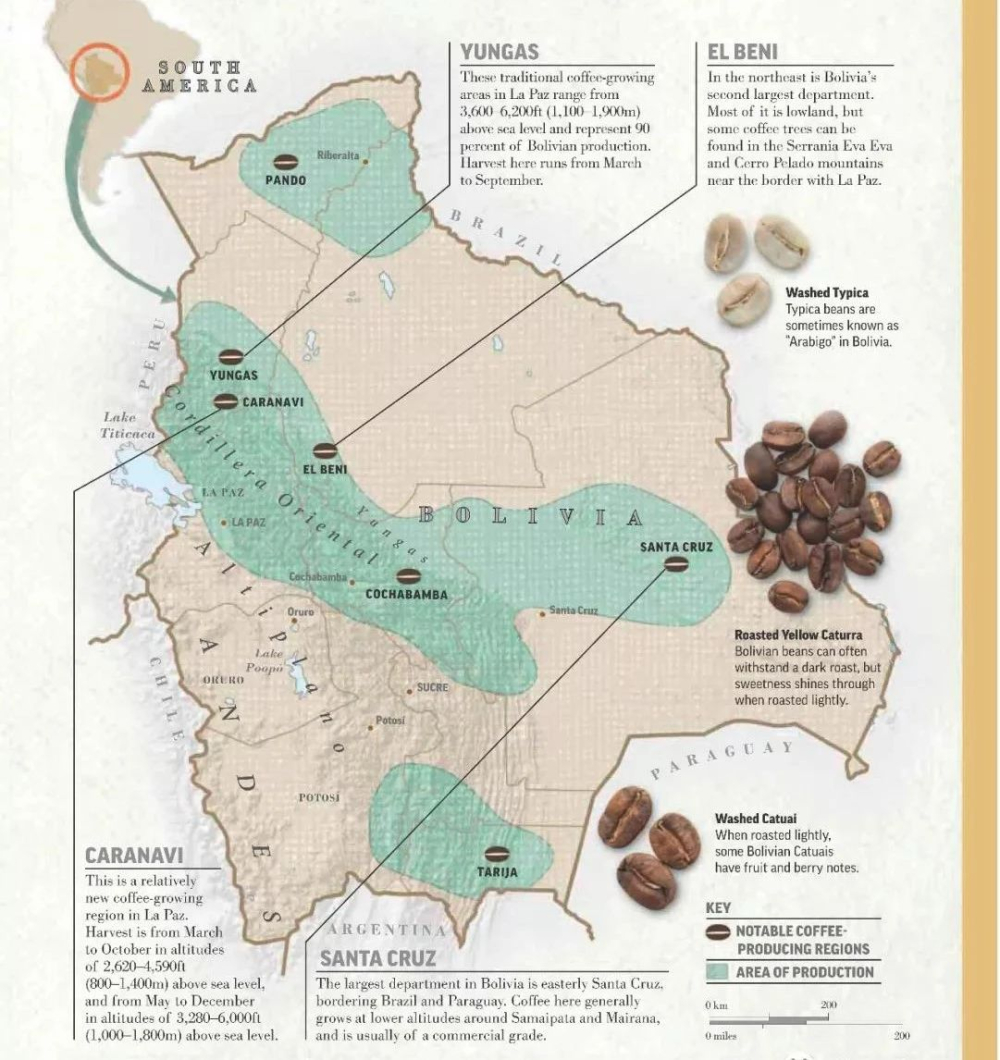
The Java variety coffee from Alpaca Estate introduced here is grown at elevations between 1,600 and 1,900 meters, falling within the mid-to-high altitude range. Unlike the commonly seen Indonesian Java variety, the Java beans in Bolivia actually originate from the Sidamo region of Ethiopia and are closely related to Geisha, sharing similar physical traits with Geisha green beans—slender with pointed ends. In contrast, the Indonesian Java variety, having adapted to low-altitude cultivation over time, differs significantly in genetic origin and flavor expression, typically offering more one-dimensional flavors with less pronounced sweetness and complexity than the Bolivian variety.
The coffee beans from Alpaca Estate feature a slender and pointed shape, exhibiting clear characteristics of a premium bean. Cupping is conducted within 8 to 24 hours post-roasting to capture the most accurate flavor profile. A light roast level is applied to highlight the bright acidity and complex fruity layers typical of high-altitude coffee. During cupping, the dry aroma reveals intense melon seed and fermented notes, followed by a floral and nutty softness in the wet aroma when brewed with 94°C water, lasting for about four minutes.
After breaking and removing the crust, the tasting phase begins. The cupping results show a clear flavor profile: the sweet and fresh fruitiness of pineapple, the vibrant juiciness of berries, and a distinct caramel sweetness, with a full body and lingering sweetness. Such a flavor combination is uncommon in high-altitude light-roast coffees, demonstrating Alpaca Estate’s refined control over cultivation and post-harvest processing.
The processing method used for these beans is "cocoa sun-drying," though it’s important to clarify that "cocoa" here does not refer to chocolate ingredient cocoa beans, but rather to a local term for a drying device or technique used to assist in drying coffee cherries. Due to the generally low temperatures in Bolivia’s high-altitude regions, natural drying efficiency is poor. Therefore, farmers first spread selected coffee cherries evenly on drying beds, turning them hourly for about a week to ensure even exposure to sunlight. The semi-dried cherries are then placed in a so-called "cocoa" dryer, set to a constant temperature of around 40°C, and turned every 30 minutes for a total of approximately 35 hours of precise drying. Finally, the pulp is removed and the beans undergo manual sorting to ensure consistent quality.
To evaluate the performance of these beans under pour over brewing, we chose the V60 dripper. With its large holes and spiral ribs, the V60 facilitates airflow. While it may sacrifice some body, it enhances the clarity of acidity and brightness of aroma. Recommended brewing parameters are: water temperature 90–91°C, grind size approximately BG#6M (similar to fine sugar), brew ratio 1:15, with 15 grams of coffee.
The actual pour over process employs a three-pour method: the first pour uses 30 grams of water for blooming for about 30 seconds to allow the coffee grounds to fully expand; the second pour reaches 125 grams at the 54-second mark, then waits for the water level to naturally drop to two-thirds of the coffee bed before the third pour; at the 1:40 mark, water is added to reach a total of 225 grams, with total brew time controlled to around 2:10. After brewing, gently swirl the coffee to evenly release flavors before enjoying.
The final pour over flavor profile aligns with the cupping results: distinct pineapple and berry juice-like notes, accompanied by the sweet caramel finish, with a full body and prominent sweetness. It’s a representative brew showcasing the flavors of high-altitude specialty coffee, ideal for deep appreciation.
The above content is compiled by CoffeeHunters, a coffee news website.


