







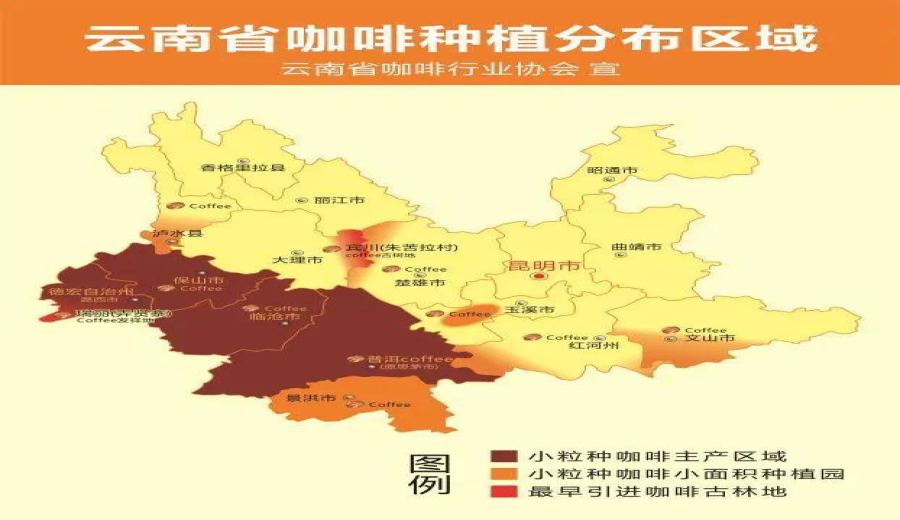
Introduction:Delve into the origins and evolution of Chinese coffee — from the first coffee tree introduced by French missionaries in 1904 to Yunnan’s rise as a new hub for specialty coffee. This article provides an in-depth look at the geography and terroir of key growing regions such as Baoshan and Lincang, analyzes the unique characteristics of the two main cultivars, Typica and Catimor, and offers practical pour over recommendations along with precise parameter settings to guide you through savoring the transformational charm of Yunnan coffee from highland to cup.
When it comes to coffee cultivation in China, no place rivals Yunnan. Since 1904, when French missionaries planted the first coffee tree in Zhukula, western Yunnan, this land near the Tropic of Cancer has gradually developed a uniquely distinctive coffee industry chain. From early varieties like Typica and Bourbon to the later disease-resistant and high-yielding Catimor, Yunnan coffee has weathered a century of ups and downs, and has now become an indispensable and important source of domestic specialty coffee.
Looking back at its development history, the 1960s were a crucial period for the expansion of coffee in Yunnan. Led by experts from the Agricultural Science Academy, Yunnan began large-scale coffee planting, with varieties mainly consisting of Typica and Bourbon, some of which were exported to the Soviet Union. Earlier, Baoshan's Ludian Basin had already achieved a certain scale thanks to seeds introduced by patriotic overseas Chinese, with a total area reaching up to 50,000 mu at one point. However, the ravages of leaf rust disease caused massive die-offs of traditional varieties, and planting areas sharply declined. It was not until the reform and opening-up in the 1980s that international coffee companies such as Nestlé entered the scene, introducing the disease-resistant Catimor variety and purchasing it at international futures prices, which allowed Yunnan coffee to regain its footing.
In 1995, the Yunnan Provincial Government incorporated coffee cultivation into the "18 Project" biological resources initiative, further boosting industrial development. The Catimor 7963 variety, developed by the Portugal Tropical Research Institute, is characterized by its dwarf stature, dense branching, short fruit nodes, rust resistance, and high yield. It has become the dominant variety in Yunnan’s coffee plantations, accounting for over 90%. In contrast, traditional Typica, while rich in flavor with delicate acidity and diverse fruity notes, has gradually been phased out by farmers due to its tall tree structure, low per-tree yield, and susceptibility to disease.
Yunnan’s major coffee-growing regions span nine prefecture-level cities and 35 counties across Pu'er, Baoshan, Lincang, Dehong, Wenshan, and Xishuangbanna. Among them, Baoshan’s Ludian Basin and Lincang have become important producers of specialty coffee due to their exceptional natural conditions. Located at the foot of the Gaoligong Mountains beside the Nujiang Grand Canyon, Ludian Basin in Baoshan sits at an altitude of 640 to 1,400 meters, featuring a typical subtropical dry-hot valley climate with abundant sunlight, year-round frost-free conditions, and significant day-night temperature variations. These factors help coffee beans accumulate rich organic matter, resulting in high levels of protein, crude fiber, and fat, along with relatively low caffeine concentration. The coffee produced here showcases a unique flavor profile that is “rich but not bitter, aromatic but not overpowering.”
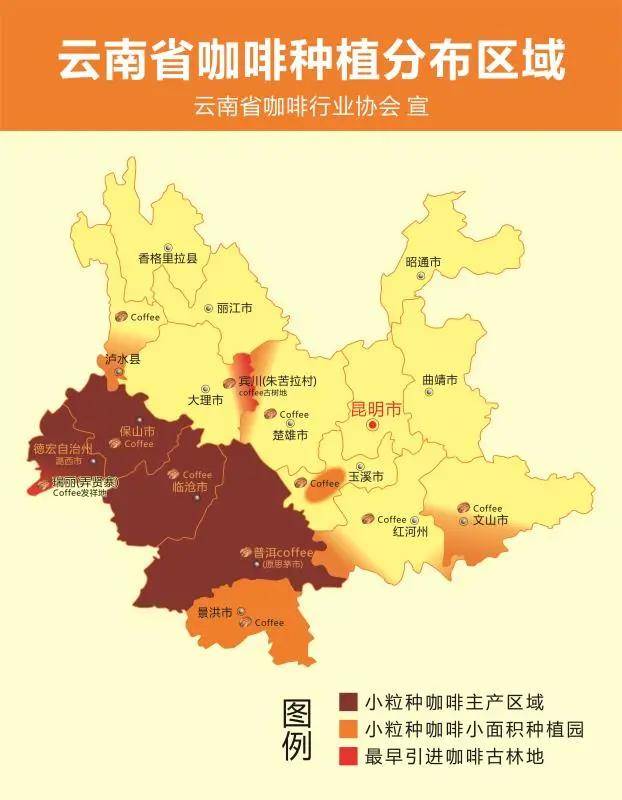
The Lincang region is influenced by warm, moist air currents from the Indian Ocean and the southwest monsoon, resulting in distinct wet and dry seasons, ample sunshine, short frost periods, and even frost-free conditions year-round in some areas. Coupled with a pronounced layered climate, it is highly suitable for the growth of Arabica coffee. Some local farms preserve original Typica varieties, which, when processed using the natural sun-drying method, can fully express their fruity acidity and delicate mouthfeel. Every November, after the coffee cherries ripen, farmers hand-pick the red ones and evenly spread them under the sun to dry naturally. During this process, they need to turn the cherries frequently to avoid over-fermentation and ensure the purity of the flavors.
For coffee enthusiasts, understanding how to extract Yunnan coffee is especially important. To fully experience its flavor potential, it is recommended to use freshly roasted beans, ideally within five days post-roast. Here is a practical pour over recommendation: Use a Hario V60 filter, with about 15 grams of coffee grounds, water temperature controlled at 90°C, grind size calibrated to 75% extraction through a #20 sieve, and a brew ratio of 1:15. Employ the three-pour method — start with pouring double the coffee weight in water for a 30-second bloom, then continue pouring in a slow circular motion from the center outward until you reach 125 grams for the first pour. After a pause, continue pouring with the same fine stream until you reach 225 grams, with the overall extraction time being around two minutes.
Yunnan small-bean everyday coffee extracted using the above parameters often exhibits nutty aromas, with herbal, chocolate, and caramel layers on the palate. The finish reveals faint fruity acidity, delivering a well-balanced cup with high clarity. As for Typica beans processed via the natural sun-drying method, the dry grounds exude aromas of caramel, nuts, and citrus. When brewed at higher temperatures, they showcase chocolate, berry, and fermented notes, transitioning to plum-like acidity and a clean, sweet finish reminiscent of black tea and sugarcane as the cup cools. With medium-to-high body, it offers a richly layered and crystal-clear taste.
The above content is compiled by CoffeeHunters, a coffee news website.


