







Introduction:Jamaica Blue Mountain coffee is world-renowned for its unique flavor and rarity, yet few truly understand its origin, grading, or proper brewing methods. This article delves into the geographical restrictions, variety characteristics, grading system of Blue Mountain coffee, how to identify authentic beans, and offers professional roasting advice along with pour over parameters to help you select and brew this top-tier coffee more precisely.
When it comes to premium coffee, "Blue Mountain coffee" is almost a household name, but very few truly know it. This legendary coffee from Jamaica is not only limited in origin, but also subject to an extremely strict grading system. What exactly is real Blue Mountain coffee? Why does it stand as the pinnacle representative in the coffee world? This article will take you through its growing region, variety, grading, pricing, and brewing methods, giving you a comprehensive understanding so you can shop and brew with more confidence.
How strict is the origin of Blue Mountain coffee?
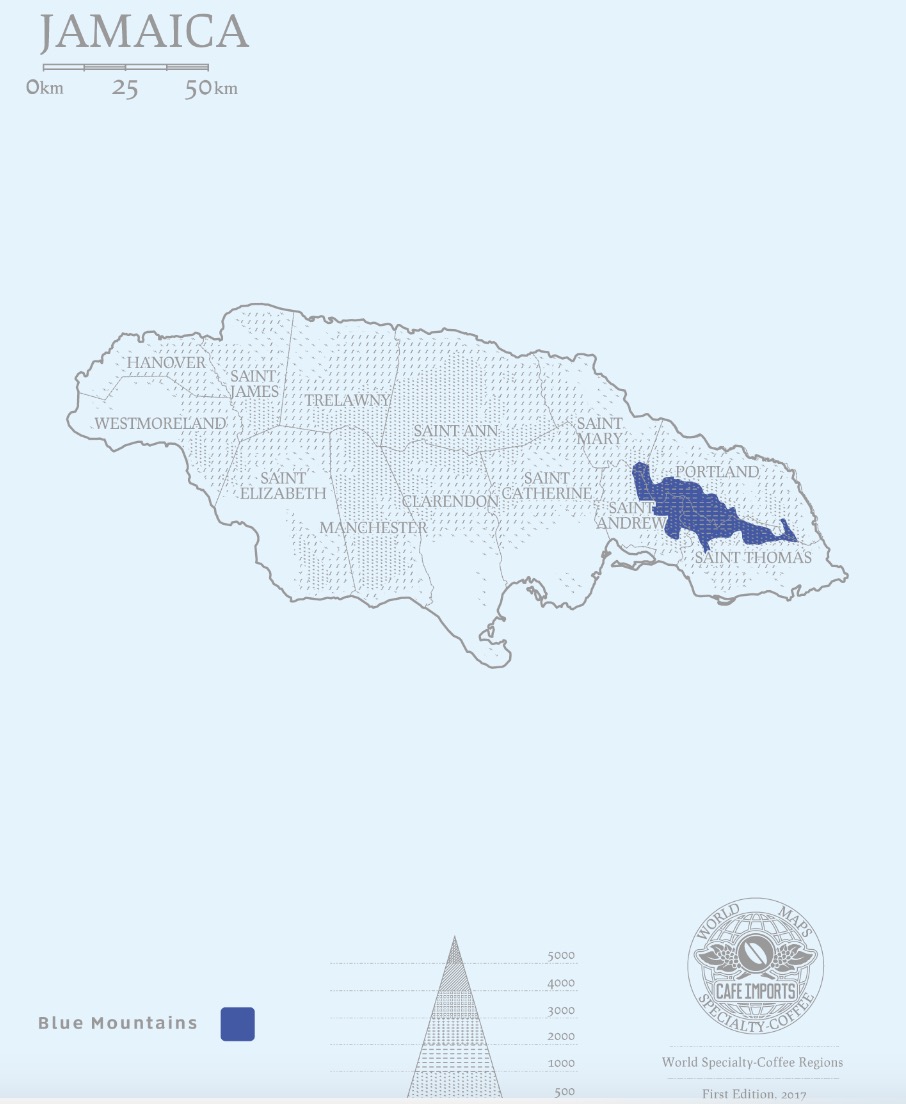
The reason Blue Mountain coffee is so precious is primarily due to the extreme limitation of its origin. Only coffee grown at elevations between1000 and 1700 metersin the Blue Mountains of Jamaica qualifies as "Blue Mountain coffee." This area spans four administrative regions: Saint Andrew, Saint Thomas, Portland, and Saint Mary. Elevations above1700 metersare designated as protected zones where no cash crops are permitted.
It’s important to note that coffee grown at460 to 910 meterscan only be labeled as "Jamaica High Mountain Coffee," while those grown below460 meterscan only be called "Jamaica Prime Coffee." Therefore, not all high-altitude Jamaican coffee qualifies as Blue Mountain.
What is Blue Mountain No.1? How are the three grades divided?
In the grading of Blue Mountain coffee, "Blue Mountain No.1" is the highest grade. Overall, Blue Mountain coffee is divided into three main grades: Blue Mountain No.1, Blue Mountain No.2, and Blue Mountain No.3, along with Blue Mountain Peaberry.
Blue Mountain No.1 requires96% of the coffee cherries to be size 17 or larger, and the post-processing defect rate must not exceed2%; Blue Mountain No.2 requires cherries to besize 16 or larger, with the defect rate also controlled within2%; Blue Mountain No.3 requires size15 or larger, with the same defect standard. As for Blue Mountain Peaberry, the size must be10 or larger, with the defect rate also not exceeding2%. These strict standards ensure the high quality of Blue Mountain coffee.
How to identify authentic Blue Mountain coffee?
Currently, the Blue Mountain coffee entering the market is mainly No.1, and it is all transported in wooden barrels. It's worth mentioning that Jamaica is the only coffee-producing region in the world that still uses wooden barrels for shipping, making the barrel an important symbol for authenticity.
In addition, the Jamaican government has strict controls over the export of Blue Mountain coffee, and beans meeting the standards receive official certification. These certifications and barrels can usually be seen in authorized dealers’ physical stores and serve as key indicators of authenticity.
What coffee variety is grown in Blue Mountain?
All the coffee trees planted in the Blue Mountains are of theTypica variety, one of the oldest Arabica types. This variety is known for its clean and layered flavors. Interestingly, the first coffee tree in Blue Mountain was introduced from Martinique in the1720s. After more than two centuries of adaptation, it has developed a high degree of environmental resilience, particularly greater resistance to coffee berry disease compared to regular Typica.
Combined with the region’s unique volcanic soil, rich in minerals, and the year-round warm, rainy microclimate, the coffee grown here boasts an irreplicable sweetness, well-balanced acidity and sweetness, and a rich, delicate mouthfeel—making it a dream coffee for enthusiasts.
Why is Blue Mountain coffee so expensive?
The annual production of Blue Mountain coffee is extremely limited, at only about600 to 1000 metric tons. In 1969, the region was severely hit by a hurricane, and it gradually recovered with financial aid from Japanese companies. To show gratitude, Jamaica signed an agreement with Japan in 1972 granting Japan priority purchasing rights, resulting in up to90%of Blue Mountain coffee being exported to Japan. Thus, supply to other regions is scarce, naturally keeping prices high.
However, this agreement wascanceled in 2012, allowing other countries to import Blue Mountain No.1. But due to limited production, prices remain relatively high. It’s worth noting that currently even pricier varieties, such as Panama’s Geisha, can cost up toover 40,000 RMB per pound, making Blue Mountain coffee’s price not the most premium by comparison.
How should Blue Mountain No.1 be roasted?
To preserve the balanced acidity and sweetness, full body, and rich character of Blue Mountain coffee, it is recommended to usemedium-dark roasting. Freshly roasted beans are best brewed5 to 6 daysafter roasting, when their flavor performance is optimal.
Recommended pour over parameters for Blue Mountain No.1
It is recommended to use aKono filter, with water temperature set at88°C[temperature placeholder]1:15(e.g., 15g of coffee grounds to 225ml of water). The grind size is advised to be70–75% passing through a #20 sieve, equivalent to medium-fine grind.
The specific pour over steps are as follows: first pour30g of water for a 30-second bloom; then pour up to125g, wait until the liquid level drops halfway, then pour the remaining100g to reach a total of 225g, with the total extraction time controlled around2 minutes and 10 seconds. This parameter helps fully express the delicate flavors of Blue Mountain coffee while avoiding over-extraction.
In terms of flavor profile, washed Blue Mountain No.1 often features intense dark chocolate and nutty notes, with a silky smooth mouthfeel and excellent balance of acidity, sweetness, and bitterness—it’s considered a top-tier favorite among many coffee connoisseurs.
The above content is compiled by CoffeeHunters, a coffee news website.


