







Introduction:Do you know why coffee beans labeled as "Arabica" can taste so vastly different? This easy-to-understand guide takes you through the botanical origins of Arabica coffee, its demanding environmental needs, and the characteristics of seven well-known varieties including Typica, Bourbon, and Geisha. From bean shape, regional adaptability, to unique flavor profiles, it helps you build a systematic understanding of coffee varieties—whether you're selecting beans or diving deeper into your pour over experience.
Arabica coffee is the cornerstone variety of the global specialty coffee market, yet many consumers find that even though packages are all labeled as Arabica, the actual flavors can vary widely. This difference mainly stems from genetic variety, growing environment, and cultivation techniques. This article starts with the botanical origins, analyzing the taxonomic status and cultivation constraints of Arabica, then introduces you to major branches such as Typica, Bourbon, Caturra, Catuai, SL28, SL34, and Geisha. With practical information like bean shape features, suitable altitudes, and flavor directions, it helps you establish a complete knowledge framework of coffee varieties.
When it comes to "Arabica coffee," many coffee enthusiasts are no strangers to it. Walk into a supermarket or browse an e-commerce platform, and the vast majority of coffee products boast the use of Arabica beans. However, these similarly labeled products can offer vastly different drinking experiences, and the reason lies in the细分 varieties, growing conditions, and varietal evolution. From a botanical perspective, Arabica belongs to the Rubiaceae family and is a small-seeded coffee bean that evolved from the hybridization of the Typica and Bourbon lineages, hence it's also commonly referred to as the "small-seed species." In contrast, Robusta is considered the medium-seed species, while Liberica represents the large-seed species.
Compared to the other two major coffee categories, Arabica has significantly lower adaptability to growing environments, making it a relatively "delicate" variety. Generally speaking, Arabica thrives best at high altitudes between 600 to 2000 meters, requiring not only fertile soil and stable day-night temperature differences but also moderate rainfall and ample sunlight. Any environmental variation can affect the final flavor. Additionally, it demands considerable care and meticulous management from coffee farmers. But it’s precisely because of this “picky” nature that Arabica can deliver more delicate, complex, and layered aromas and tastes, far surpassing other hardier varieties.
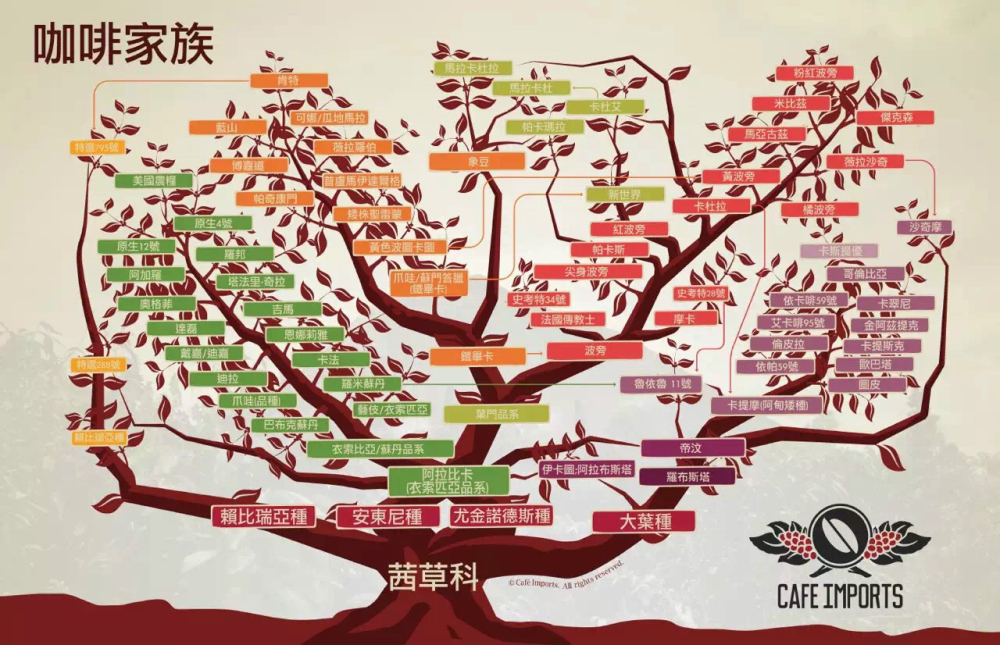
However, this elegant flavor also comes with vulnerabilities. Arabica varieties generally lack natural defense mechanisms strong enough to resist pests and diseases, as they allocate most of their energy toward developing complex flavors rather than producing disease-resistant compounds. Coupled with long-term reliance on intensive management, many varieties show relatively low resistance to common diseases like leaf rust. To overcome these challenges, agronomists have gradually cultivated new varieties that strike a balance between flavor, disease resistance, and yield through hybridization and selective breeding. Among the many branches, Typica and Bourbon are regarded as the two oldest original varieties, with most other varieties originating from natural mutations or deliberate hybridization of these two.
Typica can be considered a senior figure within the Arabica family, originating earliest in southeastern Sudan and Ethiopia, and is one of the oldest surviving coffee varieties. Its top leaves exhibit a distinctive reddish-copper color, which is why it’s also called "red-leaf coffee." Most Arabica varieties available on the market today can be traced back to Typica in some way. Typica coffee beans are slender and oval-shaped, with a thin and elongated body. Their flavor profile is known for being clean, refreshing, and delicate, with soft and layered acidity.One highly acclaimed release, the "Jamaica Blue Mountain No.1 Coffee Beans," is a classic representation of the Typica variety at its finest.
Next is the Bourbon variety, a natural mutation of Typica. Its most notable difference is the bean shape, which changes from the slender form of Typica to short, round, and plump. The name Bourbon comes from its initial cultivation history on Île Bourbon (now Réunion Island, previously called Bourbon Island before 1789) in Brazil. This variety typically features thick, round beans, with a smooth mouthfeel and pronounced sweetness, especially excelling at higher altitudes.For example, the "Brazilian Queen Estate Coffee Beans" is a widely praised example of the Bourbon variety.
Beyond these two ancient varieties, there are other equally notable branches. For instance, Caturra and Catuai are extremely common varieties in Central and South America. Caturra is a natural variation of Bourbon, characterized by higher yields, bright and fresh flavors, and prominent sweetness. Catuai, on the other hand, is the result of a cross between Caturra and the Mundo Novo variety. It not only retains the high-yield trait but also adds excellent disease resistance, often featuring rich fruit aromas in its flavor profile.A practical choice that combines the strengths of both varieties is the "Costa Rica Regional Coffee Beans."
SL28 and SL34 are classic varieties from Kenya, known for their highly distinctive flavor profiles. SL28 belongs to the Bourbon genetic group, with short, round, and thick beans, vibrant and lively acidity, and notable sweetness. SL34 falls under the Typica genetic group, with slightly oval and flat beans, offering a balanced acidity and sweetness with a subtle caramel aftertaste.One of the most famous representatives of these two varieties is the "Kenya AA Washed G1 Coffee Beans."
Finally, we must mention the rare yet uniquely flavorful Geisha variety. Originally from the Gesha Forest in Ethiopia, Geisha is characterized by slow growth and extremely low yields. The plants typically produce few flowers and have a low fruit-setting rate. The coffee beans are slender, tapering sharply at both ends while being full in the middle. Its flavor profile is highly layered, often showcasing delicate floral notes, citrus-like acidity, and a tea-like lingering sweetness.The "Panama Geisha Washed Green Label Coffee Beans" from Hacienda La Esmeralda are the pinnacle of this variety and are considered a dream coffee for many enthusiasts.
The above content is compiled by CoffeeHunters, a coffee news website.


